
 E-Paper



Finance minister Sitharaman flags global risks, commits to more reforms
Sitharaman added that the momentum that the Indian economy has got emerging from the pandemic, and the momentum that it will have over the next year that has been acknowledged even by multilateral institutions, cannot be “weakened”.

 Prefer HTon Google


Finance minister Nirmala Sitharaman has said that India’s next budget will be a carefully structured exercise that will place growth priorities at the top, while addressing inflation concerns.
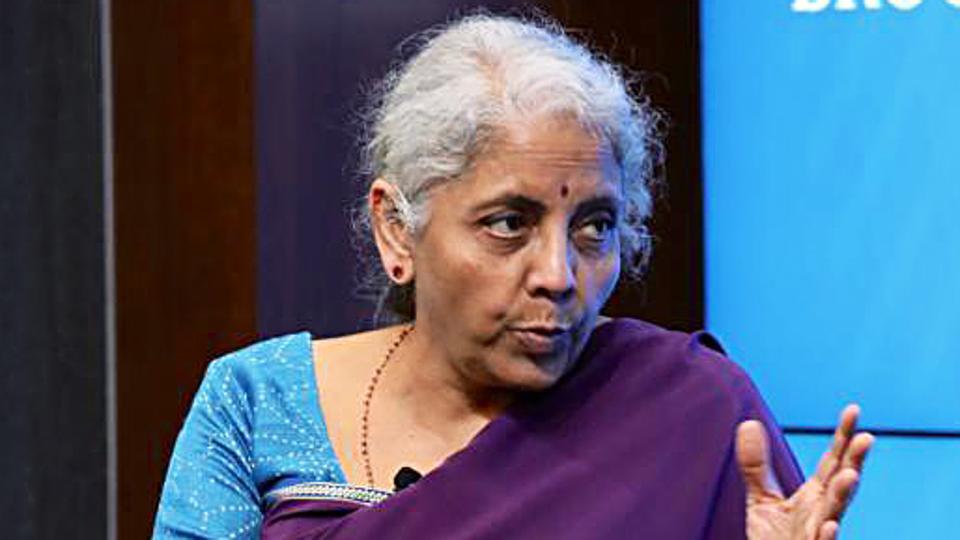
“Growth priorities will be placed absolutely at the top, even as I speak about concerns that inflation brings before me. Inflation concerns will have to be addressed. But then how would you manage growth will be the natural question. But that is the point of being sure how you are going to be able to balance the two,” Sitharaman said in response to a question on the next budget’s priorities in Washington DC on Tuesday.
Sitharaman added that the momentum that the Indian economy has got emerging from the pandemic, and the momentum that it will have over the next year that has been acknowledged even by multilateral institutions, cannot be “weakened”. “It will have to be very carefully structured budget in which growth momentum will have to be sustained.”
FM Sitharaman made the comments in a conversation at Brookings Institution with economist Eswar Prasad. They spoke about India’s resilience during the pandemic both in terms of pushing reforms and addressing the vulnerable segments of the population through welfare schemes; the risks to the global economy at the moment particularly in terms of food, fertiliser and energy crises; India’s unfinished reform agenda; its G20 presidency and commitment to multilateralism; and India’s digital push, including Unified Payments Interface (UPI), which is becoming an area of interest and collaboration with other countries.
Sitharaman said that there were risks that were “extraneous” to the Indian economy. “They are all things happening outside that are definitely hitting us. We are understanding the intensity of it and responding to it.
In particular, the FM mentioned the issue of energy prices, availability and sourcing -- and their impact on India’s climate commitments. While highlighting how India had met its Paris commitments “purely and entirely” from its own resources, Sitharaman pointed out that if natural gas was going to get more difficult to access within available means in this phase of energy transition, India will have no choice but to revert to coal to have the base level of electricity generated. “You have given your commitment, you have proved you can fulfil your commitment, but now you are at a risk to go back to thermal. This is a dilemma not just for India but for very many countries”.
Sitharaman also flagged the availability of fertilisers. She said India was in a position to produce all that it consumed and even export it. “But we do need fertilisers. Our soil is fairly fatigued out in some parts; in some other parts, there is a good level of fertility. Last year, we had to give 10X the price to import. Obviously, Indian farmers are not large farmers…They need fertilisers at an affordable price. I can’t raise their input cost by saying I am importing it at this price and take the burden as well. So we have footed the entire price. Farmer pays what he paid in 2018 or 2019-20, despite international prices are going up.”
On Tuesday night, Sitharaman also met a galaxy of top American policymakers, officials of multilateral institutions, and private sector leaders at a dinner hosted by Indian ambassador to the US, Taranjit Singh Sandhu.
The guests included John Podesta, President Joe Biden’s senior advisor on clean energy innovation and implementation; Don Graves, deputy secretary of commerce; Anthony Fauci, the President’s chief medical advisor; Sethuraman Panchanathan, director of the National Science Foundation; deputy national security advisor Michael Pyle, the US’s G7 and G20 Sherpa; Scott Nathan, CEO of the Development Finance Corporation, and Christine Grady, chief of the department of bioethics. The International Monetary Fund managing director Kristalina Georgieva and World Bank managing director and chief financial officer Anshula Kant also attended the dinner, as did former Pepsico CEO Indira Nooyi and Deloitte CEO Punit Ranjan.


