
 E-Paper



Finish hearing of Ayodhya case by Oct 18, there’ll be no extra day: Supreme Court
The court is racing against time because there are only three days of hearing left before the apex court heads for a week’s break on October 5. Other holidays await, including the festival of Diwali.


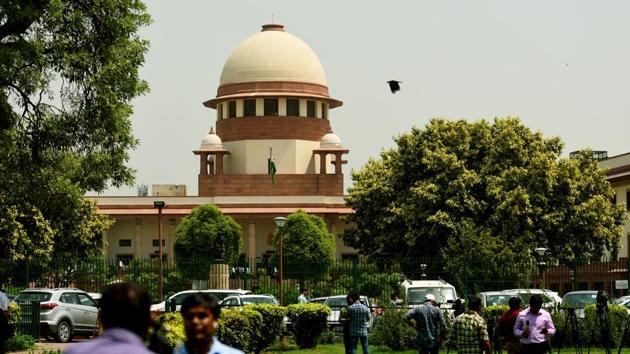
The Supreme Court on Thursday stressed the need for concluding hearings in the Ram Janmabhoomi-Babri Masjid title suit by October 18, saying “it would be a miracle to write a verdict in the case in four weeks” once both sides are done with arguing their cases.
The court is racing against time because there are only three days of hearing left before the apex court heads for a week’s break on October 5. Other holidays await, including the festival of Diwali.
“We make it very clear that there will be no extra day,” Chief Justice of India (CJI) Ranjan Gogoi, heading a five-judge Constitution bench hearing the matter, said. “It will be miraculous if we can give a judgment (in four weeks of the completion of hearings) considering what the parties had given (to the court by way of arguments),” the CJI said.
SC last week fixed October 18 as the deadline for conclusion of arguments in the case, giving itself exactly a month before Gogoi’s retirement on November 17 to pronounce its judgment on the decades-old land dispute in Uttar Pradesh’s Ayodhya between Hindus and Muslims.
The bench is hearing cross-appeals against the 2010 Allahabad high court verdict dividing the 2.77 acres of land into three equal parts, between the Sunni Waqf Board; an organisation claiming to represent Ram Lalla, or infant Ram; and the Nirmohi Akhara, a religious denomination.
Hindu groups claim that a Ram temple existed at the disputed site in Ayodhya which they claim marks the birthplace of the warrior-god Ram, and that the shrine was demolished during Mughal ruler Babar’s regime in the 16th century and replaced with the Babri mosque. On December 6, 1992, Hindu activists campaigning for the construction of a temple on the site, razed the mosque.
Senior advocate Rajeev Dhavan, appearing for the Sunni Wakf Board, apologized to the court for the arguments that were placed before it on Wednesday by his co-counsel, senior lawyer Meenakshi Arora, over the authenticity of the Archaeological Survey of India (ASI) report that said a temple existed at the spot where a Masjid had been built.
Dhavan called the arguments futile and said the contents of the report were in question and not the authorship. The court then allowed the lawyers to mould the arguments in such a way that only contradictions in the report are discussed and also whether the ASI team had done what they had been asked to or exceeded the brief.
Arora resumed her arguments and highlighted the “contradictions.” She also raised questions on the recovery of a “pranala” by the ASI as well as the discovery of a sculpture of a “divine couple”. Arora said there were contradictions in the report as the ASI’s own experts had dated some of the recoveries to different periods.
She argued that the walls discovered by ASI under the demolished mosque could have been part of an Idgah.
But justice Ashok Bhushan, a member of the bench, told the counsel that this fact had never been placed in the plaint. Also, it was earlier argued that the mosque was built on barren land. “Now you say there was an Islamic structure below it,” the judge said.
Arora explained that ASI had also drawn an inference on the temple’s existence. Therefore, a similar inference could be drawn for an Idgah.
Arora, on a court query, said other religions were also allowed to use such building materials. The pillar bases found by the ASI were in different layers of the soil beneath. This, she said, showed that they were built during different periods.
When asked how she reached to such a conclusion, Arora said she was saying so because they were in different floors. This prompted justice DY Chandrachud to comment: “The only person who could have explained these is the expert”.
The CJI also said the questions raised by Arora should have been put up before an expert. “Why ask us,” he told Arora.
But the lawyer continued to point out the shortcomings in the report. ASI, she argued, had failed to keep a record of animal bones recovered from the site. Carbon dating tests on the remains would have shown Islamic influences or evidence of animal sacrifices, she said.


