
 E-Paper



Firms rush to meet new PPE norms
Recently, thousands of PPE items among the 170,000 donated by China — world’s main supplier — failed the safety tests at the government-approved laboratories, two high-ranking officials confirmed to the Hindustan Times.


The Bureau of Indian Standards’ newly-released list of national specifications for coveralls or body-suits worn by Covid-19 healthcare workers has left some government approved manufacturers scrambling for material that would pass the new tests, even as government-approved laboratories rejected thousands of personal protective equipment (PPE) kits that were donated by China.
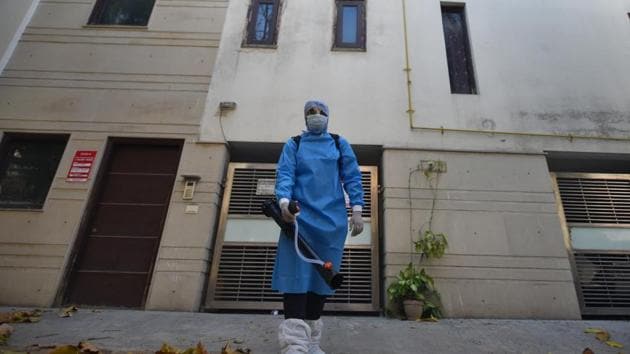
Recently, thousands of PPE items among the 170,000 donated by China — world’s main supplier — failed the safety tests at the government-approved laboratories, two high-ranking officials confirmed to the Hindustan Times.
“Yes, some of the samples of PPE kits from the imported lot did fail the safety tests,” an official from the Defence Research and Development Organisation (DRDO) in Gwalior said. The kits, which arrived in India on April 5, were sent there for stipulated quality check.
“About a week ago, China realized after complaints that some of their PPE kits were faulty. So they listed 4-5 firms that were making quality kits. We are now ordering only from them. The number of dodgy kits were not too significant,” an official of the empowered group on imports confirmed.
PPE kits include coveralls or full body suits, gloves, masks, head-cover respirators, goggles or face shields, and foot covers, among other elements. According to SITRA, India domestically produces 50,000 PPE kits (coveralls) daily, at present. However, till the beginning of this week, India faced a shortage of 15 million units, according to union textile ministry officials. It is unclear how the BIS guidelines will impact the shortage.
In an effort to standardise the quality of PPE kits, the BIS on April 14 released a specification document that said that the material used for coveralls must be fluid-resistant as well as virus-resistant. So far, the manufacturers have been making coveralls that are only fluid-resistant as per the guidelines laid down by the union health ministry in an 11-page document on March 24.
However, on Thursday, the list was taken down from the website of the BIS leading to speculation on whether the guidelines would undergo further revision.
“We were initially about to start our production with fluid-resistant materials, but we stopped even before we began because there were talks of viral-barrier suits. Now the challenge is availability of the raw material and the taping machines,” said Dr GSK Velu, chairman and managing director, Trivitron Group, one of the 81 manufacturers approved by SITRA.
“India does not have materials to make viral barrier suits. Instead, most companies are now laminating the coverall material and looking at sealing the seams to make the suits fluid and viral resistant. However, this is like wearing a raincoat in a non-AC ward, you can imagine the discomfort,” said Dr Ghanshyam Das Agarwal, chief managing director of G Surgiwear, a company that is looking to make products that are of certification level.
“The higher standard specifications released by the BIS are in a developing stage. Our feedback has already been sent through the official channels, so I cannot comment. But, it is likely that the specifications will be changed,” said Vijaya Shankara from Shree Hari Healthcare, an approved manufacturer.
According to Velu, while his company has been able to source material for viral-barrier body suits, and the manufacturing has begun, it will take at least a week for the kits to reach the market as the product will need to undergo certification.
Rajiv Nath, founder and forum coordinator of the Association of Indian Medical Device Industry (AiMeD) said that rather than import PPE kits, the government should import raw material, and other such critical material that’s missing in manufacturers’ supply chains.
“It is better to import critical missing raw material fabric for PPE that’s breathable and yet is fluid and viral resistant, rather than importing plane loads of PPE Kits,” Nath said.
“Breathability should be a bigger concern. Government should instead allow suits made of GSM 50 non-woven material, which will not pass the current test but are breathable and can provide 95 to 98% protection,” Agarwal added.
“It is good that there is a national standard now, we have been procuring the PPE kits locally and there are several that do not match the health ministry standards. If all the kits already come certified from the government then we will not have to worry about the quality,” a doctor treating Covid-19 patients in New Delhi’s Lok Nayak hospital, who did not wish to divulge his identity, said.
The issue of sub-standard PPE kits has been raised in multiple states. On Thursday, for instance, the director general of medical education (DGME) in Uttar Pradesh wrote a letter to medical colleges warning them against using substandard kits, after several complaints emerged from different Covid-19 hospitals. The kits were supplied by the Uttar Pradesh Medical Supply Corporation Limited.
“If you receive any sub-standard PPE kit or other medical items, do not use them. Return them straight away. Purchase good quality items from other sources and inform the DGME office about it,” Dr KK Gupta’s letter stated.
There are at least seven government designated private and public laboratories to check different items of PPE kits, including the DRDO and Coimbatore-based South India Textile Research Association (SITRA).
SITRA conducts checks for synthetic blood penetration (if blood will seep through the fabric), moisture vapour transmission (whether the fabric will allow moisture to pass between layers), weight test (grams per sq metre or GSM of the fabric), seam test and fabric strength.
A SITRA official told Hindustan Times that their laboratory also has the capacity to conduct dry and wet virus resistant tests on the fabric, but it was not carrying them out because there were no such directives from the government till now.
Other government approved testing laboratories include Trustin Analytical Solutions in Chennai that tests gloves, Chennai-based SGS India Private Limited that tests gloves, plastic-based products, protective clothing and respirators, the Rubber Research Institute of India, which tests rubber-based materials, and the Heavy Vehicles factory, and the Small Arms factory.
(With inputs from Amrita Madhukalya and Gaurav Saigal)


