Battling myriad hurdles, including nature’s fury, resistance from neighbouring states, missing deadlines, change in governments — the Polavaram project — considered to be the lifeline of Andhra Pradesh has seen it all.
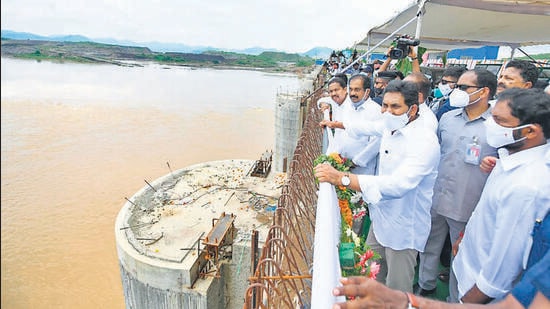
Originally supposed to finish by June 2020, the major irrigation project which is being constructed on the mighty Godavari river in West Godavari district has been a silent witness to deadline delays twice.
The revised target date was set April 2022 but this was also missed.
The project, if completed, is expected to provide irrigation to 2.95 lakh hectares (around 7.2 lakh acres) of new ayacut, besides stabilisation of an additional existing 4 lakh hectares of ayacut, apart from providing drinking water supply to 540 villages in East Godavari, West Godavari and Visakhapatnam, benefitting a population of 2.85 lakh and generating 960 megawatts of hydel power.
Reason: In August 2020, Godavari river witnessed massive floods with a flow of 21 lakh cusecs (cubic feet per second).The half-built upper coffer dam (built to divert water during the construction of the reservoir) was washed away causing huge scouring at two places in the diaphragm wall, constructed 90 ft deep in the river-bed for blocking the water and arrest seepage via foundation, on which the main earth-cum-rock-fill (ECRF) dam of 48 metres height and 1.75 km length was supposed to be constructed.
The Herculean task to repair the diaphragm wall has left the experts from the state and the central government gasping for a solution. As a result, the state government has virtually thrown up its hands on when the project would be completed.
{{/usCountry}}The Herculean task to repair the diaphragm wall has left the experts from the state and the central government gasping for a solution. As a result, the state government has virtually thrown up its hands on when the project would be completed.
{{/usCountry}}“We don’t know how much time it will take to complete the project. But we will make every effort to complete it at the earliest,” newly-appointed state irrigation minister Ambati Rambabu said, after visiting the Polavaram dam site on Thursday.
As a result of this enormous time-overrun, the project cost has also been mounting substantially over the years. The original project cost at ₹10,151 crore (in 2004-05), when then chief minister late Y S Rajasekhar Reddy of the combined Andhra Pradesh regime commenced the work on the project, has gone up to ₹16,010 crore (in 2010-11), when the project got all the clearances from the Centre.
While bifurcating the Andhra Pradesh in June 2014, the then UPA government had declared Polavaram as a national project and announced that it will bear the entire project cost. It appointed Polavaram Project Authority (PPA) under Union Jal Shakti ministry to oversee the implementation of the project by the state government.
Subsequently, the Centre said it will only bear the irrigation component cost, and not the cost of drinking water supply, rehabilitation and resettlement and hydel power project. It agreed to bear only ₹20,398 crore as per the 2013-14 estimates, even as the project cost continued to mount over the years.
The previous Telugu Desam Party government led by N Chandrababu Naidu and the present YSR Congress Party government led by Y S Jagan Mohan Reddy have been requesting the Centre for approving cost escalation. As per the revised estimates in 2017-18, the project cost shot up to ₹ 55,548 crore.
Though the PPA and the Central Water Commission approved the revised cost in principle, the Centre appointed a Revised Cost Committee in 2021, which projected the cost at ₹47,725 crore, including ₹28,191 crore only for rehabilitation and resettlement (R&R) of project evacuees.
“The Centre has been sitting on this revised project cost and has not given clearance yet. The Centre asks the state government to spend first and then asks for reimbursement by submitting bills. Under the present financial constraints, this proposition is extremely difficult,” a senior official in the state irrigation department lamented.
A consultant of the Union Jal Sakthi minister, who refused to be named, said that the main reason for cost escalation is the increased R&R of the project evacuees under the Right to Fair Compensation and Transparency in Land Acquisition, Rehabilitation and Resettlement Act, 2013, apart from increase in the number of evacuees over a period of time.
According to original estimates of 2014, the project envisages displacement of as many as 44,570 families from 271 revenue villages of eight revenue blocks but the number went up to 98,818 families, 80% of whom are tribals in 2014-15. They are supposed to be rehabilitated in several alternative locations like Buttaigudem, Jeelugumilli, Darbhagudem and Yetapaka in East and West Godavari districts.
“Now, the number of families has gone up to 1.06 lakh. Each family would get a monetary compensation of ₹6.8 lakh to ₹10 lakh depending on the location, apart from land to land and housing facilities. This is a huge task,” the consultant said.
THE PROJECT
Located near Ramayyapeta village of the Polavaram mandal in the West Godavari district, the Polavaram project was originally conceived in 1946 when the area was under Madras Presidency.
The first foundation stone was laid in 1980 by the then chief minister T Anjaiah but the project got stuck up in the power corridors in Delhi, as it involved massive rehabilitation, environmental issues and submergence of some areas in the neighbouring Chhattisagarh (then part of Madhya Pradesh) and Odisha.
Finally, in 2004-05, the then chief minister Y S Rajasekhar Reddy began fast-tracking the Polavaram project, after getting the revised foundation stone laid by then UPA chairperson Sonia Gandhi. He used his good offices with the Centre to get all the required permissions.
However, due to Reddy’s untimely death in September 2009, the project was pushed to backburner. In the meantime, Odisha and Chhattisgarh states moved the Supreme Court opposing Polavaram on the grounds that it would submerge 4,932 hectares of land in Odisha and 2,015 hectares in Chhattisgarh due to redesigning of the project discharge capacity from 35 lakh cusecs to 50 lakh cusecs. The cases are still pending.
Three years later, the Kiran Kumar Reddy government called for tenders for the project headworks and the works were entrusted to a consortium headed by Transstroy (India) Ltd for ₹4,717 crore. The project works, thus began slowly and picked up momentum after the bifurcation of the state in June 2014.
However, as the years passed, Transstroy failed to take up the works at the required pace, despite repeated warnings by the then Chandrababu Naidu government and the Union ministry. Finally, in January 2018, the Naidu government dropped Transstroy from the contract of Polavaram and entrusted the concrete and spillway works to Navayuga Engineering Company Ltd at the previously agreed project cost.
Things moved fast after that, as Navayuga made rapid progress in the project works. It took up works on the project spillway, right and left canals and the construction of the diaphragm wall and coffer dams.
According to former irrigation minister Devineni Umamaheshwar Rao, more than 70% of the work on main dam (spillway) and canal works and 100% on the diaphragm wall and coffer dams was completed.
After Y S Jagan Mohan Reddy took over as the chief minister in May 2019, he terminated the contract with Navayuga on the ground that there was a massive corruption in the agreement. In September 2019, he went in for reverse tendering of the project and awarded the contract to Megha Engineering and Infrastructure Ltd (MEIL), saying that it resulted in a saving of ₹618 crore to the government.
Though works picked up pace again after MEIL took over the project, the delay caused due to change of government and change of contractor led to escalation of the project cost.
HEAVY DAMAGE BY FLOODS
Even as the MEIL was busy completing the pending works of Polavaram project, a massive flood in Godavari river in August 2020 caused major damage to the diaphragm wall of the dam. The diaphragm wall, which is a 1.5 metres-thick concrete structure up to depths from 40 to 120 m below the river bed, is the first of its kind structure in the irrigation projects in India, meant to provide stability to the dam to withstand the water pressure. On this diaphragm wall, an ECRF of 2,310 metres was constructed.
According to the Union ministry’s consultant, quoted above, the massive floods to the extent of 21 lakh cusecs caused scouring at two places in the diaphragm wall over an area of 200 square meters. The main reason for this damage was the mistake committed by the contractor in the construction of upper coffer dam.
“Before construction of the coffer dam, the surrounding villages have to be evacuated, as it would cause their inundation. When they realised the mistake, they left the upper coffer dam midway and it resulted in damages to the coffer dam as well as diaphragm wall,” the consultant said.
I S N Raju, retired chief engineer of Central Designs Organisation (CDO) which approved the project designs, said the works should have been completed before the flood season itself. “It is not possible to take up dam works when there are floods. Due to the slackness in the works, the dam suffered major damages,” he said.
In March this year, Union minister Gajendra Singh Shekawat visited the Polavaram dam area. “As per his instructions, we have taken up a study of the extent of damage done to the project and will come out with solutions to address the issue,” irrigation expert and advisor to the ministry Sriram Vedire said.
Last month, a team of experts constituted by the state, inspected the project site to work out the design and methodology for repair of the diaphragm wall and fix a timeline for construction of the ECRF dam.
“The committee led by former director of IIT, Delhi, V S Raju is learnt to have come up with various options – whether to carry out the repairs to the existing diaphragm wall or construct a parallel wall again. The committee will submit its report to the Centre soon and a decision on how to proceed further will we be taken,” state irrigation minister Ambati Rambabu said.
According to the minister, there was a suggestion to drain out the entire water from the area to carry out the repairs. “But it is not so easy and is quite expensive. The CWC is exploring other options,” the consultant quoted above said.
As per the state minister, it requires at least ₹800 crore to repair the damage caused to the diaphragm wall. “If pumping of water has to be done, the total cost would be around ₹2,000 crore,” Rambabu said.
Retired chief engineer Raju, however, said the expenditure might not be so huge. “I think, the repairs can be carried out at ₹500 crore to ₹600 crore,” he said.
BLAME GAME BETWEEN TDP, YSRC
A blame game started between the YSRC and the TDP over the damage caused to the Polavaram dam. During a discussion on Polavaram in the state assembly in March last week, the chief minister alleged that poor handling and mismanagement of the project by the previous TDP government led to the damage.
“Huge gaps were left in both upper and lower coffer dams resulting in the damage of diaphragm wall of the project. It was a man-made disaster,” he said.
TDP leader and former irrigation minister Devineni Umamaheshwar Rao said that the damage would not have occurred had the Jagan government continued the project with the same pace, instead of halting them for change of contractor.
“Irrigation minister Ambati Rambabu doesn’t know the difference between a compound wall and a diaphragm wall. If he has guts, he should release a white paper on the Polavaram project progress and status,” he demanded.
The TDP and YSRC have also been indulging in war of words over rehabilitation and resettlement of the project evacuees. The Jagan government has decided to maintain the water level in phases, so that rehabilitation of evacuees could be taken up in a phased manner.
In the first phase, the state is contemplating maintaining the reservoir level of Polavaram project at a contour of 41.15 metres, as against the full reservoir level of 45.72 meters.
“There will be no change in either design or the height of the dam. The height of the project spillway and earth-fill-rock dam would remain as per the original design. However, the water level in the reservoir would be maintained below the contour of 41.15 metres, and any excess water flowing in the river would be discharged downstream through the spillway gates,” an irrigation official connected with the project, said.
At this water level, the evacuation would be confined to around 40 villages and the R&R cost could drastically come down to around ₹ 2,000 crore. “We can do take up evacuation in a phased manner,” the official said.
However, the TDP says if the water level is maintained at 41.415 metres, it would be almost at dead storage and it cannot supply water to the canals through gravity.
“At the FRL of 45.72 metres, the project can store 194 tmc ft (thousand million cubic feet) of water. If the level is reduced to 41.15, the storage will come down to less than 100 tmc ft, which is not sufficient to meet the irrigation requirements. The Polavaram project will remain a barrage, not a dam,” Uma Maheshwar Rao said.
Retired engineer Raju, however, said no dam will be filled to the full reservoir level at one go, keeping in view the dam safety. “It has to be done in a phased manner over a period of three to four years. Even at 41.15 metre level also, the project can serve the irrigation needs,” he asserted.