New Delhi: The Narendra Modi government’s decision to confer the Bharat Ratna, country’s highest civilian award, to PV Narasimha Rao posthumously, will be seen, in one part, as recognition for a political leader who put India on the path of prosperity by initiating economic reforms. Rao’s 1991 government achieved this task when the Indian economy was on the precipice of a sovereign default and had to suffer the ignominy of mortgaging India’s gold reserves to international financial institutions for a
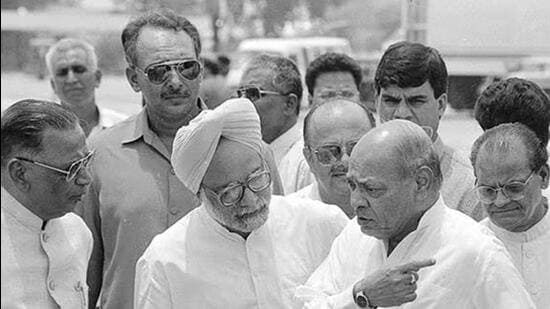
New Delhi: The Narendra Modi government’s decision to confer the Bharat Ratna, country’s highest civilian award, to PV Narasimha Rao posthumously, will be seen, in one part, as recognition for a political leader who put India on the path of prosperity by initiating economic reforms. Rao’s 1991 government achieved this task when the Indian economy was on the precipice of a sovereign default and had to suffer the ignominy of mortgaging India’s gold reserves to international financial institutions for a bail out package.
A more nuanced and politically loaded reading, however, will not ignore that the award also exploits the fault-lines between Rao and the Gandhi family leadership of the Congress party after 1991.
Rao became India’s unlikely prime minister after Rajiv Gandhi’s assassination during the campaign for 1991 Lok Sabha elections. The economic situation, when Rao assumed power, was extremely precarious, with foreign exchange reserves enough to cover just more than a month of India’s import bill. While there was already a widespread consensus within the Indian deep state for such reforms, and the actual architect of the policy changes was a person who was Rao’s finance minister and would become the only other Prime Minister the Congress has had after Rao. Still, it was Rao rather than (the then political greenhorn) Manmohan Singh who sugar-coated the sharp turnaround in Congress’s Nehruvian economic doctrine to make the reforms a politically palatable commodity within the ruling party’s orthodoxy. Rao’s biography by Vinay Sitapati illustrates how he himself radically changed his economic views towards a more pro-market outlook after spending time in western countries.
Also Read: Narasimha Rao, Charan Singh, Swaminathan to get India’s highest civilian honour
While Rao continued to push the reforms as a continuation of the economic policies of Jawaharlal Nehru and Indira Gandhi, Manmohan Singh and his team were given absolute authority to drive the reform agenda in the government. The fact that such widespread changes were brought in by a government which did not even have a parliamentary majority speaks volumes about Rao’s political prowess.
To be sure, Rao had his share of political embarrassments while holding the prime minister’s office with episodes such as the JMM bribery case and the Harshad Mehta stock market scam putting his government and leadership in the dock over corruption-related issues.
While economic reforms have come to enjoy a bipartisan consensus in the Indian economy and the Indian economy has benefitted significantly from them, Rao himself was shunned by the Congress party after his loss in the 1996 elections. The reason for the Congress almost abdicating Rao – when he died in 2004 his body was not even brought to the Congress headquarters – is more in the realm of the worsening of relations between Rao and Sonia Gandhi after she joined and eventually took charge of the Congress party in the late 1990s.
Among the most significant reasons for the bad blood between Rao and Gandhi was the fact that it was under Rao’s watch as PM that the Babri Mosque was demolished in Ayodhya in December 1992. The event, apart from creating widespread communal unrest in the country, also damaged the Congress’s standing among minority voters.
One Subscription.
Get 360° coverage—from daily headlines
to 100 year archives.
Archives
HT App & Website