E-Paper



G7 summit: PM pushes for wider energy access
Addressing a special session with the theme “Investing in a better future: Climate, energy, health” at the summit in the German resort of Schloss Elmau, Modi said access to energy shouldn’t the privilege of only the rich at a time when energy costs are increasing because of geopolitical tensions.


Prime Minister Narendra Modi on Monday pushed back against the suggestion that developing countries cause more damage to the environment at the G7 Summit, and said India, home to 17% of world population, accounts for only 5% of global carbon emissions.
Addressing a special session with the theme “Investing in a better future: Climate, energy, health” at the summit in the German resort of Schloss Elmau, Modi said access to energy shouldn’t the privilege of only the rich at a time when energy costs are increasing because of geopolitical tensions.
Germany, the current president of G7, invited the leaders of India, Indonesia, South Africa, Argentina and Senegal to the summit of seven of the world’s largest economies in an effort to strengthen global collaboration on issues such as climate action, health and energy security.
Modi also participated in another session focused on food security and gender equality, and held bilateral meetings with German Chancellor Olaf Scholz, South African President Cyril Ramaphosa, Indonesian President Joko Widodo, and Canada’s Prime Minister Justin Trudeau.
In his speech at the session on climate change and energy, Modi said: “Unfortunately, it is believed that there is a fundamental collision between the developmental goals of the world and environmental protection. There is also another misconception that poor countries and poor people cause more damage to the environment.”
Speaking in Hindi, he added, “Seventeen percent of the world’s population resides in India. But our contribution of global carbon emissions is only 5%. The main reason behind this is our lifestyle, which is based on the theory of co-existence with nature.”
India has shown over thousands of years, including in times of immense prosperity in the past and currently as the fastest growing large economy, that its commitment to the environment has not been “diluted even a single bit”, he said.
“All of you will also agree...that energy access should not be the privilege of the rich only – a poor family has the same rights on energy. And today when energy costs are sky-high due to geopolitical tensions, it is more important to remember this,” Modi said, referring to the spike in crude prices following the Ukraine crisis.
In recent years, India has repeatedly pushed developed countries to do more to meet climate action goals, including providing more funds and transferring technology to boost the adoption of green energy. It has also pushed back against calls from the West not to accelerate the purchase of discounted Russian energy and said its energy procurements will be based solely on national security interests.
Modi noted that India’s dedication to climate commitments is reflected in its performance, such as achieving the target of generating 40% of energy from non-fossil sources nine years before of the target of 2030, and completing the target of blending 10% ethanol in petrol five months ahead of the target.
India has the world’s first fully solar-powered airport and its railway system will become net zero in this decade, while the delivery of LED bulbs and clean cooking gas door-to-door has shown that millions of tons of carbon emissions can be prevented while ensuring energy for the poor, he said.
He hoped the rich countries of G7 will support the efforts of India, a huge market for clean energy technologies. “G7 countries can invest in research, innovation, and manufacturing in this field. The scale that India can provide for every new technology can make it affordable for the whole world,” he added.
The health of humans and the planet are interconnected, and this is why India adopted the approach of “one world, one health”, Modi said. During the Covid-19 pandemic, India found creative uses of digital technology for health, and G7 countries can help take such innovations to developing countries, he added.
Modi noted he had called for a movement known as LiFE, or Lifestyle For Environment, at last year’s COP26 meet in Glasgow. India launched the Global Initiative for LiFE campaign on the World Environment Day this year.
“The goal of this campaign is to encourage an eco-friendly lifestyle. We can call the followers of this movement ‘triple-P’ or ‘pro planet people’, and we should all take the responsibility of increasing the number of triple-P people in our own countries,” he said.
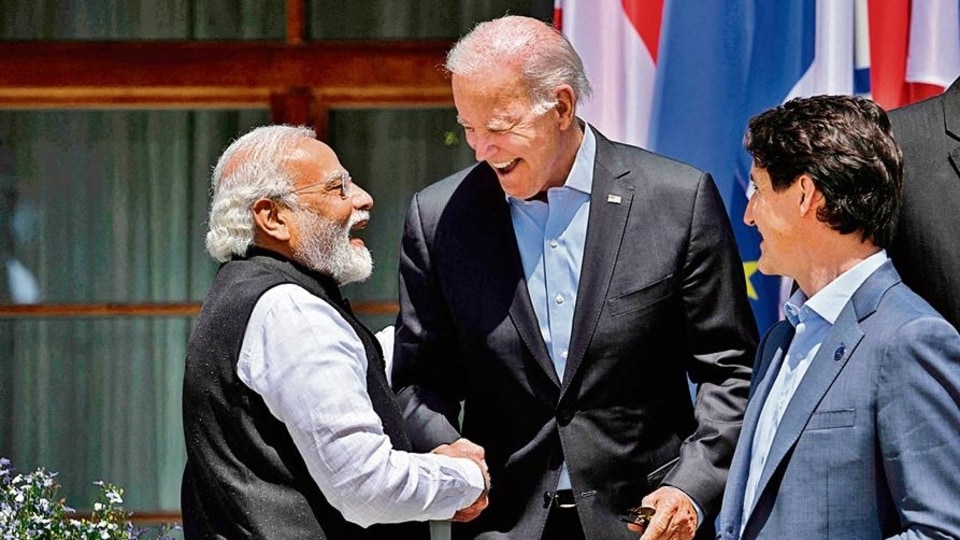
Modi briefly interacted with US President Joe Biden, French President Emmanuel Macron and other G7 leaders during a photo-op. Footage showed the leaders shaking hands and exchanging greetings.
The main agenda item for the G7 Summit on Monday was further support for Ukraine. Scholz and Biden discussed this issue at bilateral talks on Sunday and were unanimous in their assessment, the German chancellor said. “Germany and the US will always act together when it comes to questions of Ukraine’s security,” Scholz said.
Ukrainian President Volodymyr Zelenskyy virtually participated in Monday’s consultations, and Scholz said recent missile attacks in Kyiv had again demonstrated what a brutal war Russian President Vladimir Putin was waging. A Russian missile strike on a crowded shopping mall in the central Ukrainian city of Kremenchuk killed at least 10 people and injured 40 more.
Zelensky told G7 leaders that he wanted the war in Ukraine to end by the end of the year as the grouping works to starve Russia of oil revenues, according to media reports.
During Modi’s meeting with Scholz on the sidelines of the G7 Summit, the two sides discussed climate action, provision of climate financing and technology transfer. Both leaders agreed to deepen trade, investment and people-to-people ties.
This was the second meeting between the two leaders this year, following the India-Germany inter-governmental consultations in Berlin on May 2. The two leaders also emphasized the need to take forward the bilateral Green and Sustainable Development Partnership.
Greater coordination in global bodies, especially in the context of India’s forthcoming G20 presidency, was discussed. Scholz and Modi also exchanged views on regional and global developments.
Modi and Ramaphosa welcomed the WTO agreement reached in June that supports the production of Covid-19 vaccines in developing countries. India and South Africa submitted the first proposal suggesting a waiver for all WTO members on implementing certain provisions of the TRIPS Agreement in relation to the containment and treatment of Covid-19.
They reviewed progress in bilateral ties, especially since the signing of the Strategic Programme of Cooperation in 2019. They expressed satisfaction at progress in the defence, education and agriculture sectors, and called for deepening cooperation in trade and investment, food security, pharmaceuticals, digital financial inclusion, insurance and health.
Modi congratulated Widodo on Indonesia’s ongoing G20 presidency, and the two leaders discussed India’s forthcoming G20 presidency. They also exchanged views on global and regional issues.
During the second session on food security and gender equality, Modi said India’s approach has transitioned from “women’s development” to “women-led development”. In order to ensure food security, he suggested countries should focus on availability of fertilisers, a structured system for using Indian agricultural talent, nutritious alternatives such as millets and natural farming.