
 E-Paper



India's GDP grows 4.1% in Q4 amid Ukraine war dent
The Indian economy is expected to have grown at 8.7% in the 2021-22 fiscal year, as per provisional estimates released by the National Statistical Office (NSO) on May 31, the fastest annual growth rate by a major economy.


The Indian economy is expected to have grown at 8.7% in the 2021-22 fiscal year, as per provisional estimates released by the National Statistical Office (NSO) on May 31, the fastest annual growth rate by a major economy.
The latest annual growth number is 20 basis points lower than the 8.9% forecast, which was made in the second advanced estimates released by the NSO on February 28. One basis point is one hundredth of a percentage point.
While GDP levels in 2021-22 have crossed pre-pandemic levels, incomes and purchasing power for much of the population might still be lagging. This can be seen from the fact that both per capita GDP and per capita private final consumption expenditure for 2021-22 continued to be lower than 2019-20 levels in real terms.
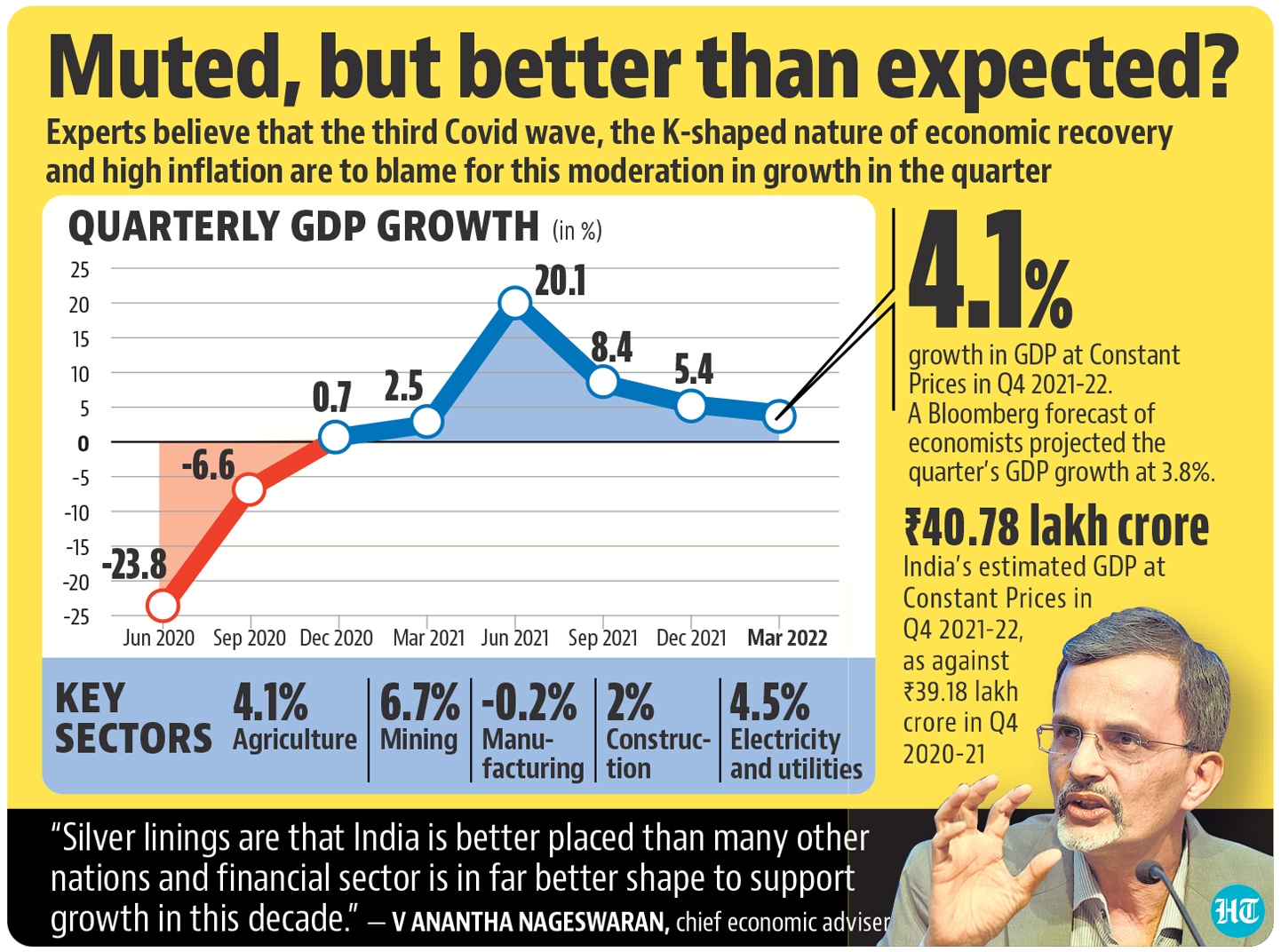
The lower than expected economic performance in 2021-22 was because of a loss of economic momentum in the last quarter of the financial year. While the February projections assumed a GDP growth of 4.8% in the quarter ended March, NSO’s latest statement puts this figure at just 4.1%.
To be sure, the latest growth numbers are better than what was widely expected. A Bloomberg forecast of economists projected the quarter’s GDP growth at just 3.8%.
Headwinds from the third wave of the Covid-19 pandemic, the K-shaped nature of the economic recovery and the squeeze on purchasing power due to high inflation are to blame for this moderation in growth in the quarter, experts said.
“The latest GDP growth number only confirms the criticality of the growth challenge once the favourable base effect dissipates,” said Himanshu, an associate professor of economics at Jawaharlal Nehru University. “The inflationary squeeze on mass demand is only going to make things worse and fiscal policy must do all it can to protect the poor from the pain of inflation.”
GDP growth for the four quarters ended March 2022 were 20.1%, 8.4%, 5.4% and 4.1%, respectively. The corresponding numbers for 2020-21 were minus 23.8%, minus 6.6%, 0.7% and 2.5%.
Both retail and wholesale inflation have been increasing at a fast rate, with the benchmark inflation measure of Consumer Price Index reaching an eight year high of 7.95% in April. The government has announced a host of measures to control price rise and alleviate the pressure on household budgets. These include a reduction of excise duty on auto fuels, reduction of customs duty and imposition of export duties on a host of manufactured goods and export bans on important crops such as wheat and sugar.
“Silver linings are that India is better placed than many other nations and financial sector is in far better shape to support growth in this decade,” chief economic adviser V Anantha Nageswaran said, commenting on the GDP numbers.
Headwinds to growth are faced by all countries mainly because of global situation (the Ukraine war, supply chain disruptions and consequently rising commodity prices), Nageswaran said.
“There are multiple challenges. One is the tightening that is happening in the central banks in the developed world and other is the possibility of commodity prices going up even further,” he said. “But again, I repeat, it would be much harder for other countries than for India.”
He attributed his confidence to the huge food and fertiliser subsidies extended by the government to protect the poor and vulnerable.
The Indian economy consolidated its recovery in 2021-22, with most of its constituents surpassing pre-pandemic levels of activity, he said. The continued expansion of economic activity was evident in high frequency indicators in the first two months of the current financial year, Nageswaran added.
He, however, pointed to vulnerabilities such as high global prices of commodities with significant import dependency on crude, edible oil, fertilizer and metals. Balancing growth, inflation, fiscal and current deficits and the external value of the currency will be the continuing policy focus of the government, the economic advisor said.
Where the latest quarterly GDP numbers raise an alarm is on the unequal pain inflation seems to have inflicted in the Indian economy. This was best seen in the performance of the manufacturing sector. Despite a robust performance of high frequency indicators such as the purchasing managers’ index for manufacturing, its gross value-added component actually saw an annual contraction of 0.2% in the March quarter.
This, when read with anecdotal accounts of larger firms gaining in terms of market share and pricing power at the cost of smaller firms, seems to suggest that the K-shaped nature of the recovery is continuing in the economy and employment intensive firms might still be suffering.
GDP numbers are not the only statistic that suggests the Indian economy might be undergoing a sequential moderation. While the index of eight core sector industries recorded an annual growth of 8.4% in April, in absolute terms the April reading (143.2) was lower than the March number (158.2).
Rising inflation and decelerating growth is likely to complicate policymaking choices on both the fiscal and monetary policy fronts. Reserve Bank of India governor Shaktikanta Das has already said that the monetary policy committee raising interest rates on June 8, which is when its next meeting will culminate, was a given.
“Peak impact of interest rate hikes on GDP will be felt only towards the end of this fiscal year,” Dharmakirti Joshi, chief economist at ratings firm Crisil, said in a statement.
“I see support to growth from a strong bounceback in contact-based services, which last fiscal was about 11.3% lower than fiscal 2020 levels,” Joshi said. “But headwinds from slower global growth and higher oil prices have tilted the risks — to our forecast of 7.3% for the current fiscal – downwards.”


