E-Paper



‘German poll result won’t impact India ties’: Philipp Ackermann
German elections won't alter foreign policy; focus on enhancing ties with India continues, despite far-right AfD's rise, says ambassador Ackermann.


New Delhi The outcome of the German elections, including a strong showing by the far-Right AfD party, is not expected to impact foreign policy, and the new government is expected to continue with efforts to enhance the partnership with India, German ambassador Philipp Ackermann has said.
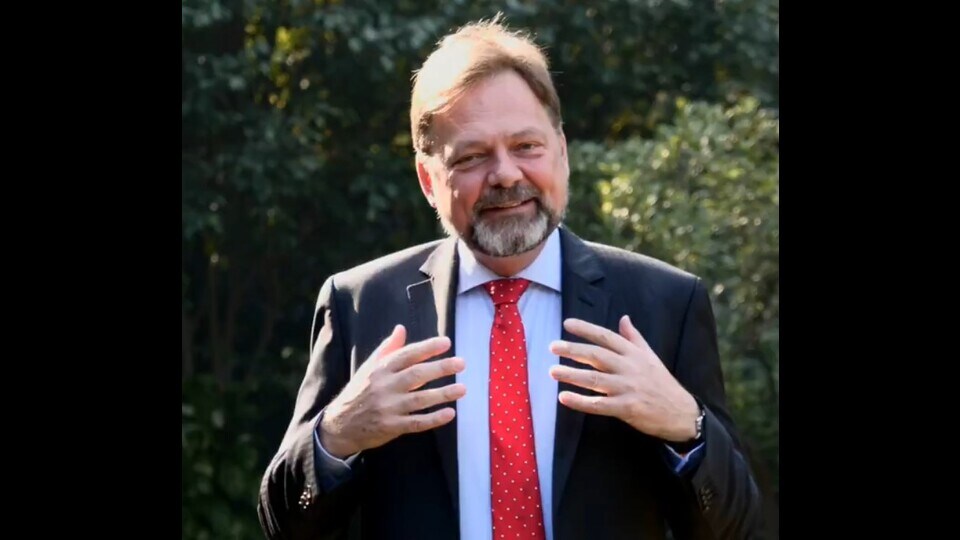
In an interview with HT, Ackermann pointed to the need to balance legal migration with a “psychological uneasiness in Germany...about dealing with the challenges of migration”. He also acknowledged Germany’s “very good experiences” with Indian workers and students.
How do you assess the outcome of the German election and what does this mean for relations with India?
Many Germans attached high importance to this election because the turnout was 82.5%. That means these elections were perceived as extremely important for the future of Germany.
The result – I think you can’t hide the fact that it’s difficult. For the first time, you have a far-Right party at 20.8%. We will be having tough discussions in Parliament. The second thing is it limits the options for a coalition because the winning Christian Democratic Union (CDU) has made it very clear it doesn’t want to join hands with the Alternative for Germany (AfD).
You have to understand the “firewall” in Germany has a different character than the management of Right-wing parties in other European countries because of the history. I would argue AfD has people in its rank and file who are really very extreme.
The CDU has excluded going with the Left Party. With the Greens alone, it’s not enough and they need to have the Social Democrats back on board. That’s a formula we know, because that’s the formula for three out of the four mandates for [former chancellor] Angela Merkel.
[CDU’s chancellor candidate] Friedrich Merz has said he wants a government by Easter. This would be very ambitious because coalition negotiations, unlike in India, are very formal and end with a contract. If he manages that in two months, we will have a very smooth transition.
There is relative consensus on foreign policy between big German parties. We don’t expect a huge shift in foreign policy. Merz has positioned himself very clearly on the Ukraine crisis, the West Asia crisis, and been very clear on Europe. I would say, with all due caution because I haven’t talked to the incoming government, this is also true for India. The shift towards India that the previous government very clearly managed, and which is laid down in the paper “Focus on India”, will prevail under the next government.
Because of developments in the US, do you foresee European powers like Germany focusing on an enhanced partnership with India? We are very free trade-oriented; we feel this American idea of putting tariffs on many countries is not convincing. I think the new government will make an extra effort to get the FTA negotiations [with the European Union] going and get it a bit further than it has come. America is a very close ally of Germany, we are intertwined in many, many ways. We’ve built up a relationship over 80 years and this is not to be deleted in one month. Ukraine will be a difficult chapter to start with, but when it comes to business, we are a very globalised economy and we feel tariffs are always an impediment to global trade.
Given the rise of AfD in Germany and the shift against immigration across Europe, will this impact plans to increase visas for Indian professionals? We have no ceiling. One of the new government’s main tasks is to make people understand there are two different chapters to migration – legal migration, which we need urgently, and illegal immigration, which we should reduce and shrink. Everybody understands that in many areas of German professional life, we urgently need migration. The law we have now is very liberal, very open-minded.
There is a psychological uneasiness in Germany that we have to acknowledge, and that is reflected in the vote, about dealing with the challenges of migration and integration. That’s a general feeling and that has to be met by the government. How do you do that? I think deportations of those who cannot be staying because they are illegally in Germany will increase, but also there must be an extra effort when it comes to involving people in the workforce.
So things are on track for legal mobility and an increase in the number of Indian students in Germany? The numbers are clearly going up. We now have 280,000 Indians in German, up from 260,000 [in 2023]. We have a clear increase in visas every year, it’s between 5% and 15%, depending on the category. There is a clear and relentless interest in studying in Germany and we have about 3,500 to 4,000 students a month who register at an assessment agency. Be it craftsmen, workshops, hospitals, restaurants or IT companies, people have had very good experiences with Indian workforce. The experience with Indians is better than with others and, therefore, Indian workforce and students are particularly welcome.
With two-way trade surpassing $30 billion, do you see the positive trends continuing? After the Asia Pacific Conference of German Businesses last October, we see a renewed interest. Wherever you go, there are investments here and there. There are big investments and medium-sized companies are investing too. We see a new attention when it comes to India as a place for foreign investments. Will there be investment of billions of dollars and setting up of new assembly lines? I think maybe less but when it comes to services, R&D and production, you will see more and more.
On the Ukraine crisis, the Europeans don’t seem to be at the negotiating table. How will this pan out and is there a possible role for India? Every effort to bring peace to this poor country is commendable. What we see from the American side, a lot of the path is not paved yet. Don’t take everything you hear for granted. It is a good thing the current administration in Washington is trying to bring this war to an end. But it has to be made very clear that Ukraine must be at that table. There must be some red lines.
Ukraine must go along with what is on the table. You can’t just have a diktat where you say, ‘Take it or leave it, and otherwise you will cease to exist.’ That’s not an option. Europe has invested a lot of money, certainly we paid more than the Americans and it’s not as loans. It’s only natural to have the Europeans at the table, not least because the American side foresees a clear road for Europe after the war has stopped.
I think India always had this very interesting position, that it could talk to both sides in in a credible way. I would say it depends on the American negotiation techniques, whether they will involve India. For the time being they have a very restricted format. When it widens, and it must widen at some stage, India is certainly an interesting option.
 ABOUT THE AUTHORRezaul H Laskar
Rezaul Hasan Laskar is Foreign Editor with the Hindustan Times, which he joined in 2015. He began as a journalist in his hometown of Shillong in northeast India and has worked in newspapers and wire services over the years. He moved to New Delhi in 1997 and initially focused on defence, national security, Jammu and Kashmir and the northeast, while also working of foreign policy and international relations. He has been part of the media delegation accompanying PMs on foreign visits and has reported from destinations ranging from Tibet to Ukraine. Between 2007 and 2013, he was the Press Trust of India correspondent in Pakistan, one of only two Indian journalists allowed to report from the country. He extensively covered Pakistan’s domestic politics and the life of the common people, as well as the fallout of the 2008 Mumbai attacks on India-Pakistan relations and the subsequent trial in Pakistan of the suspects involved in the attack. As part of his reportage in Pakistan, he travelled the breadth of the country, from the Swat Valley to Balochistan. Reza’s first gig in journalism was writing a weekly music column, and music – especially classic rock – remains a keen interest. He is also a movie buff and a keen photographer.Read More