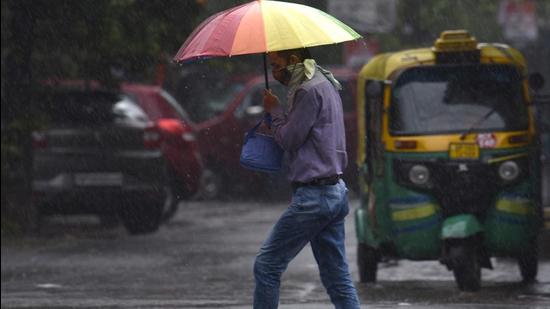
Delhi made up 83% of its August rainfall deficit in just three three-hour spells, two of them on August 21 and one on August 31. But on 15 of 31 days of August, usually the wettest month of the monsoon season, it did not rain at all in the national capital. This may well be the emerging trend in India, where short and more intense spells of rain are replacing uniformly distributed rainfall. However, even this phenomenon has several regional
2) Rain falling on fewer days now
There were five years in the 2011-2020 decade that saw an unusually high number of days with a lot of rainfall. If years are ranked on the basis of the number of days in the year which figure in the top 10% of highest rainfall days of the monsoon since 1901, 2019 ranks first with 30 days. Another four years (2011, 2013, 2016, and 2020) rank within the top 50 years. 2014 and 2017 are ranked 51st. Until August 31, 2021 has seen five days among the top decile of highest rainfall. Such high rainfall days are also complemented by long dry spells. It now takes fewer days for 50% of monsoon rains to fall. At the all-India level, this has decreased from 41.34 days (average in 1961-2010) to 40.9 days (average in 2011-2020). In several northern and north-eastern states, this change is more: from 21.74 days to 19.4 days in Bihar, for example, or 20.54 days to 16.7 days in Manipur. In all, 19 of 29 states (including Delhi) have seen a reduction in number of days it takes for 50% of monsoon rains to take place. And 24 states have seen a reduction in number of days it takes for 99% of monsoon to take place.
{{^htLoading}} {{/htLoading}} 3) Fewer rainfall days, higher intensity rain in most places
Fewer days of rainfall does not necessarily mean that rainfall is getting more intense. It can also mean the drying up of a place. That is why intensity and rainfall days need to be read together. While the number of days it takes for 50% rainfall has decreased in most states (all states left of the vertical line in chart below; some states, Assam, Bihar, Jharkhand West Bengal, and Uttar Pradesh, have not seen an increase in heavy and extreme intensity rainfall (more than 35.5mm in a grid in a day).
Here a decrease in rainfall days has likely just made the states drier. Heavy and extreme rainfall has increased (all states above horizontal line) in most western and southern states. Those among them where the number of rainfall days has reduced (top-left quadrant) likely now see prolonged dry spells followed by intense wet spells. Where rainfall days have increased (top-right quadrant) likely see a more uniform distribution. This is not the case this year for Gujarat and Rajasthan, though; in both states a break phase has led to long dry spells.