E-Paper



Global South a victim of double standards: PM Modi
PM Narendra Modi said the Global South has received ‘nothing more than token gestures’ in climate finance, sustainable development and technology access

 Prefer HTon Google


Comprehensive reforms of institutions of global governance are necessary because these bodies have failed to address the concerns and interests of the Global South, Prime Minister Narendra Modi said at the Brics Summit in Rio de Janeiro on Sunday.
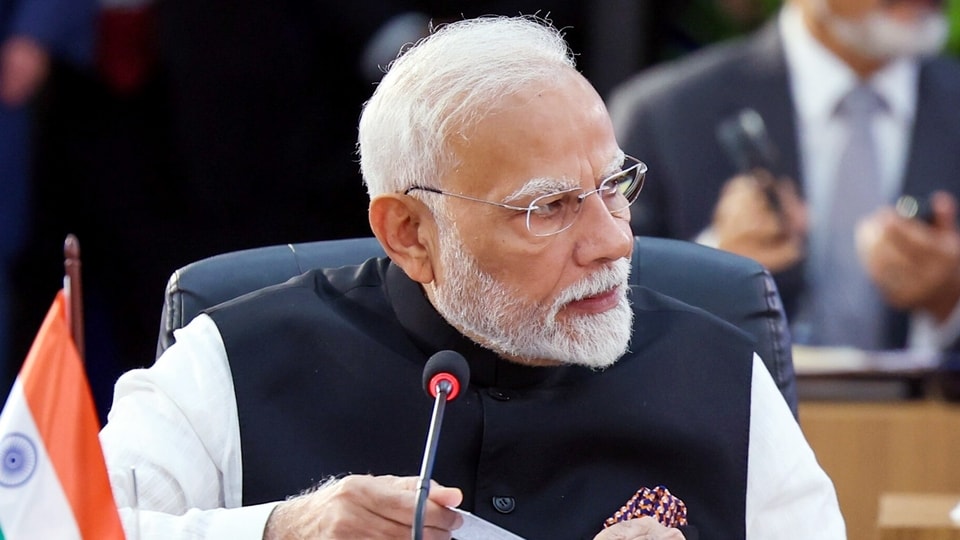
Addressing a session focused on peace and security and reform of global governance, Modi said that besides their failure to give the Global South a place at the decision-making table, these institutions have no solutions to conflicts around the world, health and economic crises, and new challenges in cyber and space.
Modi was scathing in his criticism of the UN Security Council, World Trade Organization (WTO) and multilateral development banks, saying they hadn’t been revamped in 80 years. Besides being a “victim of double standards”, he said, the Global South has received “nothing more than token gestures” in climate finance, sustainable development and technology access.
“Whether it is about development, distribution of resources or security-related issues, the interests of the Global South have not been prioritised,” he said, speaking in Hindi.
“Two-thirds of humanity is not adequately represented in global institutions built in the 20th century. Countries that make up the majority of today’s global economy are not at the decision-making table,” he said.
He added: “It is not just a question of representation but of credibility and effectiveness. Without the Global South, these institutions seem like a mobile with a SIM card but no network.”
India began positioning itself as the voice of the Global South during its presidency of the G20 in 2023, when it launched an outreach to developing countries and began raising their concerns and interests at multilateral bodies. India has also sought to strengthen its development partnership with countries of the Global South, with experts viewing such measures as part of efforts to counter China’s influence around the world.
The institutions of global governance, Modi said, are unable to deal with challenges of the 21st century, including conflicts, pandemics, economic crises and emerging challenges in cyber and space. “Today, the world needs a new multipolar and inclusive world order. This will have to start with comprehensive reforms in global institutions,” he said.
These reforms cannot be symbolic and must have a real impact. “Governance structures, voting rights and leadership positions must change. The challenges faced by countries in the Global South must be prioritised in policy-making,” he said.
The expansion of BRICS and the addition of new members is proof that the bloc has the ability to change itself with time, Modi said. “Now, we will have to show this same willpower for reforms in institutions like the UN Security Council, WTO and multilateral development banks,” he added.
“In the age of AI, where technology is updated every week, it is not acceptable for a global institution not to be updated even once in 80 years. Twenty-first-century software cannot be run with 20th-century typewriters,” he said, adding that India will rise above its interests to make constructive contributions with the BRICS member countries on such matters.
The PM also said that condemning terrorism should be “our principle” as he thanked the countries that stood by India in the aftermath of the Pahalgam attack. “Condemning terrorism should be our ‘principle’, not just a ‘convenience’. If we first see in which country the attack took place, against whom, then it would be a betrayal against humanity,” he said.
The bloc held a summit of the leaders of Brazil, Russia, India, and China in 2009, and it changed its name to BRICS with the addition of South Africa in 2011. The grouping was expanded during 2024-25 with the inclusion of Egypt, Ethiopia, Indonesia, Iran and the United Arab Emirates.
Modi arrived in Brazil earlier in the day as part of the fourth leg of his five-nation visit. After the BRICS summit, he will travel to Brazil’s capital, Brasília, for a state visit, marking the first bilateral visit by an Indian PM to the country in nearly six decades.