
 E-Paper



Choke on the new normal: India’s air pollution not just a winter problem
The periodicity and duration of dry spells in the country, which is leading to the dust storms, are rising as total rainfall events reduce – a direct consequence of climate change and global warming.

 Prefer HTon Google


The unusually high concentration of particulate matter in the last few days in north India clearly shows that air pollution is not a seasonal problem anymore.
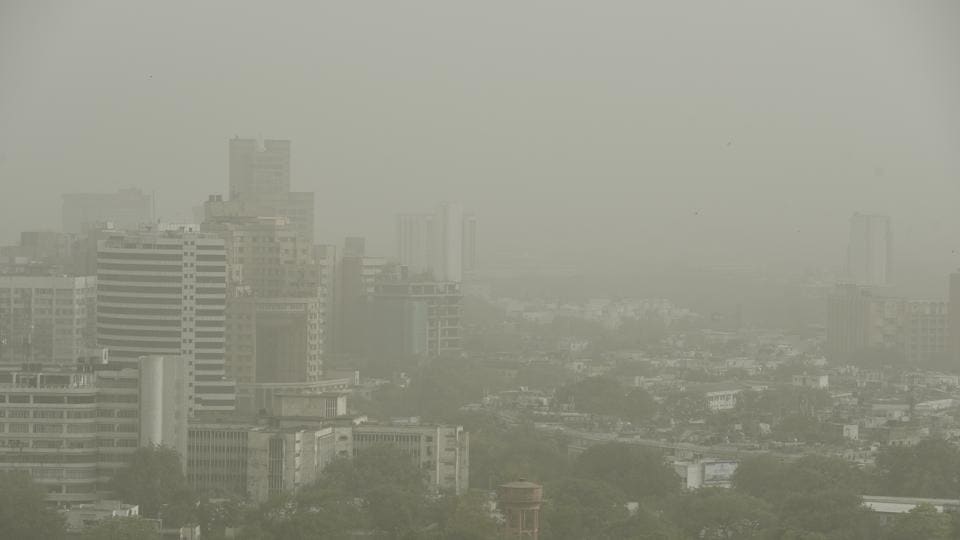
As the climate gets warmer and frequency of rains reduces, such spurts in coarse particles making breathing difficult will become a new normal, unless governments wake up to the alarm.
The latest assessment report of the Intergovernmental Panel on Climate Change (IPCC) says that the planet can bear only up to a 1.5 to 2 degrees Celsius increase in temperature from pre-industrial era levels.
The world had already warmed by 0.9 degrees Celsius till 2015 and at the present pace of emissions, climate scientists say, the IPCC mark will get breached latest by 2050, if not earlier.
The Indian Institute of Tropical Meteorology (IITM), in series of papers, said that both the periodicity and duration of dry spells in the country were rising as total rainfall events in a year had fallen even though the average rainfall in a year has not changed much, a direct consequence of climate change.
The annual average rainfall has remained the same because the frequency of heavy downpours (for example, the June 2013 flash floods in Uttarakhand) has increased in the past two decades.
During dry spells, the earth gets heated up and moisture in the atmosphere dips, creating depressions that pull winds from the oceans. As there is less rain, and green barriers in and around cities have been destroyed by urbanisation, the winds lift dust and local emissions, causing a spurt in air pollution.
Such events have been higher in 2018 — a year of freaky weather that witnessed three killer thunderstorms in May before this dust-laden westerly — because the average rainfall since November 2017 has been about 60% below normal.
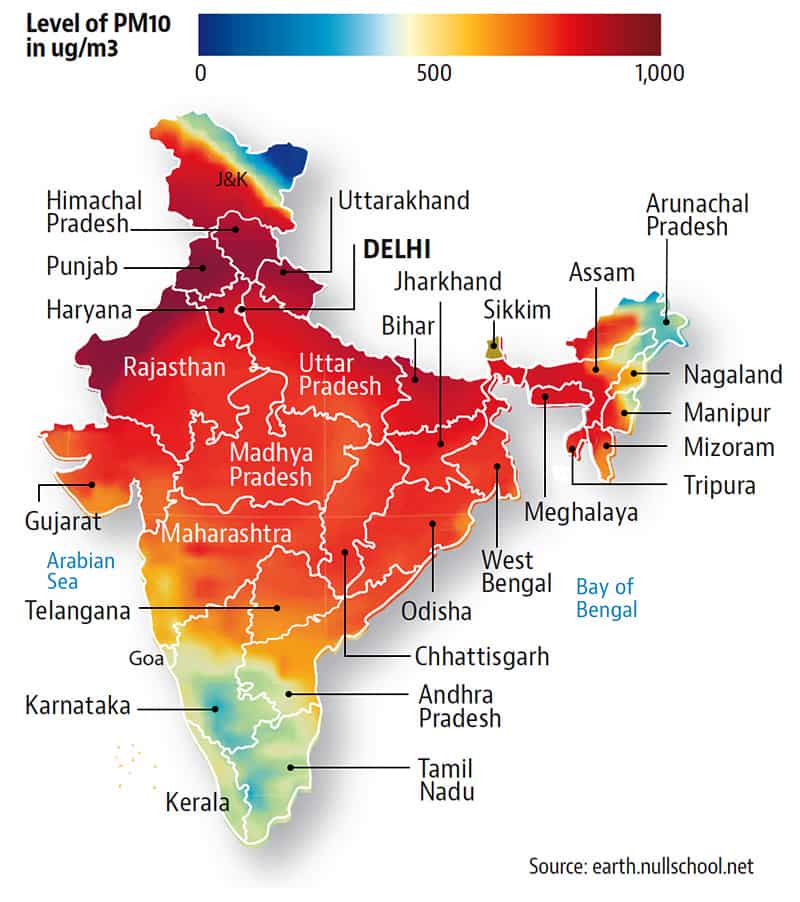
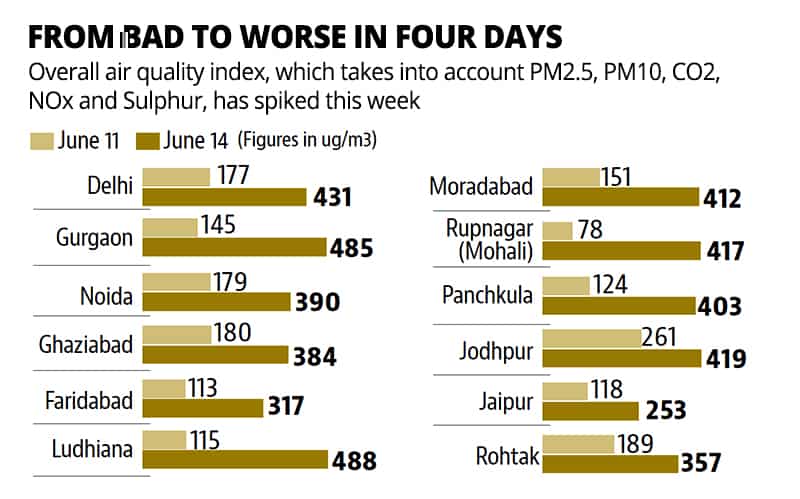
But the impact could have been substantially reduced had governments — the states and Centre — made air pollution mitigation a round-the-clock exercise, and not restricted it to winter months, when pollution levels are high. As a result, most of north India is covered under a thick blanket of dust haze with air pollution worse than in the winter months.
On Thursday, the peak particulate matter pollution around Delhi University and Mathura Road crossed 1,400 micro grams in a cubic metre of air, close to 20 times the Indian safety standard.
Even in places such as Jodhpur in Rajasthan and Panchkula in Haryana, the PM levels were close to 1,000. And this has remained constant for the past 48 hours.
Blaming only weather conditions would be a colossal mistake. It is a man-made catastrophe that impacts health of one and all, as half of the air pollution spurt is caused by local dust in the absence of proper roadside landscaping and emissions from industry and vehicles.
In the coming years, we can prevent such events by ensuring that every city implements the Centre’s dust management plan, there are restrictions on registration of new fuel-guzzling vehicles, and green dust barriers are developed around cities.


