
 E-Paper



Grap curbs stepped up as AQI touches ‘severe’ in Delhi
The national capital’s AQI hit 400 at noon on Saturday and picked up to 402 at 1pm, before dipping to 397 in the 4pm bulletin

 Prefer HTon Google


Delhi’s pollution levels briefly breached the “severe” level on the air quality index (AQI) on Saturday afternoon for the first time since January on the back of unbridled farm fires in upwind states, prompting authorities to enforce the third stage of the Graded Response Action Plan (Grap), which brings with it a ban on construction and demolition across the National Capital Region (NCR), among a raft of other curbs.
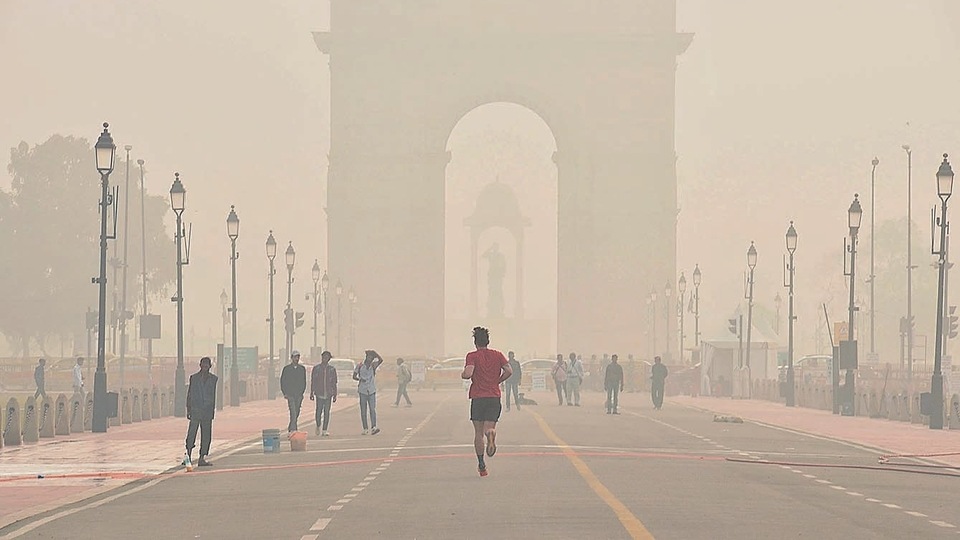
The national capital’s AQI hit 400 at noon on Saturday and picked up to 402 at 1pm, before dipping to 397 in the 4pm bulletin, showed the Central Pollution Control Board’s (CPCB) data, a spike in pollution levels that was a direct consequence of winds bringing in smoke from paddy stubble being burnt in Punjab and Haryana, said central government officials.
Data showed that smoke from stubble fires was responsible for 21% of Delhi’s PM2.5 (ultrafine particulate matter smaller than a 2.5 micrometres in diameter) levels on Saturday, triple the 7% contribution just a day ago.
While the Delhi government on Saturday issued a statement saying it was implementing all measures to reduce the pollution levels in the region, the Punjab government said it provided machinery for handling of paddy straw to motivate farmers against burning the stubble. Experts, however, said not enough was being done on the ground to check stubble burning.
Pollution levels are unlikely to dip over the next two days, warned officials of the India Meteorological Department (IMD).
Saturday’s AQI was a sharp increase from 357 on Friday, 354 on Thursday and 271 on Wednesday, with calm winds at the local level and dipping temperatures in Delhi exacerbating the air emergency wrought by stubble fires.
According to CPCB, an AQI between 201 and 300 is classified as “poor”, 301 and 400 “very poor”, and one over 400 is “severe” — the worst band on the scale, and levels at which even healthy individuals are at risk of severe respiratory illnesses.
At least 19 monitoring stations had readings in the deep red at 5pm on Saturday, with Anand Vihar in east Delhi the worst, at 452. Wazirpur was a close second, with a reading of 435.
“There has been an alarming increase in stubble burning this year over Punjab,” said an official of the Union environment ministry, arguing that the state government was not doing enough to curb farm fires.
“Between September 15 and October 28 this year, 10,214 farm fires were reported in Punjab, compared to 7,648 for the same period in 2021,” said the official, asking not to be named.
However, data from authorities in Punjab was even more chastening, with the state recording over 12,000 farm fires over the past 45 days alone, many times higher than any other state where agriculture workers burn paddy stubble. For instance, in this time, Haryana logged 1,813 farm fires, Uttar Pradesh recorded 705, Madhya Pradesh saw 599 and Delhi logged just five.
Punjab agriculture minister Kuldeep Singh Dhaliwal, meanwhile, said that state government has provided machinery for in situ and ex situ handling of paddy straw, and is motivating farmers to shun the practice of stubble burning. “Though stubble fires are witnessing an uptick these days but the overall area under farm fires will reduce by 15-20% by the end of the season this year,” he said.
As pollution levels soared on Saturday morning and afternoon, officials of the Commission for Air Quality Management (CAQM) convened an urgent meeting and imposed Stage 3 of Grap, a system which puts in place a series of pre-emptive steps aimed at preventing a pollution spike. Measures under this stage can be imposed when forecasts show that the AQI is likely to cross, or touch, the 401 mark.
Grap prescribes a list of curbs when air pollution levels in Delhi hit certain pre-set triggers. The restrictions get stricter as AQI worsens. The updated plan, released by CAQM this July, now takes into account AQI, and not just PM2.5 and PM10 levels as triggers for the curbs, as was the case with the earlier iteration.
The first set of measures come into play when the AQI hits the ‘poor’ zone (from 201 to 300). Stage 2 is imposed when it is “very poor” (between 301 and 400), Stage 3 when it is “severe” (between 401 and 450), and Stage 4 when AQI is in “severe plus” (above 450).
The third stage of the plan bans constructions and demolitions (except for projects of national importance, ISBT, railways and Metro work, sanitation projects), and empowers state governments to impose restrictions on BS-III petrol and BS-IV diesel light motor vehicles, if required. It also mandates the regulation of operations of industries not running on PNG, biomass, or other clean fuels. Brick kilns, hot mix plants and stone crushers not operating on clean fuels are also to be shut, and mining and other linked activities are now banned in the NCR, according to the measures.
“The Commission, while comprehensively reviewing the overall air quality parameters during the meeting noted that due to unfavourable meteorological conditions with slower wind speed and sudden spike in the farm fire incidents, it is considered necessary to implement Stage III of GRAP with immediate effect in the entire NCR,” the CAQM said in an order.
To be sure, these measures stand in conjunction with earlier curbs, such as a ban on the use of diesel generators (except for essential services, such as at hospitals or railway stations) and restrictions on the use of coal or firewood in hotels and restaurants.
In a statement issued on Saturday, the Delhi government said that it was making all efforts to reduce the city’s rising pollution levels. “The GRAP System has been implemented by the Delhi Government, and an anti-dust campaign is being carried out. Bio decomposer is being sprayed on stubble to cope with it, and strict steps are being made to prevent biomass waste,” the statement said.
IMD scientist RK Jenamani said the air is unlikely to get cleaner over the next few days, with pollutants likely to stay settled, thanks to slow winds.
“Calm conditions are prevailing, due to which pollutants are not getting dispersed. Between 12pm-4pm, the wind picked up some speed. For the remaining part, the conditions were calm. The air quality will continue to remain ’very poor’ and we will have to see how much further it deteriorates. We are also seeing shallow fog in the morning hours,” said Jenamani.
According to the Early Air Quality Warning System for Delhi-NCR, pollution levels are likely to remain between the “very poor” and “severe” categories till Sunday and may get worse from Monday.
“The air quality is likely to deteriorate and remain in the ‘severe’ category from Monday till Tuesday,” said the forecast. After that, the AQI is likely to remain largely in the “very poor” to “severe” category for the next six days.
On Saturday, the Union ministry of earth science’s System of Air Quality and Weather Forecasting and Research (Safar), also said the AQI is expected to deteriorate and remain within the ‘upper end of very poor’ or ‘lower end of severe’ till Tuesday, as “stubble fires were increasing significantly, with favourable strong upper-level wind flow”.
Low temperatures in Delhi helped pollutants stick around in the city’s air.
The Safdarjung observatory, Delhi’s base weather station, recorded a maximum temperature of 31.8°C on Saturday, a degree above normal. The minimum, meanwhile, was 15.6°C, around normal for this time of year.


