
 E-Paper



Growth and inclusion must go hand in hand, says PM Modi
Growth cannot be achieved without inclusion and only growth can ensure real inclusion, Prime Minister Narendra Modi said on Friday as he underlined his government’s record of efficient welfare delivery to help underprivileged communities, and thereby stimulate the economy.


Growth cannot be achieved without inclusion and only growth can ensure real inclusion, Prime Minister Narendra Modi said on Friday as he underlined his government’s record of efficient welfare delivery to help underprivileged communities, and thereby stimulate the economy.
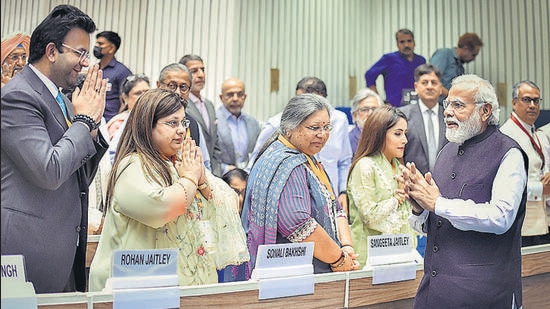
Modi was speaking at the first annual Arun Jaitley Memorial Lecture, organised by the department of economic affairs, ministry of finance in recognition of the former Union minister’s invaluable contribution to the nation. The lecture was delivered by Tharman Shanmugaratnam, senior minister, government of Singapore.
“Growth with inclusivity, inclusivity with growth is the fundamental policy of our government — sabka saath, sabka vikas. Over the last eight years, the speed and scale at which India worked on inclusion is unmatched anywhere in the world,” he said at Vigyan Bhavan.
Modi remembered Jaitley, a senior Bharatiya Janata Party leader and former Union finance minister, as a close friend who was a masterful orator and a personality worth remembering.
“His one liners would reverberate in the air. His friendly nature was legendary. People could be from different worlds but all still be his friend. Everyone today feels his loss,” Modi said, offering tributes to the late leader.
During his lecture, Modi touched on the welfare delivery mechanisms created by his government, especially cooking gas, housing, toilets and water. He talked about his administration’s push towards better health care facilities, financial inclusion of the poor, medical and technical education, space ecosystem and ending redundant laws.
“I decided when I was elected that even if I didn’t create any new laws, I would end redundant laws. My government was able to strike 1,500 redundant laws off the books,” he said.
“We gave free cooking gas cylinders to 90 million women. This is more than the population of South Africa, Australia, Singapore and New Zealand. We built 100 million toilets, more than twice South Korea’s population. We opened 450 million jan dhan accounts, and built 30 million pucca houses,” he said.
Shanmugaratnam spoke about India’s growing importance in the global economy and appreciated the Modi government’s focus on providing toilets, electricity connection and drinking water supply to millions of people in what he described as “correcting legacy of neglect”.
“But, India is not going to be able to achieve its economic or social ambitions in the next 25 years without substantially higher growth ambition. India must grow by at least 8 to 10% over the next 25 years, 8 to 10% a year,” he said.
The initial remarks were made by Union finance minister Nirmala Sitharaman, who spoke on the impact left by Jaitley, pointing out that it was during his tenure that the date of presenting the Union Budget was advanced to February 1, the separate Railway Budget was abolished and two key reforms – the Goods and Services Tax and the Bankruptcy Code – were brought in.
The event was closed by a panel discussion between NK Singh, chairman of the 15th Finance Commission, economist Arvind Panagariya, and Mathias Cormann, secretary-general of OECD.
Moderating the discussion on the theme ‘Growth through Inclusivity, Inclusivity through Growth’, Singh said that India converted “great challenge of the pandemic into a historic opportunity” to take forward its entire reform strategy.
In his address, Modi also paid tribute to former Japanese prime minister, Shinzo Abe, who was assassinated on Friday during a campaign speech.
The Prime Minister recounted several of the government’s initiatives to speak of the access to poor that the government has worked on. Among these was the Ayushman Bharat scheme, which he said not only allowed over 35 million people to access free treatment in four years, but with such a focus on inclusion also came increased demand and better growth in the sector.
Modi stressed on the importance of the aspirational districts programme in elevating the standards of living of people in far-flung regions and said that it, along with efforts like learning in mother tongue (promoted by the new education policy) and the Udaan scheme for regional connectivity were helping the cause of inclusion. The Har Ghar Jal project, he added, too worked in this direction by providing 60 million new tap water connections.
He spoke about the boost received by the aviation sector due to the government’s efforts to expand access to flying and building infrastructure in smaller towns and outside metropolises. “Even those with Hawai chappals can now sit in a flight,” he said.
He criticised the approach of previous government who initiated major reforms only when it became compulsory. “We do not consider reform as necessary evil, but a win-win choice, where lies the national interest, the public interest,” he said.
“Our policymaking is based on the pulse of the people. We listen to people, understand their needs and aspirations. Hence, we have not allowed policies to be influenced by populist impulses,” he said.
He also spoke about India’s pandemic efforts were unique. “Private players of our country have done a very good job. But behind them stood the full force of the government in the form of a partner in progress,” he said, citing it as an example of how the approach of “minimum government, maximum governance” was yielding good results.


