E-Paper



Heat, electricity usage shatter April records
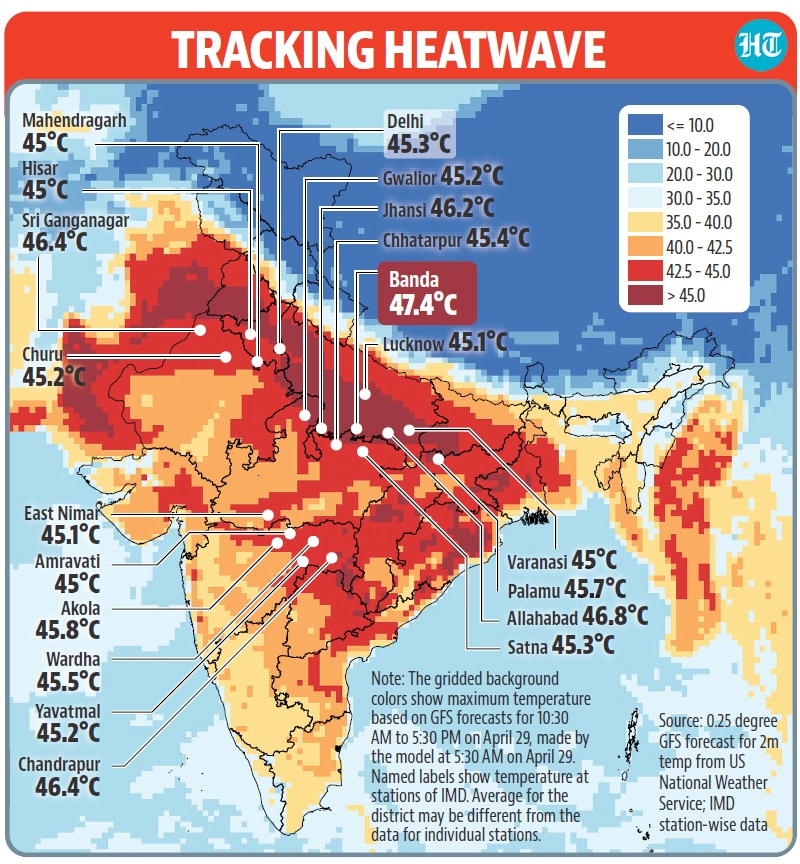
Uttar Pradesh's Banda, with a maximum temperature of 47.4°C, was the hottest in the country on Friday.

 Prefer HTon Google


A relentless heatwave continued to sweep large swathes of India, with the maximum temperature in Delhi soaring, for the second day running, to 43.5 degrees Celsius (°C) – the highest recorded in the month of April since 2010. With a maximum temperature of 47.4°C, the city of Banda in Uttar Pradesh was the hottest in the country on Friday.
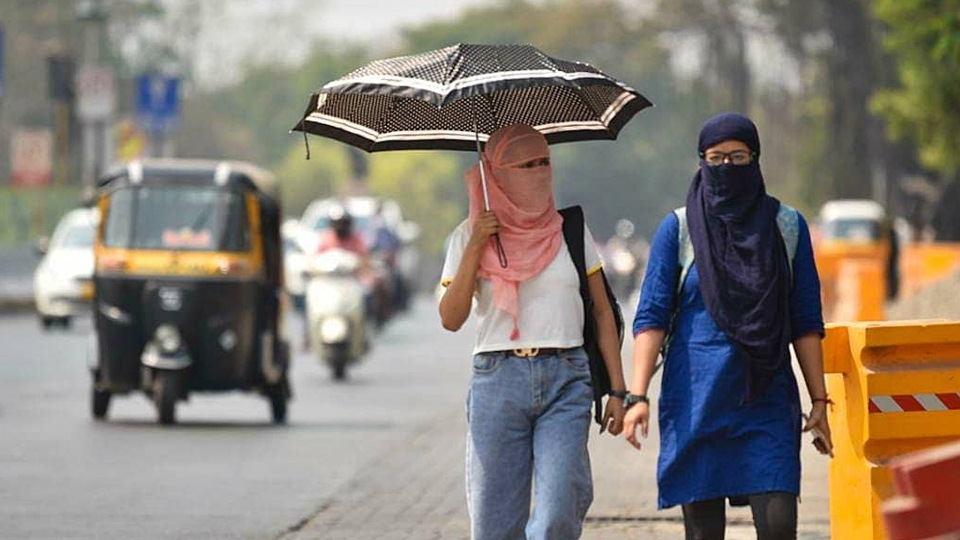
This near-nationwide heatwave continued to break other records as well: India on Friday registered yet another all-time high peak power demand of 207.111 GW – the third time in four days this record has been shattered. With a demand of 201.066 GW, the country had set a new record on Tuesday, which was broken just two days later with Thursday’s demand of 204.653 GW – a day when as much as 10,778MW of peak demand could not be met due to a continuing coal shortage limiting electricity generation across the country.
IMD has issued an orange warning for all of northwest India, central India and Jharkhand for Saturday. A yellow warning, meanwhile, is in place for nearly the entire country barring a few pockets till May 3 in view of extreme heat. An orange alert is a warning to administrators to be prepared for imminent heat waves; a yellow alert is to warn them to be watchful.
On Friday, at least 28 weather stations in the country recorded temperatures exceeding 45°C, according to IMD data, as the month’s soaring heat continued to set pace to be one of the hottest April recorded in recent years, especially in the northwestern states.
According to IMD’s gridded dataset, four states – Gujarat, Rajasthan, Punjab, and Madhya Pradesh – are seeing the hottest April 1-April 28 period this year since 1951. Meanwhile, Haryana, Delhi, and Uttar Pradesh are seeing their second hottest April 1-April 28 period since 1951. More states joined the record books for April 28 in particular, gridded data for which became available on April 29. The day was the hottest this year since 1951 in seven states: Punjab, Haryana, Delhi, Madhya Pradesh, Uttar Pradesh, Maharashtra, and Mizoram. It was the third hottest in four states – Gujarat, Rajasthan, Odisha, and Tripura – and fifth hottest in Jharkhand and Manipur.
Temperatures soared not only in the desert regions of Rajasthan, but also states such as Uttar Pradesh, Madhya Pradesh, Gujarat, and Haryana.While Banda was the hottest city in the country on Friday, it was followed by Prayagraj (also in UP) with 46.8°C, and Maharashtra’s Chandrapur and Rajasthan’s Sri Ganganagar, both of which recorded a maximum temperature of 46.4°C.
Temperatures exceeded 45°C in several major cities across the country, including MP’s Jhansi (46.2°C) Khajuraho (45.4°C) and Gwalior (45.2°C) , Maharashtra’s Akola (45.8°C), Jharkhand’s Daltonganj (45.7°C),UP’s Fursatganj (45.4°C), and Rajasthan’s Churu (45.2°C).
While Delhi logged 43.5°C, several parts within the Capital as well as its satellite towns reported numbers even eclipsing that – the mercury soared to 46.4°C in east Delhi’s Sports Complex, 45.9°C in Pitampura, and 45.9° in Gurugram.
Experts said the absence of rain through April in the northern regions of the country has only exacerbated the already-intense heat.
“From March 1 to April 20, large parts of north India are dry. Moreover, due to an ‘anti-cyclone’ over the Arabian Sea, winds are moving in the clockwise direction creating an area of subsidence where hot, westerly winds are blowing. There are clear skies so there is abundant radiation. This has led to an unusually intense heatwave spell over large parts of the country. This dry, hot weather is likely to impact both quality and yield of wheat in many parts of north India,” said Mahesh Palawat, vice president, climate change and meteorology, Skymet Weather.
During an anti-cyclone, air pressure is high on the surface, causing the air above it to come down. This air warms up as it comes down on account of high pressure. The outward hot winds caused by this are ranging as far as Odisha and West Bengal. But early next week, the western disturbance will likely put an end to this anti-cyclone, pushing moisture-laden winds in from both the Arabian Sea and the Bay of Bengal, a phenomenon that will likely reduce temperatures through most of the plains.
“We are expecting a marginal increase in temperature today and tomorrow over northwest India. They could be higher than maximum temperatures recorded on Thursday. From May 1 we can expect a dip in temperatures over east India. Models are showing good pre-monsoon activity over east India in the coming days. There will be thunderstorm activity over parts of northwest India especially the western Himalayas around May 2 to 4. Maximum temperatures could back to normal temporarily after that,” added Palawat.
With hundreds of millions of people now facing hot and dry conditions, several states have been forced to announce measures such as early summer vacations in schools to shield children from the intense heat. Chhattisgarh, Odisha, Madhya Pradesh and West Bengal are all among states that have been forced to shut schools in varying degrees due to the heat.
Health experts have warned that the ongoing heatwave poses extreme dangers for vulnerable people including infants, the elderly, and people with chronic diseases. There is also an increased likelihood of heat illness symptoms in people who are either exposed to sun for a prolonged period or doing heavy work.
“In some regions experiencing heatwaves, it is not just about the high temperatures but the accompanying rise in humidity too that matters. Sustained heat waves can be dangerous, especially when combined with high levels of humidity. If the air has high levels of humidity along with the heat, the body becomes unable to regulate the internal temperature. This can result in a heat-stroke leading to multiple organ failure and deaths,” said Roxy Mathew Koll, a climate scientist at the Indian Institute of Tropical Meteorology.