
 E-Paper



Plunder of historic Madrasa | Hidden closets, stolen books: Crime & politics in Rampur
At the core of the probe is a madrasa established by the first nawab of Rampur, Faizullah Khan, in 1774.


At first glance, the less-than-a-minute clip seems innocuous. A group of men gathered in a cramped room, currency worth a few hundred rupees strewn on a mossy green bedspread as a game of cards proceeds. Such clips of friends gambling small sums of money is common in Uttar Pradesh. On the rare occasion when it attracts police attention, criminal charges are minor – a fine of ₹50 or a maximum jail term of one month.
But when this clip went viral on July 16, it created a storm. In Rampur, people immediately recognised two men – Salim and Anwar, childhood friends, classmates, strongmen, and aides of Abdullah Azam Khan, the local legislator and the son of Rampur’s most powerful politician, Azam Khan. By evening, police registered a case under the Public Gambling Act. By then, the men went underground.
Then, police caught a break. On September 16, Samajwadi Party (SP) chief Akhilesh Yadav posted an image of him meeting Azam Khan in Noida. In the background, police informers noticed, were two men who resembled characters from the video. Two days later, they were picked up from Rampur. Using their statements, police found thousands of invaluable but rotting books stowed away in secret compartments, handwritten manuscripts and antique almirahs tumbling out of sealed walls, and a large road-cleaning machine dug out of the earth – all inside the campus of a university established and helmed by Azam Khan. Using police accounts, case papers and narratives from residents, HT pieced together a story allegedly of plunder of a 248-year-old institution, theft of invaluable literature, and political manoeuvrings.
PAGES OF HISTORY
At the core of the probe is a madrasa established by the first nawab of Rampur, Faizullah Khan, in 1774. Education was imparted here in Urdu, Persian, and Arabic,” said Zubaid Khan, Madrasa Alia’s principal. For decades, it operated out of a two-storey building in the heart of the town. Its library, particularly, drew scholars from far and wide. “There were 9,333 books stacked in 50 almirahs,” said Zubaid. This included handwritten manuscripts in Urdu, Persian and Sanskrit, books of shayari, the Quran and Ramayana in Persian, and some editions dating back to the 16th century.
But the last few decades saw a decline. The madrasa lost the ability to award graduate degrees. Faculty appointments stopped in 2010, and the student strength dwindled to just 100 by 2016. But those invested in the institute remained hopeful. “When Rajnath Singh visited the madrasa as CM in 2001, he promised to revive the institute and granted ₹1.76 crore,” said Mohammad Ur-Rahman, a clerk who has worked at the institute since 1997. But a rude shock awaited the staff when they reported for duty on September 10, 2016. “The lock on the gate was changed. Local shopkeepers told us that Azam Khan’s men arrived in a car to change the lock,” said Ur-Rahman.
“It was the SP government at that time. Azam Khan was extremely powerful. I approached my senior officials for guidance. They advised me to stay quiet,” Zubaid said. Among officials he approached was Rajender Pal, the district inspector of schools at that time. Pal, now retired, said the madrasa’s campus was handed over to the Maulana Mohammad Ali Jauhar Trust started by Azam Khan in 2016. The public works department gave the madrasa campus for lease at a rate of ₹30 per year for 30 years to the trust, said Zubaid. “We were told to accommodate the madrasa and its students elsewhere,” added Pal.
The trust set up the Mohammad Ali Jauhar University on a sprawling 300-acre campus in 2006. Azam Khan was named the chancellor and his son the pro vice-chancellor.
Today, Madrasa Alia operates out of two rooms in a rundown section of the Government Oriental College in Rampur. Only 38 students are enrolled, accommodated on 10 benches laid out inside a tiny room and the corridor outside.
Soon after the Bharatiya Janata Party (BJP) won a second term at the Centre in 2019 – it had already replaced the SP government in the state – Zubaid said he started wondering if the madrasa could get back some of its priceless books. He wrote to the district authorities and on June 15 that year, a case of trespassing and theft was registered. Based on Zubaid’s complaint, that very day, the police raided the Mumtaz Central Library of Jauhar University. “Some 2,550 books bearing stamps of Madrasa Alia were recovered,” said Sansar Singh, the additional superintendent of police (ASP) of Rampur. It appeared the matter was at an end.
TWIST IN THE TALE
A day after Salim and Anwar were arrested, local BJP leader Baqar Ali Khan filed a first information report (FIR) of theft. Khan accused Azam Khan and his son of diverting road-cleaning machines from the local municipality to Jauhar University. “During the Kumbh Mela in 2013, Azam Khan was UP’s urban development minister, and in charge of the mela. At his instance, five-six cleaning machines were purchased. After the mela, the machines were given to the municipality, but Azam Khan got some machines diverted to his university,” said Sansar Singh.
Hours after Baqar’s complaint, police landed at the Jauhar campus with earthmovers. They were taken there by Salim and Anwar. About 70 metres off the campus road, in a thicket of grass ringed by trees, the cranes began digging out mud. About five feet deep and 10 feet long – the pit yielded a large and yellow cleaning machine with a damaged top. It was covered by a thick, brown tarpaulin sheet. “We believe Azam Khan expected to reuse the machine someday when he would return to power,” Sansar Singh said.
Police arrested five people in connection with the crime. Also named was then chairman of Rampur municipal corporation Azhar Khan. Azhar’s wife, Fathima Zabi – who is the current chairman – defended her husband. “Five different machines were purchased by the municipality in 2013-14 under ‘Naya Savera’ scheme. None of those machines are missing. The police could have planted some other machine in the university campus,” Zabi said.
Ashok Kumar, Rampur’s superintendent of police, said Salim and Anwar were involved in dumping the machine. The two ran a construction company and supplied materials in the university, the SP said.
HT made multiple unsuccessful attempts to reach Azam Khan and his son over phone calls, text messages, and physical visits to their residence three times over two days. The SP denied the charges, and called it a political conspiracy. “Almost everyday fake cases are being filed against Azam Khan…conspiracies against him began soon after the BJP government was formed and we suspect that his university too will be demolished,” said the party in a statement.
Families of the arrested men also raised doubts. “The tyres of the machine remained inflated all these years. The machine’s paint did not fade. My son has committed no crime,” said Salim’s father, Mehboob.
LOST TREASURE
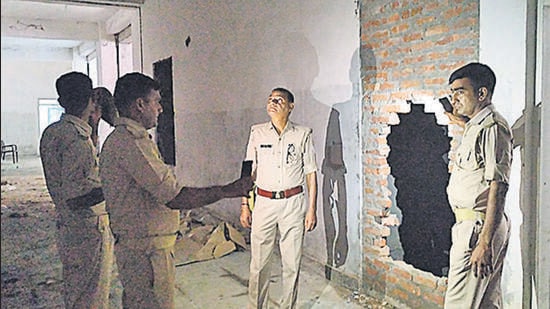
On September 20, Zubaid received a call from the police asking him to attend a search for stolen books in the university campus. Salim and Anwar had told the police that more books were stowed away on campus. The site of the second raid was inside a half-finished three-storey building with stone walls, tall pillars, and a large courtyard in the middle – a proposed medical college.
After an hour-long operation to tear down walls, police found books packed in large sacks and dumped in an under-construction portion that was to serve as a common toilet. The area was then sealed with bricks and cement to make the space inaccessible. “The books were soaking in the collected rainwater. Most of the books were destroyed, and resembled raddi. It was a painful sight,” said Jogendra Singh, a constable who witnessed the raid.
Police counted 387 intact books, five Qurans, one Ramayana, and 4,000-5,000 putrefied and soaked books among the recoveries. The next day, more excavation in the same building unearthed 41 almirahs. They were found dumped below the staircase in another part of the same floor, and the area sealed with bricks and cement.
The university now bears a deserted look. Many of the 1,100 students have left campus, and teachers have suspended classes. Vice-chancellor Mohammad Arif said he couldn’t speak on the subject as he only took over three months ago. “We are not obstructing the legal action,” Arif said. But the deputy registrar, SN Salam, questioned the police raids. “From the start of the pandemic, the medical building has been serving as the Covid care centre. It has been under the chief medical officer since then. The books could well have been planted in the building that was inaccessible to us,” said Salam.
Police now say the investigation will continue. Police have arrested seven people. Azam Khan and his son face charges of criminal breach of trust, criminal conspiracy and under the Damage to Property Act. Sansar Singh said they may even be arrested.
Zabi called the police action an attempt to implicate her ahead of the municipality elections in a few months; she is accused of ordering her staff to burn the documents pertaining to the purchase and upkeep of cleaning machines. “Some of the burnt files are from the 1970s and 1980s, when we had nothing to do with the municipality,” she said.
But Madrasa Alia fears it may have little to celebrate. The books recovered in 2019 remain in police custody, and those uncovered this month are far too many to be accommodated in the two-room campus. “We have requested the Government Oriental College to store them somewhere until our fate changes,” said Zubaid.
For now, the madrasa is trying to survive.


