E-Paper



Umergam records third highest 24-hr rain ever recorded in India
Umergam recorded an extreme rainfall event, receiving 1,064mm of rainfall in the 24 hours till 8:30am on July 23

 Prefer HTon Google


New Delhi: Umergam in Gujarat’s Valsad district recorded an extreme rainfall event, receiving 1,064mm of rainfall in the 24 hours till 8:30am on July 23 — the third highest 24-hour rainfall ever in the country — the India Meteorological Department (IMD) said on Wednesday.
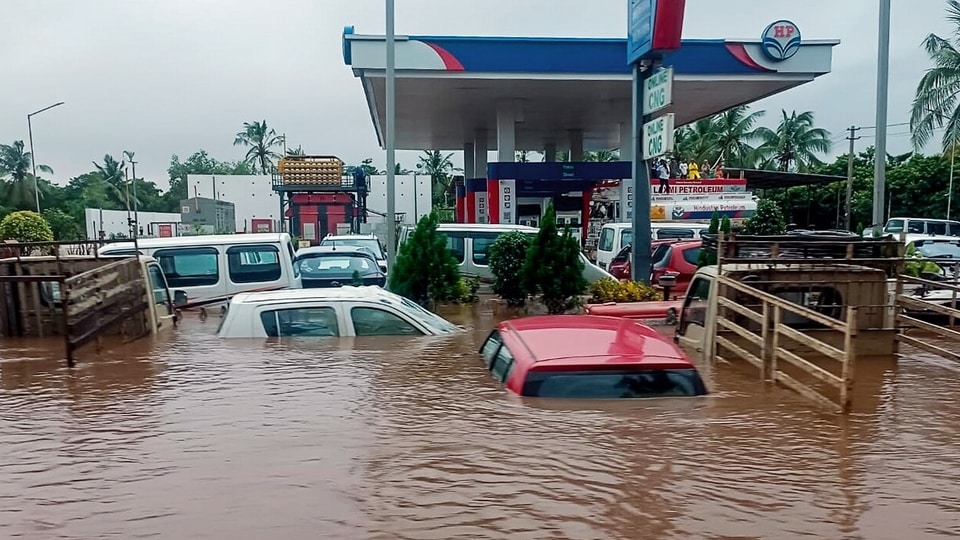
IMD attributed this to a combination of the weather systems -- the monsoon trough, a large scale cyclonic circulation and a western disturbance – all feeding moisture to southern Gujarat.
The highest ever daily rainfall spell was 1,563.3mm recorded on June 16, 1995 in Sohra (widely known as Cherrapunji), while the second highest was at Aminidivi (Lakshadweep), where 1,168.5mm was logged on May 6, 2004. Forecasts show active monsoon conditions are likely to persist over northwest, central and the adjoining north peninsular India, east and northeast India during the next three to four days, it said.
In its bulletin, the IMD said an upper air large-scale cyclonic circulation – present in the lower and middle tropospheric levels was over central MP on July 22, shifting west towards southeast Rajasthan. At the same time, the monsoon trough was south of its normal location, passing through Bikaner, Banasthali Vidyapeeth, Guna, Damoh, Pendra Road, Medinipur and thence southeastwards towards the northeast Bay of Bengal and tilting southward with height. “A Western Disturbance also lay as an upper air cyclonic circulation over Jammu and neighbourhood and interacted with the monsoonal circulation,” said the IMD, stating all of this impacted Gujarat.
Experts said with moisture to persist through these weather systems, this rainfall will now move northwards across northern Gujarat and into Rajasthan on Friday.
“Isolated heavy to very heavy rainfall with extremely heavy rainfall is likely at isolated places over Konkan and Goa; over Gujarat Region, southeast Rajasthan and Madhya Maharashtra,” the IMD said for the 24 hours till Friday. For Valsad, an orange alert is in place for Friday, with the IMD still forecasting heavy to very heavy rainfall in isolated pockets there. On Saturday, a yellow alert is in place, however, heavy rainfall may still occur in some pockets.
“The intensity will reduce on Friday, with this weather activity to move towards Rajasthan. On Late Wednesday and early Thursday, this was impacting south Gujarat,” said Mahesh Palawat, vice president at Skymet. He said this was down to an intense cyclonic circulation over southeast Rajasthan and adjoining Gujarat and MP, with a wind shear zone also existing there. “We also had strong moisture incursion from the Arabian sea, with constant moisture reaching around Valsad and other parts of south Gujarat,” he added.
The IMD has added that subdued rainfall is likely over south peninsular India over the next seven days.
The extreme rainfall has helped bring down India’s overall monsoon deficit to some extent. It stood at -17% – down from -24% on July 19.
IMD in its forecast for July has said below normal rainfall – 94% lower than the LPA is likely. Overall, the IMD has projected this year’s monsoon rainfall to be 90% of the LPA, down to the El Niño.