
 E-Paper



Hijab row to ‘40% commission’: The political faultlines in Karnataka ’22
Revision of textbooks of social sciences and language and protests over posters of Savarkar were among other political issues that took centre stage

 Prefer HTon Google


Karnataka witnessed a high-voltage political slugfest and communal tensions in 2022. The year began with a question of whether woman students can wear hijabs in educational institutions after a college barred six students from attending classes in coastal Karnataka. Echoes of the controversy were heard in other parts of the state, too.
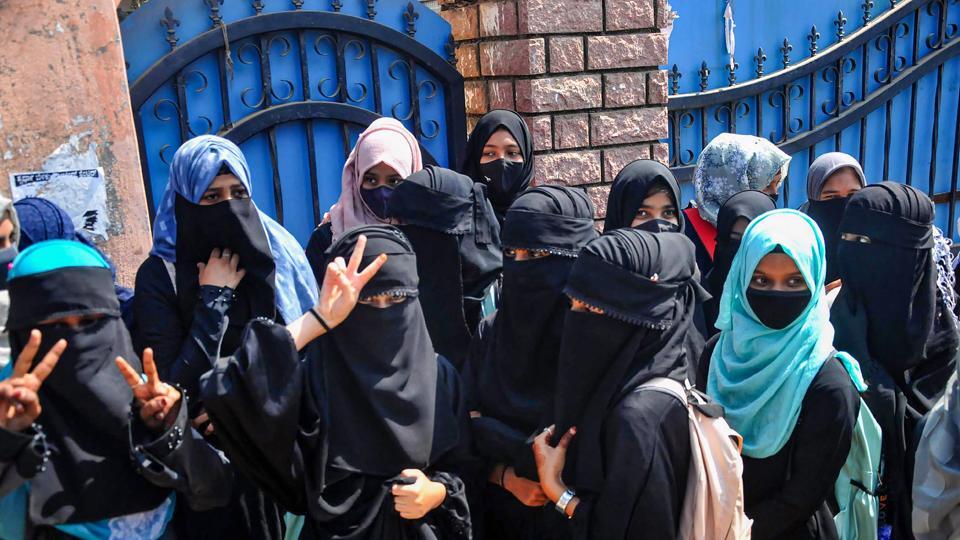
The tense situation amid the hijab row took a turn for the worse in February with the killing of a Bajrang Dal activist. In July, three murders took place in Dakshina Kannada district in a span of 10 days leading to communal conflict and political outrage.
The education sector in the state has also been in the thick of controversies. What started as a routine textbook revision evolved into strong “saffronisation” charges by writers and progressive organisations.
Meanwhile, protests erupted over posters of Vinayak Damodar Savarkar with the Congress criticising the Bharatiya Janata Party (BJP) for eulogising the Hindu ideologue. The Basavaraj Bommai-led government also struggled to find ground amid the corruption charges and allegations of a “40% commission government”.
Here is a recap of some of the biggest political developments of them all.
Hijab row
The year began with the hijab row that became a fierce debate in January. It started when six girl students at a government pre-university college in Udupi district protested in December 2021, after they were barred from attending classes for wearing headscarves. “We are being discriminated against and not being allowed inside the classroom since we began wearing the hijab,” the girls said in their complaint to the district commissioner.
Education Minister BC Nagesh said students were instigated to protest.
After the state government passed an order barring students from wearing headscarves, the students challenged the order in the high court on January 31. The court upheld the government order on March 15, ruling that hijab does not constitute “essential religious practice” in Islam. It then made its way to the Supreme Court, which delivered a split verdict and referred the case to the chief justice of India.
Pro-Hindu activists’ murder
In February, a 6-year-old Bajrang Dal activist, Harsha, was hacked to death in Shivamogga, sparking outrage and leading to violence in the district.
The murder of BJP youth wing worker Praveen Nettaru in Dakshina Kannada sparked outrage with instances of stone-pelting and lathicharge as well as an attack on BJP state unit president Nalin Kumar Kateel’s vehicle and mass resignations by party workers.
Nettaru was killed in front of his broiler shop in Bellare by three-bike borne assailants when he was heading home. Two days later, 22-year-old Fazil was killed near a cloth shop in Surathkal. Just a few days earlier on July 19, Masood, an 18-year-old in Bellare, was also hacked to death allegedly for rearing a calf.
Textbook revision
In May, the revision committee headed by writer Rohith Chakrathirtha revised class 6-10 social science textbooks and class 1-10 Kannada language textbooks. It kicked up a row after reports emerged that chapters on freedom fighter Bhagat Singh, Mysuru ruler Tipu Sultan and Lingayat social reformer Basavanna, among others, were allegedly removed from the syllabus.
However, a speech by Rashtriya Swayamsevak Sangh founder Keshav Baliram Hedgewar made its way into the Class 10 revised Kannada textbook. The education minister said the textbook does not contain anything about Hedgewar or RSS but only his speech on what should be an inspiration to the youth.
Following the controversy, Bommai announced that the textbook committee will be disbanded.
40% commission row
In April, BJP leader KS Eshwarappa resigned as Karnataka Rural Development and Panchayat Raj Minister following allegations of his involvement in the suicide of a Belagavi-based civil contractor Santosh Patil. Patil accused the BJP leader of demanding 40% commission in public works.
Patil’s death was followed by several contractors coming forward to allege that the BJP demanded 40% commissions as bribes from state-hired contractors. The BJP said the allegations are politically motivated.
Savarkar poster controversy
In August, the BJP and the Congress blamed each other for violence over posters of Savarkar and Tipu Sultan in Shivamogga on Independence Day. Prem Singh was stabbed in the Gandhi Bazar area of Shivamogga after two groups clashed over installing a flex of Savarkar and 18th century ruler Tipu Sultan.
BJP MLA from Shivamogga, KS Eshwarappa kicked up a row saying, “If Hindu society rises, then such activities won’t survive.”
Meanwhile, Siddaramaiah was criticised for questioning why Savarkar’s photo was put up in a Muslim area.
The state assembly also saw protests by the opposition on Monday as the winter session was set to begin in Belagavi. Opposition leaders, including Siddaramaiah and DK Shivakumar, staged a demonstration against the Bommai government over the unveiling of a portrait of Savarkar.


