How 3 physicists froze time for a peek at electron dynamics
On their way to Nobel Prize, Pierre Agostini, Ferenc Krausz and Anne L’Huillier generated brief pulses of light, enabling the study of electrons in motion
New Delhi An analogy with hummingbirds, described by the Royal Swedish Academy of Sciences, gives a sense of the kind of work that won Pierre Agostini, Ferenc Krausz and Anne L’Huillier the Nobel Prize for Physics on Tuesday.
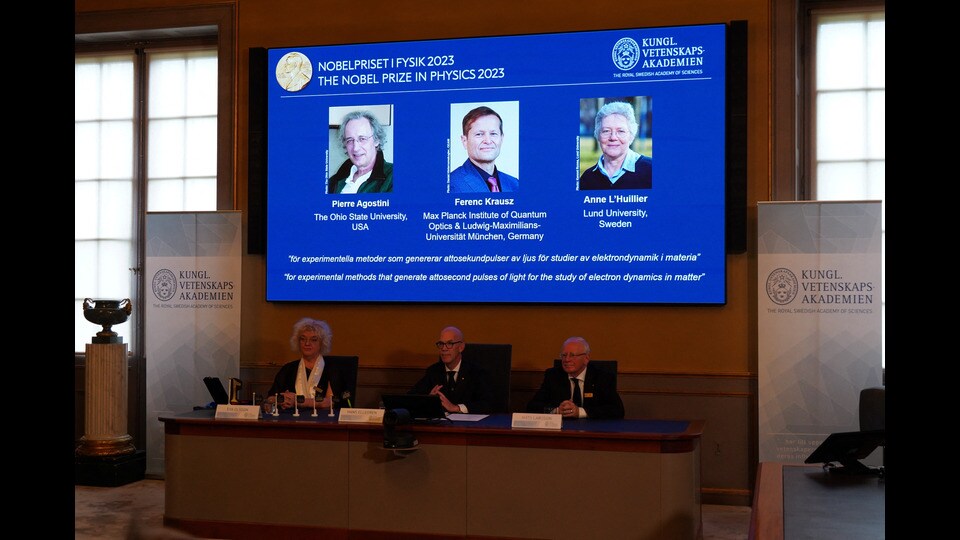
Scientists Pierre Agostini, Ferenc Krausz and Anne L'Huillier are announced as the winners of the 2023 Nobel Prize in Physics at a press conference in the Royal Swedish Academy of Sciences in Stockholm, Sweden, on Tuesday. (REUTERS)
A hummingbird beats its wings 80 times per second. Each wingbeat is too momentary for human perception; what the naked eye sees is a blurry movement. High-speed photography, however, makes it possible to capture such fleeting moments. For a hummingbird, the exposure time needs to be much shorter than a single wingbeat, or 1/80 of a second.
In nature, there are phenomena several times faster than a hummingbird’s wingbeats. For example, the movement of electrons. These superfast subatomic particles move at the scale of attoseconds, or a billionth of a billionth of a second. For context, if you take the duration of a heartbeat as one second and the age of the universe as a billion billion (1 quintillion) seconds, then there are as many attoseconds in the duration of a heartbeat as there are heartbeat durations across the age of the universe.
Could it be possible to capture a moment so fleeting? Agostini, Krausz and L’Huillier showed that it was. They created flashes of light at the scale of attoseconds, brief enough to enable taking snapshots of electron movement. This is attosecond physics; what the laureates’ experiments have generated are attosecond pulses of light.
Light and matter
How short can a pulse of light possibly be? The duration can be inferred from the wave nature of light. The period of a wave is the time it takes to complete one cycle: moving up to a crest, going down to a trough, and returning to its starting point. The shortest possible pulse of light can be taken to be the length of one cycle, which is extremely short, given that a light wave cycles 430,000 billion times per second.
The road to creating short pulses lies in combining a sufficient number of waves of the right sizes. This concept is in the domain of advanced physics, related to a phenomenon called “higher harmonic generation” that happens due to intense interaction between light and matter.
“Essentially, when many different wavelengths combine, you get peaks and dips, most of which cancel each other, but some line up to produce a highly intense pulse for a very short duration,” said Urbasi Sinha, professor of light and matter physics and the Raman Research Institute, Bengaluru.
This was eventually achieved by passing laser light through gas. “A gas is made of free atoms; that's the definition of a gas. If I want to examine the atoms in a gas, the laser is more or less the most ideal diagnostic tool. Particular kinds of lasers are very fast; that means that you can study very fast dynamic processes,” said Anders Kastberg, a physicist at Cote d’Azur University and a friend of L’Huillier.
When a laser is passed through a gas, the interaction between light and atoms generates “overtones”, or waves whose frequency is above a threshold, a concept familiar to music as well as electromagnetic waves.
It was with overtones that attosecond physics began.
How the science developed
In 1987, L’Huillier and her colleagues in France transmitted an infrared laser beam through a noble gas, producing overtones. Her research in this field, which continued in Sweden in the 1990s, laid the theoretical foundation for attosecond physics and future breakthroughs.
In 2001, Agostini and colleagues in France produced a series of consecutive light pulses. These were like a “train with carriages”, and the innovations they used allowed them to measure the duration of each pulse as 250 attoseconds.
At the same time, Krausz and his team in Austria successfully isolated a single pulse, lasting 650 attoseconds, and used it to study a process in which electrons were pulled away from their atoms.
In 2008, an electron was “filmed” for the first time. A study at Lund University co-led by L’Huillier captured videos of an electron riding a light wave just after it had been pulled away from an atom. Today, attosecond pulses make it possible to measure the time it takes for this to happen and the relation between this time and other atomic properties.
In short, it opens the door to a universe inside the atom which would not have been otherwise accessible.
Much of this is research for the sake of knowledge, but like all other forms of scientific knowledge, there can be practical implications too. Attosecond pulses can be used to push molecules, which emit a measurable signal, a kind of fingerprint that will tell scientists what molecule it. The possible applications of this include medical diagnostics, the Royal Swedish Society said in a statement.
Puzzles Editor Kabir Firaque is the author of the weekly column Problematics. A journalist for three decades, he also writes about science and mathematics.

 E-Paper