
 E-Paper



209 kg and a weight-loss programme: How 'obese' patient was prepped for surgery at AIIMS Delhi
Reflecting on his journey, the patient shared that he had gained weight over the last 4 to 5 years. He also stated that he was unable to perform daily tasks.

 Prefer HTon Google


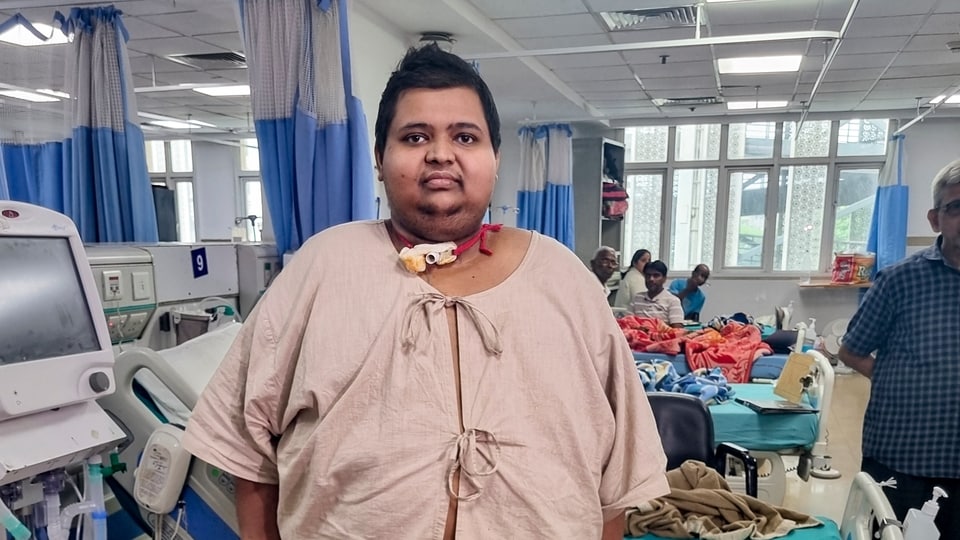
A team of doctors at the All India Institute of Medical Sciences (AIIMS), Delhi successfully performed a complex bariatric surgery on a 32-year-old man weighing 209 kg. The patient, who is a resident of Karawal Nagar, suffering from severe obesity, initially could not fit safely on a standard operating table, but doctors helped him lose weight for the procedure.
Also Read | Bathinda AIIMS to introduce robotic surgeries by year-end
Critical condition and weight gain
The patient, at his first consultation, weighed 181 kg with a Body Mass Index (BMI) of 64. However, after delaying his decision about surgery by roughly a month, his weight increased to 209 kg, his BMI to 74, and his abdominal girth expanded to 198 cm, news agency PTI reported.
According to Dr Naval Vikram, Professor in the Department of Medicine, the patient also suffered from hypertension, prediabetes, severe obstructive sleep apnea, depression, dyslipidemia, gastroesophageal reflux disease, and bilateral knee pain. His condition deteriorated ahead of surgery to the point where he could no longer maintain adequate oxygen saturation levels despite continuous positive airway pressure (CPAP) support.
Measures taken by doctors
The patient’s extreme body habitus and 198 cm abdominal girth prevented him from being positioned safely on a standard operating table.
Dr. Manjunath Maruti Pol, Professor in the Department of Surgery, explained that as the patient could not maintain blood oxygen levels even on CPAP, tracheostomy was performed.
"Consequently, tracheostomy was performed as the patient was not maintaining blood oxygen levels even on CPAP. Therefore, tracheostomy had to be performed on the patient's bed inside the operating theatre," Dr Manjunath said.
The doctors reportedly first helped the patient lose weight. After treatment, his weight reduced to 160 kg.
"This case demonstrates that pre-op multidisciplinary optimisation with VLCD and airway stabilisation can transform an otherwise inoperable patient with super-super obesity into a suitable candidate for bariatric surgery," Dr Manjunath said, as quoted by PTI.
A multidisciplinary team of doctors
The patient spent 32 days being dependent on CPAP through the tracheostomy.
During this time period, he was being treated by a multidisciplinary medical team comprising physiotherapists, intensivists, psychiatrists, nutritionists, bariatric surgeons, pulmonologists, and anaesthesiologists.
Dr. Richa Jaiswal, Senior Dietician at AIIMS, noted that the patient was put on:
- A 32-day very low-calorie diet (VLCD)
- Respiratory physiotherapy
- Infection control measures
- Nutritional counseling
Following the comprehensive treatment, the patient's weight decreased from 209 kg to 172 kg. Meanwhile, his abdominal girth went from 198 cm to 178 cm.
"Perhaps the most striking observation was the substantial reduction in abdominal girth (198 cm to 178 cm) after only 32 days of VLCD. This reduction was clinically more important than the absolute weight loss because it permitted safe positioning and improved respiratory mechanics," Dr. Manjunath observed.
Also Read | Don’t use AIIMS name and logo on social media, staff told
"Super-super obesity associated with prolonged CPAP dependence and tracheostomy should not be considered an absolute contraindication to bariatric surgery. A structured multidisciplinary optimisation programme incorporating prolonged VLCD, respiratory stabilisation, nutritional support, and meticulous operative planning can safely bridge such patients to definitive metabolic surgery," Dr Manjunath said.
Surgery and recovery
On July 24, the doctors performed a laparoscopic One Anastomosis Gastric Bypass (OAGB).
The surgery was completed in two hours and 10 minutes without major complications, the report stated.
Post-surgery, the patient's recovery progressed:
- The abdominal girth had further reduced to 155 cm.
- By the 13th post-operative day, the patient was breathing on his own, walking independently, and had resumed self-care activities
What did the patient say?
Reflecting on his journey, the patient shared that he had gained the weight over the last four to five years.
He also added that he spent most of his time sleeping, developed severe breathing problems, and continued to gain weight.
The patient also stated that he was unable to perform simple daily tasks and activities. He also said that he was on medication for depression and had a habit of overeating.
"Earlier, I could hardly walk and even simple activities were a struggle. Now I am able to walk again. The doctors have told me that with continued weight loss and follow-up, my weight could eventually come down to around 70 kg," the patient said.


