Long hours of work in the Intensive Care Unit (ICU) and erratic sleep rhythms have caused the under eyes of Dr Naman Jain, 35, to turn puffy. Other marks have faded. “While wearing the PPE suit, I had to tape the second mask which I wore above the N-95 mask under my eyes so that it would stay in place. While taking it off, the skin under my eyes would often tear,” says Dr Jain, of the critical care department at Fortis Hospital in New Delhi’s Vasant Kunj.
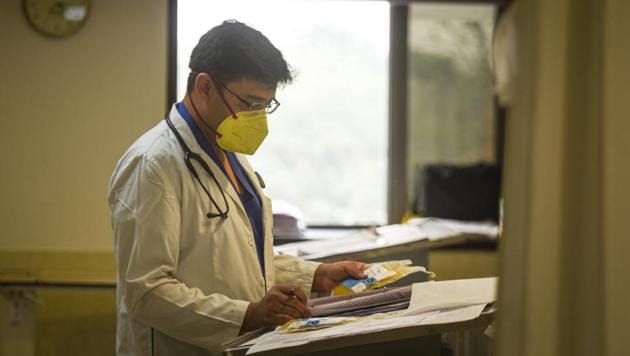
It’s a drill he has now become better at. It would take him around 10 minutes to wear the PPE suit, which includes six articles of protective gear to be worn in a certain sequence; he now does it in three.
Delhi is the state with the fourth highest number of confirmed Covid-19 cases in India; the first confirmed case was detected on March 2. At the beginning, the Delhi government designated Ram Manohar Lohia Hospital and Safdarjung Hospital as the only Covid-19 care facilities. Fortis, like many other private hospitals, began to attend on patients of the viral disease only in April. Dr Jain has been on Covid-19 duty since April.
In pre-pandemic times, he either worked the 9am-5pm shift or the 5pm-9pm shift with a weekly day off, when he would stay home with his wife Shilpi. “From April, I’ve been working seven days and then spend seven days in quarantine. I’ve to completely isolate myself in this period. The first two months, April and May, I did not return home and quarantined in a nearby hotel in Vasant Kunj.”
That the health crisis would pose a huge challenge to health-care professionals dawned on him gradually. “Like everyone else, I had heard the news on TV. But there was no question of not being mentally prepared. This is what we do. There was no question of not going out or staying back home no matter what the risk. I telephoned my mom and told my wife it is possible I may not escape infection and survive. Had my wife not been brave, it would have been difficult to carry on my tasks if I had to fight on both fronts,” says Dr Jain. “With time, I think I know how to keep myself safe”. But he always adds this caveat; there are no guarantees.
{{/usCountry}}That the health crisis would pose a huge challenge to health-care professionals dawned on him gradually. “Like everyone else, I had heard the news on TV. But there was no question of not being mentally prepared. This is what we do. There was no question of not going out or staying back home no matter what the risk. I telephoned my mom and told my wife it is possible I may not escape infection and survive. Had my wife not been brave, it would have been difficult to carry on my tasks if I had to fight on both fronts,” says Dr Jain. “With time, I think I know how to keep myself safe”. But he always adds this caveat; there are no guarantees.
{{/usCountry}}This is also what he tells patients and their attendants. “Medical illiteracy is one of the challenges right now,” he says. “Every doctor faces difficult questions from families who at times turn on us. It’s almost a year since the crisis broke over all our heads, people should know that overnight things can turn serious in Covid cases, especially if a patient is aged and has comorbidities. If the patient gets into a cytokine storm where the body’s immune system turns hostile and multiple organs get affected along with the lungs or there is massive pulmonary embolism, there is not much a doctor can do. The medical field has its limitations.”
Being a doctor in the ICU, death is not new to Dr Jain. “It is always hard losing a patient, it’s just that now you are losing a person faster. And that does cause stress”. But lessons have been learnt on the job. “Daily, we get new studies that help us understand the disease and its progression,” he says. With time, he has also learnt how to “carry on for long periods without food and water, or having to relieve myself to take a toilet break. This is not to say that it isn’t hard or that there aren’t bad days.”
Initially, the stress was overwhelming when colleagues too started getting infected. So far, he has known fear, he says, only twice. “When a colleague in the ICU who was working on the same shift as I was got infected. And another time when as my breath was fogging the mask and clouding my vision, I had to remove my shield to intubate [the process of inserting a tube through the mouth and then into the airway so as to put him on the ventilator] a patient so I was in direct contact with the patient. But the effort paid off as he walked out of our hospital alive,” he says.
There is also on-the-job pressure when relatives get admitted. “To make my 76-year-old uncle understand his condition was a hurdle. He survived.” Even his own family got the same line, Dr. Jain says. “I had told them there were no guarantees that he would come out alive, but we will try our best.”