
 E-Paper



HT This Day: August 5,1958 -- Speedy justice need of the hour
The President on Monday made a strong plea for revision of the legal procedure in order to make it intelligible to the common man.


The President on Monday made a strong plea for revision of the legal procedure in order to make it intelligible to the common man.
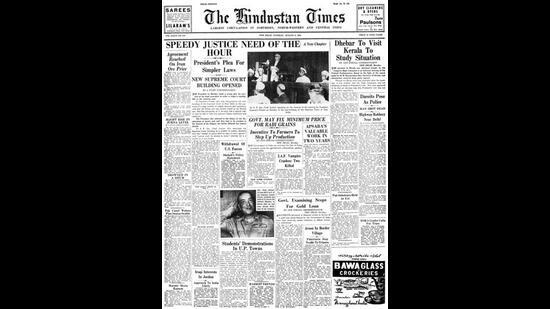
Dr Rajendra Prasad, who was inaugurating the new building of the Supreme Court in New Delhi in the presence of a large number of judges, lawyers and legislators, said that the Indian law was mainly based on the British law. But the interpreter of it, he said, had a special task in that he had to take into account Indian conditions and traditions.
The President also referred to the delays in the dispensation of justice and said they had to be avoided in the interest of the litigant, for justice delayed was justice denied.
Mr S. R. Das, Chief Justice, who described the Supreme Court building as a symbol of justice, declared that this “ citadel of justice shall be open to every person “ and “ justice shall be denied to none,” whether he is a citizen or a non-citizen.
Seated on the bench beside Mr S. R. Das and Dr Rajendra Prasad were Mr Nehru, and Dr S. Radhakrishnan and senior judges of the Supreme Court. The National Anthem struck up punctually at 9 a.m. to indicate that the function had begun.
Dr Rajendra Prasad said he regarded it as a great privilege to be associated with the opening of the new building. He commended the design of the building which had been made to resemble a pair of scales-universal symbol of justice. A study of the design impressed on one the fact that the building was a combination of Western art and Indian concepts.
The President observed that the Indian Constitution and the laws had very largely been modelled on Western laws and constitutions. The Constitution, particularly, was based on the British Constitution. In spite of this, there were obvious differences. The British Constitution was unwritten, unitary with Parliament as the supreme authority. The laws and authority of the British Parliament could not be questioned in any court. On the other hand, the Indian Constitution in spite of its length, was not able to cover all emergencies and contingencies.
The other distinction was that the Indian Constitution was a federal one limiting the powers of Parliament and restricting them to subjects within its exclusive jurisdiction and in the Concurrent List. So, when one thought of the Constitution and our laws, one had to think of these distinctions. Therefore, the interpretation of our laws required deep and wide learning not only of Western laws and constitutions but also an intimate knowledge of conditions prevailing in India and Indian traditions.
DELAYED JUSTICE
Dr Prasad referred to the delays that occurred in the dispensation of justice and said the delays were caused from the smallest court to the highest court of appeal. Delay was an important factor for the litigant because in many cases justice delayed means justice denied. There was another aspect which came in for criticism and that was the expenditure.
“We have very largely based our laws on the British model. We have drawn a great deal from the British laws for many of the Acts which have been adopted by our legislatures, and the procedure is very largely based on the British procedure. The law of evidence is, practically, entirely derived from that source. While they have all proved to be good in their own way, we have in the process of adopting them adopted many rules which have become artificial in the special conditions of this country. It is, therefore, up to the judges, the legislators and the members of the public so to revise the whole thing and so to reconstruct our laws and our procedures as to make the whole thing simple and easily intelligible to the man in the street,” he said.
In spite of these limiting factors, Dr Prasad said, the judges had been able to give satisfaction to the people, as a whole, and the credit was theirs. He congratulated the judges of the Supreme Court and through them judges all over the country for the splendid work that they were doing not only now in independent India but also in the days when the country was not free. “Our judges have acquitted themselves with credit to themselves and with great benefit to the country. I hope that these traditions will continue.” he said.
Dr Prasad said the Bar had assisted the judiciary in their task and occupied a very important position in our public life as from the Bar were recruited not only judges and our public men but also a good percentage of the country’s public servants. He expressed appreciation of the ample accommodation provided to the members of the Bar in the building.
Dr Prasad concluded his address on this note. “In the welter of politics when most things seem to be in the melting-pot at many times, the courts of justice seem to place before us the one stable element and I have no doubt that they will continue to do so.”
The inauguration ceremony of the new building was performed by Dr Prasad by opening the door of the Chief Justice’s court amidst rounds of cheers.


