
 E-Paper



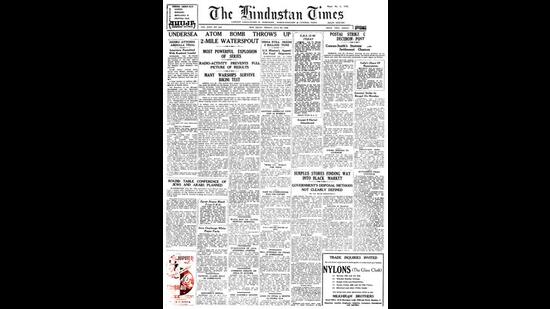
HT This Day: July 26, 1946 -- Undersea atom bomb throws up 2-mile waterspout
The world’s first under-water atomic explosion has sunk the 28,000-ton battleship Arkansas, the 33,000-ton aircraft carrier Saratoga, three landing craft, and possibly five submarines.


The world’s first under-water atomic explosion has sunk the 28,000-ton battleship Arkansas, the 33,000-ton aircraft carrier Saratoga, three landing craft, and possibly five submarines.
The Japanese battleship Nagato, the destroyer Hughes and a transport are listing. Attempts to board the Saratoga, which remained afloat for several hours, were thwarted by violent radioactivity. She was America’s oldest carrier.
There is no other apparent damage to the target fleet caused by the tremendous detonation which sent an awe-inspiring column of water surging almost two miles into the air.
A million tons of radio-active spray contaminated the entire fleet of 87 ships spread out over five square miles. Instruments showed that the waterspout reached a height of 5,000 feet, but gas and vapour which topped it spiralled upward for another 4,000 feet.
Vice-Admiral W. H. P. Blandy, commanding the operation, reported that the tremendous wave the atom bomb raised was only seven to ten feet high when it hit Bikini and did not inundate Bikini.
The event was not without human drama. An hour before the bomb was due to go off it was disclosed - that by some freak chance some of the crew of a target ship had been left aboard. Minutes were already ticking away and men aboard the United States ship Cumberland Sound, 15 miles away, were already throwing switches leading up to detonation of the bomb. The stranded men raised a distress signal---according to a pre-arranged plan for such an emergency-and were rescued in time.
Joseph Latin, Reuter’s special correspondent, who watched the atom bomb test from the U.S.S. Appailachian nine and a half miles from the target fleet, cabled these impressions of the spectacle which followed the world a first underwater atomic explosion:
“It looked as though the whole lagoon rose into the sky. A frightening mountain of blackened water emerged from the lagoon driven up- ward by the mighty atomic force.”
“As the column surged upward it became pure white and brown and I orange tinted clouds billowed outward. At a height of a mile and a half the column spread out in a huge white dome.
“Seemingly almost slowly, the I gigantic man-made geyser appeared to squash out its base which broadened out to a diameter of five miles obscuring the entire target fleet of 87 vessels.
“At the same time a tremendous mass of water from the top of the column mushroomed out and poured down on the whole area.
“Watched through binoculars, it - almost seemed that the mountain of water would envelop us too and I involuntarily dropped my glasses. That brought the thing back into the proper perspective and I realized that there was nine miles of ocean between us and the huge water spout.
It did not seem possible, as more than a million tons of water descended, that a single ship could survive, but when the vapour and spray cleared, all the mighty ships I with the exception of the old battleship Arkansas and two small craft were there.”
Admiral Blandy announced that “there is no rea on to doubt the efficiency of the atomic bomb.” He reported that a wave ten feet high had swamped an island nearby but not Bikini. He warned that ships of the test fleet would not be able to enter the Bikini lagoon as quickly as after the explosion of atom bomb IV on July 1.
One destroyer, risking grave injury to its crew has already swept into the lagoon to within a mile of the centre of the gamma ray drenched armada. Its “Geiger counters”-radio-activity gauges--showed results which supported Admiral Blandy’s own warning that it is dangerous to approach the target area and that it may be dangerous for some time to come.
William Laurence. “New York Times” correspondent and one of the few men in the world to have seen all the five atom bombs explode-the original New Mexico test, war-time attacks on Hiroshima and Nagasaki and the two Bikini tests-said: “This explosion seemed to be by far the most powerful of all.”
There is no sign of any fires among the target ships. As the cloud cleared, the correspondent says, many ships exild be seen torn from their moorings. Still floating were the Nevada, the Pensacola, the New York, the Sakawa, the Saratoga and the Independence.


