
 E-Paper



HT This Day: June 14, 1929 -- Bhagat Singh & Dutt sentenced to transportation
M R. Middleton, District and Sessions Judge, Delhi, delivered judgment to-day in the Assembly Bomb Case, sentencing Bhagat Sing and B. K. Dutt t to transportation for life under section 307 I. P. C. and Section 3 of the Explosive Substances Act.


M R. Middleton, District and Sessions Judge, Delhi, delivered judgment to-day in the Assembly Bomb Case, sentencing Bhagat Sing and B. K. Dutt t to transportation for life under section 307 I. P. C. and Section 3 of the Explosive Substances Act.
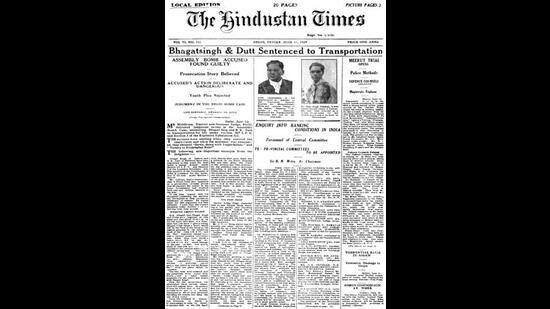
THE accused were smiling when they entered the court-room and when the sentence was announced, they shouted “Down, down with Imperialism,” and “ Victory to Proletaz9at Rule!”
THE following are important excerpts from the judgment: ---
Bhagat Singh of Lahore and B. K. Date of Burdwan have been committed to this comb for trial under a charge framed under Section 307 1. P. O. and Sanction 3 of the Explosive Substance Act. The sanction of the Government of India is necessary for the initiation of the trial under section 3 thereof.
Mr. Jeffreys, Senior Superintendent of Police Delhi who appeared as a prosecution witness proves that he reported the matter to the Local Government and received both oral and written sanction to the trial.
It has been argued that the document containing the sanction are incomplete as they contain no statement of reasons. No logical base for this argument has been adduced. I hold that the consent necessary under Section 7 of the Act has been duly proved.
Allegation Against Accused
It is alleged that Bhagat Singh and Dutta were together at this place and that about 12-30 pm on the 8th April 1929 when the President had just risen to give a ruling, Bhagat Singh threw a bomb which fell on the floor of the house in the narrow gangway in the neighbour hood of the seats 4-B, 5-37, and 34. This explosion caused injures to various persons and furniture. After this Dutt, throw a bomb which fell on seat No. 146 and which did much damage to the sent on that row and in front of that row and resulted in injuries to the person seated at the official gallery and to the left of the seat. After this Bhagat Singh produced an automatic pistol and fired two shots whereupon the pistol jammed. Meanwhile Dutt commenced scattering leaflets of seditious nature and us was joined in this by Bhagat Singh after the pistol failed to function.
The two men were arrested and the pamphlets were found from Dutta (and a spare loaded magazine for the pistol was found with Bhagat Singh.
How far the prosecution has established these various allegations will appear later. At present is may be noted that at the trial, accused have put in a written statement in which they admitted throwing the bombs, but deny the use of army pistol.
From the evidence of numerous witnesses to which it is unnecessary to refer in detail, it, appears that on the 8th April 1929, shortly after noon, there was a division on the Trade Disputes Bill and that after, the result of this division has been announced, the president rose to announce the ruling in connection with the Public Safety Bill. It appears from the evidence that this ruling was one which was expected to be of considerable interest and attention of the most of the persons at that moment was centered on the President. It is at this moment that the first bomb is said to have. exploded.
After referring to the evidence tendered by the various witnesses, the Judge proceeded to connect the accused with the event.
The First Bomb
Sardar Sobha Singh explained that be saw Bhagat Singh standing in the gallery and throwing something which looked like a cigarrete case, which not was followed by the noise of an explosion and lot of smoke.
Mr. Pasricha saw the flame and smoke and heard the noise of the first explosion.
Mr. C. V. O’ Brian stated that he actually saw some object flying through the air b hind him and fall amongst the Government Benches.
Sergeant Terry and Inspector Johnson both heard the first explosion.
After the Explosion
I now turn to the evidence of events immediately after the explosion. This concerns the alleged firing of the pistol by Bhagat Singh and scattering leaflets by Dutt and later on Bhagat Singh joining him.
Mr. Cliffs after assisting a lady into the corridor stood behind a pillar whence he saw Bhagat Singh fired two shots from a pistol; meanwhile Dutt was standing near Bhagat Singh and was scattering the leaflets. Sergeant Tarrey heard the two pistol shots soon after the second explosion.
Sardar Sobha Singh had sent two policemen towards the accused and had started to follow them. Mr. Pasricha gave the impression that some appreciable period followed between the moment he saw the man scattering the leaflets and the arrival of the police. He mentions the arrival of the police official without stating how many were there. He thinks he noticed Bhagat Singh raise his hand above his head and was arrested. After the arrest this witness went back to look for his hat and stick.
Mr. O. Brian did not see the actual arrest.
Mr. G. E. O. Brian stated that he was prevented by his mother from approaching the second. He did not notice the actual arrest but he saw that Sergeant Tarrey had arrested the two men.
All the witnesses who saw the arrest agreed that the second offered no resistance.
Identification
Sardar Abdul Samad Khan, a First-Class Magistrate of Delhi, described how he held two identification parades on 13th April. The Magistrate’s description of the methods adopted at the parades show that, they were properly conducted and there can be no doubt that all the witnesses did pick out the accused from many other persons.
It is not a case in which there is any reason to suspect the production of all evidence prompted by enmity or other motive. On the other hand, the evidence concerns the events which took place at a time of intense excitement. The witnesses had every reason to believe that they were in danger and that those on the public gallery were exposed to mob excitement.
At such a time impression are bound to be vague. The trend of some part of the cross examination has suggestions that witnesses cannot be trusted to tell the truth. I cannot find any indication in support of the suggestion. There is a big difference between discrepancies due to lack of observations that I sthe former visitors the whole evidences of witnesses concerned, while the latter vitiates the evidence on a particular point only. Bearing this in mind after very careful comparison of all the statements, I have endeavored to summaries the above. I can find nothing to suggest that any witness has willingly gives a false version of any fact.
Accused’s Admission
The accused have admitted the throwing of bombs. The use of a pistol is not a factor in the charge against, them. In one sense, the evidence regarding the pistol to not directly relevant, it becomes relevant only as the test of credibility of the evidence as a whole.
Result of two explosions
The two persons most seriously injured were Sir Bomanji Dalal and Sir George Schuster. Sir Bomanji had a lacerated wound and Sir George had a gash of half an inch. The evidence on record leaves room for doubting as to whether Sir Bomanji Dalal’s injuries were the result of the first or second explosion. There can be no possibility of doubt that the injuries were caused by the explosions.
The judge then described the damage done to the furniture etc.
Nature of Bomb used
Sub-Inspector Chet Singh was deputed to collect the fragment of the metal which was lying in the Assembly Chamber as a result of the explosion. He was assisted by two constables.
The Chemical Examiner’s report merely consists of a list of exhibits with notes as to the traces of Chemical reaction. ln his evidence in the trial, Doctor Robson repeated the substance of these opinions and amplified his reason. He was then cross examined as very great length to test the value of his opinion and the date on which they were based.
In defence, Doctor Munsoori of the Muslim University in Aligarh has been called as an Analytical Expert. He criticizes the report of the Chemical Examiners as being indefinite.
Summing up the evidence of these two expert witnesses, the judge said it has been shown that there was not sufficient data available to enable either of them to form a certain opinion as to the nature and the amount of charges within the bombs. I am also of opinion that the strength of explosive force exerted by the bombs can be more safely gauged from the consideration of the actual results than the opinion based on assumed charges.
I consider that Doctor Robson bee been able to adduce sound reasons for his opinions that the bombas were of a mechanical type.
Statement of Accused
After the last prosecution witness had been examined on the 6th June, the accused were examined to enable them to explain the circumstances appearing in the evidence against them. They have put in a written statement signed by them both through their counsel.
After due consideration, I decided that, certain portions of this statement were irrelevant and expunged them from the record.
Opinions of Assessors
Very diverse opinions have been recorded by the assessors. One assessor concludes that both the Accused were guilty under Section of the Explosive Substance Act. Another assessor is of opinion that Bhagat Singh might have thrown both the bombs A third assessor considers that both the accused were guilty under Section 8 of the Explosive Substance Act . The fourth assessor concluded that the bombs were of such a nature that they could not cause death.
I accept the direct sad oral evidence produced before me as cogent proof that Bhagat Singh and B. K. Dutt each threw bombe into the Legislative Assembly, that Bhagat Singh fired a pistol and that Dutt scattered the leaflets.
I find cogent proof that the two bombs used were such as would in the natural course of events have caused death, had they fallen close to a human being. In corning to this finding, I have disregarded the argument employed by the learned counsel for the defence.
Sentence
The acts of each accused constituted an offence punishable under the different previews of the law. The punishments can be regarded as retributive, preventive or deterrent. In this case both the accused appeared to be callous as to who might suffer; their note might have resulted in death of not only one, but of several persons who have offered them no form of provocation and who were not even acquainted with them
The accused alleged that they hold human life sacred but their allegation is negatived by their attitude throughout has been that their acts are justifiable. With such an attitude, their acts are of those men who have not fallen into crime on the spur of the moment but by deliberate design. From the preventive point of view their evidence merits severe punishment. The accused acts were deliberate and they made preparation for their acts.
In these circumstances their youth must not be allowed to stand in the way of infliction of inadequate punishment I, therefore, sentence both the accused to transportation for life.


