
 E-Paper



HT Archives: Gavaskar crosses Bradman’s mark with 30th century
Sunil Gavaskar achieved his 30th Test century on December 28, 1983, at Chepauk, becoming the leading century-maker in cricket history.


The saga of Sunil Gavaskar reached its pinnacle of glory at the Chepauk ground on December 28, 1983. Playing an innings of Bradmanesque stature, the master batsman achieved his 30th hundred to emerge as the leading century-maker in the history of Test cricket.
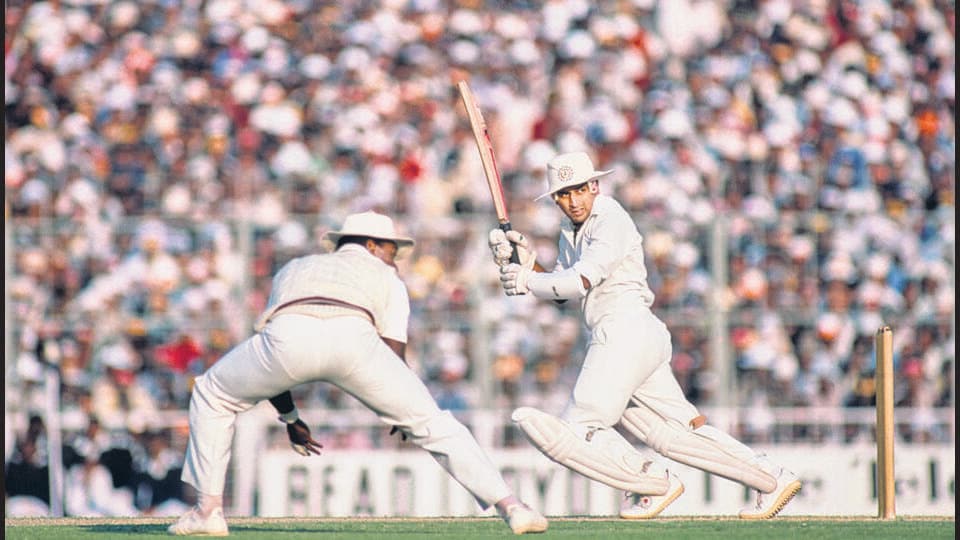
Gavaskar had equalled Don Bradman’s existing record of 29 centuries in the second Test of the current series against the West Indies in Delhi and then narrowly missed a hundred in the third Test at Ahmedabad. But, on the penultimate day of the sixth and final Test, he kept his date with destiny. It was an effort befitting the illustrious career that has so far spanned 99 Tests and which started with the Caribbean tour of 1971.
On a day when an hour’s play was lost due to the wet conditions of the ground, a capacity crowd had turned up, perhaps anticipating the historic occasion. And Gavaskar, in his characteristic manner, did not go back on the promise which he had made on the eve of the match. The spectators cheered when he slowly moved through the nineties. And when Gavaskar turned paceman Davis to square-leg to take a single and achieve the magic figure, the Chidambaram stadium erupted with joy and ecstasy.
Gavaskar, the master of concentration, was still at the crease with 149 in India’s score of 262 for six at the draw of stumps. His able partner, Ravi Shastri, was dismissed by Winston Davis in the last over after making a valuable 72. It was these two batsmen who extricated India from their customary troubles with a century partnership. Coming together at 92 for five, Gavaskar and Shastri added 170 runs through a stint of splendid batting. Their fine efforts had a telling effect on the balance of the match where, at one stage, India seemed to have problems in avoiding the follow-on. But that was not to be and the sixth-wicket pair assured India an honourable draw here after three humiliating defeats suffered in the series.
Gavaskar never had to struggle throughout the day. He played the four West Indies speedsters with consummate ease and the two spinners, Roger Harper and Larry Gomes, with even more freedom. Unlike the hurried approach witnessed in the previous Tests of the series, his was a thoroughly professional piece of batsmanship-treating each ball on its merit. He has so far batted for a shade over 400 minutes and hit 16 boundaries, besides a couple of fives earned, courtesy of overthrows from Malcolm Marshall and Michael Holding. There was no lapse in concentration even after crossing his century and as it is, a double century is for his asking on this slow track on the final day.
Against Marshall, Holding, Andy Roberts and Davis there was no let up from the broad blade of Gavaskar. He went for his shots with fluency and power. His timing was superlative and the strokes, especially the drives on either sides and the occasional nudge round the corner, was like fresh water gushing out of a stream. Perhaps, the West Indians had little reason to relish the occasion for the Indian maestro had plundered no less than 13 hundred off their attack. Yet, skipper Clive Lloyd and his men showed appreciation of the feat by a round of applause while skipper Lloyd and Richie Richardson shook hands with Gavaskar on completion of his epic century.
On a day of landmarks, the sixth wicket stand between Gavaskar and Shastri improved upon a 12-year-old record against the West Indies. The existing record of 137 was set by Dilip Sardesai and Eknath Solkar in the first Test at Kingston in the 1971 series. The century also brought another record for Gavaskar improving upon Geoff Boycott’s total number of 47 three-figure partnerships.
Wicket-keeper Jeff Dujon was the lucky recipient of the bat with which Gavaskar attained his record-breaking feat. That was a commitment Gavaskar had made earlier in the tour to Dujon.
Gavaskar later admitted that he was “terribly nervous” while going down at No 4, a position occupied by Hazare, Manjrekar and Vishwanath at one time or the other. But there was no hint of it at any time he was at crease except for a 12-ball lull when he was on 93. Thereafter, as before, it was Sunil Gavaskar all the way.


