
 E-Paper



HT This Day: July 7, 1966 -- Devaluation in best interest of country
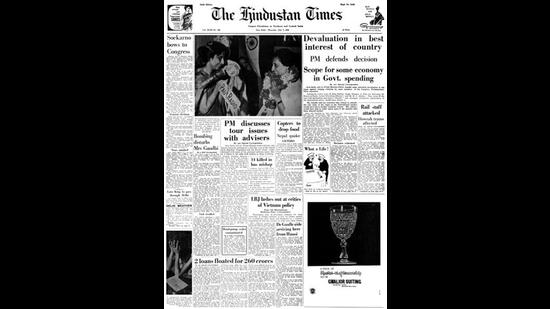
Prime Minister Indira Gandhi today defended devaluation of the rupee against carping criticism by some members of the ‘Congress Parliamentary Party executive.


Prime Minister Indira Gandhi today defended devaluation of the rupee against carping criticism by some members of the ‘Congress Parliamentary Party executive.
Among the critics were Dr Ram Subhag Singh, Minister of State for Railways, Mr Humayun Kabir, former Petroleum Minister, and Mr H. C. Mathur. They were of the view that devaluation had been a “blunder “ and increased production, particularly in the agricultural sector, would have stayed it.
Mrs Gandhi told the executive that refusal to concede the real value of the rupee in the international market would have led to further economic trouble. The country would have had to suffer much more if the decision had been delayed further.
About the complaint by members that the Government had not explained to the people the compelling necessity for devaluation, she said the Government’s case had been adequately publicized through brochures. Papers had been made available to members of Parliament and the Congress Working Committee.
She denied that the Government had been pressed into taking the decision by any foreign country or agency. The Government had done what it thought was in the best interests of the country.
She agreed that there was need for cutting down unproductive Government spending in order to consolidate the gains of devaluation. She had written to Chief Ministers, but follow-up action was necessary.
She suggested that members of the executive divide themselves into small groups and suggest to the Government how economy in public expenditure was possible. She admitted that there had been a small increase in the prices of various goods after devaluation, but pointed out that steps were being taken to ensure to the people the necessities of life at reasonable prices.
Some members drew her attention to reports about the Soviet Union having given arms to Pakistan. They wanted the matter to be raised by Mrs Gandhi with Soviet leaders.
Decision criticized
Today’s discussion on devaluation remained inconclusive as all members did not get a chance to speak for want of time. During the two and-a-half-hour meeting several members criticised the Government decision. There were other members who took the view that the decision having been taken, the Government should initiate immediate follow-up action.
According to Mr Mathur devaluation was “ill-advised” and constituted a “Himalayan blunder’’ on the Government’s part. In his view the Government should have discussed the step with members of the party in some way.
He referred to the repeated statements by Government spokesmen in Parliament and outside during the Budget session that devaluation was not being considered. He did not think that devaluation would bring any benefit to the country’s export trade as the scope for increasing the export of traditional commodities like jute and tea was limited.
The only way to correct the balance of payments position was through increased production. He argued that if the country became self-sufficient in food her I dependence on foreign aid would be considerably reduced.
Mr H. C. Heda said the decision to devalue having been taken by the Government, it was the duty of everyone to make it a success. He pleaded for further liberalization of import of components and raw materials in case the situation improved. He wanted industries which were starving for lack ‘ of raw materials to be given full opportunities of working to capacity.
He pleaded for decontrol of sugar and said that the export incentive schemes having been withdrawn the Government should study how exports would be affected.
Mr R. S. Pandey said the country had always supported the Congress party’s economic decisions. He, however, drew the Prime Minister’s attention to “the economic advisers and planners having failed the country during the past 18 years.” People had been denied even the basic essentials of life and prices were soaring.
It was the failure of internal production which had brought about devaluation. The only way to pull the country out of the economic quagmire was by increasing industrial as well as agricultural production.
Mr Pandey congratulated the Prime Minister for having called, for the first time, a meeting of the managers of public sector undertakings and said there was no hope of the economy moving forward unless these undertakings gave adequate returns. He pleaded that if the public sector managers failed to deliver the goods, they should be dismissed.
The discussion on devaluation was initiated by Mr Jagannath Paharia. He said the Government should convince the party why devaluation became necessary, how it could influence economic growth and how far it would affect the fourth Plan.
After devaluation prices were rising. In his view, before announcing devaluation the Government should have taken measures to curb the rise in prices.
Mr Paharia felt that people should have been educated about the impact of devaluation
Seed distribution
Mr P. Venkatasubbiah was critical of the seed distribution machinery and said that agricultural production was suffering because farmers were not supplied with enough seed. The quality of the seed supplied was defective.
Mr Shivaji Rao Deshmukh said that in Maharashtra administrative inefficiency had virtually wiped out the hybrid maize crop. Farmers were not told the proper way of sowing hybrid seed and had sown the male and female seed together instead of giving a seven-day gap.
Dr C. D. Pande said successive Finance Ministers had assured the country that the financial situation gave no cause for anxiety and there was no justification to apprehend that the value of the rupee was falling. The devaluation decision was sudden. The arguments now being advanced in its justification should have been visualized earlier. He demanded that unproductive Government expenditure should be drastically cut.
Mr Mohan Dharia said there was no reason why the Government should have resorted to devaluation. The impression was gaining ground that devaluation was due to foreign pressure.
He was critical of the faulty distribution machinery. He also felt that farmer would have to be given greater incentive if production was to be raised.
Dr Ram Subhag Singh demanded top priority for agricultural development and urged that administrative expenditure be reduced. In his view, one of the defects of planning was that planners were not conversant with the problems of export. He made a pointed reference to the import of tobacco and other commodities as part of the PL-480 agreement. This was lx cause of India’s dependence on others for grains. The effort should be to achieve self-sufficiency in agricultural production. particularly of grains.
He said officials after retirement should not seek alternative jobs but go back to agriculture.
Mr Baliram Bhagat, Minister of State for Finance, briefly referred to the circumstances leading to devaluation and promised to distribute to the party members, the note which was distributed to the Congress Working Committee members yesterday.
His contention was that wholesale prices had gone up by only 1.2 per cent. In the first week after devaluation and by 2 per cent in the second week.
The executive will meet again to discuss devaluation after the Prime Minister’s return from her Soviet tour.


