
 E-Paper



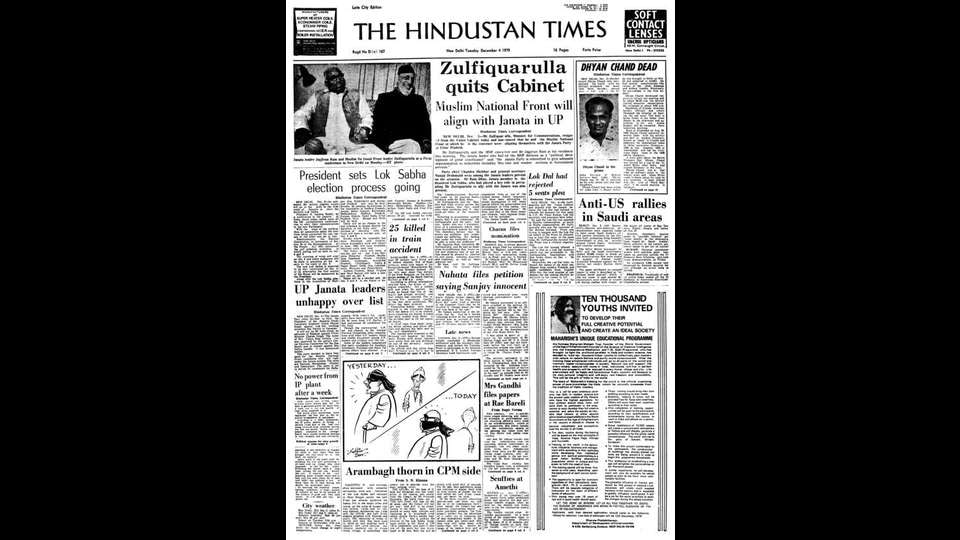
HT THIS DAY: December 4, 1979 — Hockey wizard Dhyan Chand dead at 74
Dhyan Chand had been ailing for some time in Jhansi before he was brought to Delhi on Nov 23 and admitted to AIIMS. He had several complications like cancer of the lever, diabetes and kidney trouble. Eventually he succumbed to the first ailment

 Prefer HTon Google


New Delhi- Hockey wizard Dhyan Chand who mesmerized the world with his brilliant stick work for more than three decades, passed away at 4-23 a.m. at the All Indian Institute of Medical Sciences here today (December 3). Dhyan Chand was 74. He is survived by his wife, seven sons and fore daughters.
Dhyan Chand had been ailing for some time in Jhansi before he was brought to Delhi on Nov 23 and admitted to AIIMS. He had several complications like cancer of the lever, diabetes and kidney trouble. Eventually he succumbed to the first ailment.
Dhyan Chand developed respiration failure last evening and by about 00-30 a.m. the doctors slated intensive resuscitation. He collapsed at about 4-25 a.m.
Hundreds of friends, relatives, hockey officials and others thronged the hospital on hearing the news. The body is being flown to his home town Jhansi in the afternoon and according to his son, Ashok Kumar, will be cremated there tomorrow morning.
Born at Allahabad on Aug. 28 1905 Dhyan Chand achieved immortal fame with his artistry and skill in hockey. Popularly known as “dada” to friends and admirers, he represented India in three successive Olympics-1928 at Los Angeles, 1932 at Amsterdam and led the victorious India team in the 1936 Berlin Olympics.
A story goes about the Berlin Olympics that Dhyan Chand was invited for a cup of tea by Adolf Hitler after India had routed Germany in the final.
Dhyan Chand was at that time an ordinary sepoy in the Indian army when Hitler came to know about his rank he was reported to have offered him the title of Field Marshal if he would migrate to Germany.
Another story is that most of the Europeans did not believe the way Dhyan Chand used to sprint down with the ball glued to his stick. In fact, some people are reported to have examined his stick to find out whether —some- thing like a magnet was attached to his stick. They were left bewildered when they found nothing.
Dhyan Chand rose to the rank of a Major and retained it till his retirement In 1986. He was the recepient of Padma Bhushan in 1956 and then joined the Rajkumari Amrit Kaur coaching scheme in 1961 a0 the chief hockey coach.
In the hospital at the AIIMS, last he talked about hockey was his distress at Mehboob not coming upto his expectations.
PTI adds: From Amsterdam Olympics in 1928 to those at Los Angeles 1932, and Berlin 1936, Dhyan Chand enthralled the world of hockey. A ‘wizaed’, a ‘juggler’ he was hailed by connoisseur and critic alike.
But to Dhyan Chand hockey was not only an art but also a science in which came into play the laws of force, of spatial magnitude.
At Berlin, efter India beat Germany in the final 8-1 (six scored by Dhyan Chand), astride the victory stand, he was asked by Hitler “What are you?”
Dhyan Chand: “A Sepoy in the Indian Army.”
Hitler: “If you were a German, I would have made you at least a major-general.”
India was then an enslaved nation, but on freedom. Dhyan Chand was not considered worthier than to be a major, to which rank he was elevated. But more honoured he was in 1956 on conferment of Padma Bhushan by President Rajendra Prasad.
World War II blitzed two Olympics, one to have been held In Tokyo in 1940 and another in 1944. It also ended the career of Dhyan Chand who last played international hockey in 1948 leading an Indian team to East Africa. On return he hung up his stick for good.
Yet in the shortened span of his career in the international arena, Dhyan Chand scored around 400 goals, a record that has not been equalled in the last 25 years in the course of which eight Olympics were held, nor will it perhaps ever be equalled, let alone surpassed.
As a hockey player he was incomparable even among his illustrious contemporaries, Jaipal Singh Dara and his own brother, Roop Singh, with whom he made a perfect combination, the former as centre forward and the latter as inside-left.
Hockey in the first quarter of the century was a pastime of the British military officers and confined to cantonments. Dhyan Chand took it to the cities of India to give birth to Indian hockey. The Indian Hockey Federation (IHF) was born in 1925.
Born in 1906, in Allahabad, Dhyan Chand joined the Indian Army as a sepoy, spending most of his time in Jhansi. It was here that he perfected his game which he began playing at the age of 17.
In 1926, Dhyan Chand was a member of the Indian Army team which toured Australia and New Zealand. The team won all its matches to put India on the world hockey map. That was Dhyan Chand’s preparation for the first Olympics, in which India could only participate under British flag, on the withdrawal of the British national team.
After Amsterdam came the Los Angeles Olympics which too India won, defeating the United States by 24 coals of which eight came from the stick of Dhyan Chand. En route matches were played in Japan and on landing in California.
For the Berlin Olympics, Dhyan Chand led India. He was at the zenith of his career, that war practically ended.
On his retirement in 1948, Dhyan Chand devoted himself to coaching and took a hand in shaping the 1948 and 1952 Olympic teams under Kishan Lal and Digvijay Singh “Babu”.
If Dhyan Chand helped in the birth of Indian hockey, he had also the misfortune of seeing its decline and fall at Rome in 1980.
Indian hockey is dead, so Dhyan Chand.


