The last man trapped deep inside a stone quarry, P Rajendran was ‘last seen’ on WhatsApp at 9.05 on the fatal night of May 14 before he started driving down the open-pit mine in Tirunelveli district. Five days later, his distraught wife Manimekalai, his daughter and family were at the accident site waiting to see his body. “For the first three days, I was confident that he would be in some corner of the quarry,” says Manimekalai. “Every day, I’d be waiting for him. When I saw families carrying away one dead body after another, I lost all hope.”
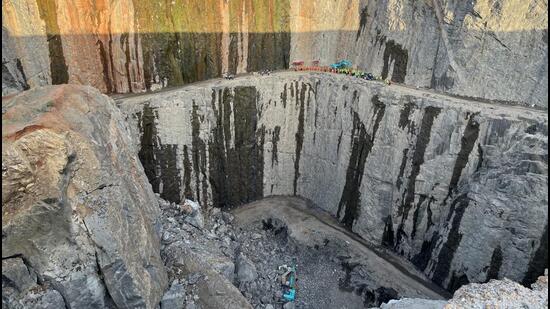
A gigantic boulder collapsed post 11 pm on May 14, burying 6 workers and heavy equipment inside a stone quarry under mounds of heavy rocks with only two survivors. It took eight days for rescue operations to end and Rajendran was pulled out to the surface on Sunday, 190 hours later at 9 pm on May 22. The accident at the quarry occurred at Adaimithipankulam, only 10 km from the main city, but off the high road in the interiors, which is hidden from the public eye.
A 200-hours rescue effort
From the land atop, the green JCBs damaged in the accident 360-feet below looked like toys. Buried deeper than that, the rescue team located 45-year-old Rajendran on May 19 by a bad smell due to his decaying body. The team of NDRF, fire and rescue personnel, geologists, explosion experts and a civil volunteer skilled in rope rescue technique had a plan to reach him. With expert advice, they strategically used explosives to break up the huge rocks, ensure it doesn’t explode into pieces and then retrieved Rajendran’s body. It was only on May 22, around 6 pm, when rescue personnel first caught a glimpse of him in a sitting position inside the lorry’s cabin.
On the first day after the accident, two of the trapped men were pulled out alive by the Tamil Nadu Fire and Rescue Services. The third person, Selvam, who was brought alive to the surface, died on the way to the hospital. His body was crushed from the waist down. After his death, rescue workers knew that their chances of finding survivors were increasingly slim. The remaining three men had suffocated and died under boulders weighing thousands of tonnes. “We have done several rescue operations. In those cases, there were usually voids so people could get some air and survive, but here all the voids were filled by small and large rocks. Unless body parts of the person are exposed, we know they can’t survive,” says P Sudhakar, Assistant Commandant, NDRF 14th battalion, Arakonnam.
{{/usCountry}}On the first day after the accident, two of the trapped men were pulled out alive by the Tamil Nadu Fire and Rescue Services. The third person, Selvam, who was brought alive to the surface, died on the way to the hospital. His body was crushed from the waist down. After his death, rescue workers knew that their chances of finding survivors were increasingly slim. The remaining three men had suffocated and died under boulders weighing thousands of tonnes. “We have done several rescue operations. In those cases, there were usually voids so people could get some air and survive, but here all the voids were filled by small and large rocks. Unless body parts of the person are exposed, we know they can’t survive,” says P Sudhakar, Assistant Commandant, NDRF 14th battalion, Arakonnam.
{{/usCountry}}The rescue operation took more than a week for two reasons. The boulders, which broke up and slid, causing the accident, were still unstable. The rocks kept falling, putting the rescue workers at risk. On May 15, a second boulder slid, after which, the government brought in two private geologists who advised operations to be paused for several hours every day until the land was stable again. The access road to the open mine pit was cut off by the boulder, which slid down, preventing the JCB to reach the accident spot.
So, an iron rope was used to lower and lift a rescue official. It took 10 minutes for one person to get down and come up. “23 of my men were down there. So, it took us 230 minutes. More than three hours to bring them up to just wind up for the day,” says Sudhakar. It was also the only way to send rescue workers water and food, he adds.
“In Jammu and Kashmir (Ramban tunnel collapse), the NDRF is using a JCB for rescue operations. But we couldn’t do that here,” said Sudhakar, terming it a big challenge. In absence of a JCB machine, they took a day to pull out a body after it was spotted.
However, the district administration was firm that all the bodies must be returned to the anxious families. Sudhakar says that’s when S Ramesh, deputy general manager (mines), India Cements Limited, got down to the sites, he suggested blasting the rocks using explosives.
This was a long process which required meticulous planning. “If anything went wrong, there was no space for the rescue workers to go. We wouldn’t have been able to save all the men,” adds Sudhakar. The first blast was successful, and the fifth body was retrieved.
Then came a bigger challenge because the 6th person was trapped 15 feet further below the 5th person. “His location was declared as an unsafe area even for rescue. But we took the risk and went back in. We told the district administration it would take a minimum of 3 days to retrieve him and several blasts to remove layers of boulders. But we did it. We put a rope and rolled him out and bagged him,” says Sudharkar. “The saddest part is after so much effort we couldn’t bring out anyone alive. But we brought all the bodies up intact without cutting off any parts of their body while pulling them out.”
Violations caused the accident
Those at the site say the accident could have been prevented had leaseholders mined as per lease approval. The quarry was permitted to mine 450,000 cubic metres for five years. “But as per our calculations after the accident, they have mined 1.7 million cubic metres,” says an official at the site, not wishing to be identified. “That’s almost three times additional mining. And they have gone in really deep for this. The permitted depth is 50 metres, but they have gone in 110 metres. The design of the quarry is also wrong. It was a man-made accident,” he says, adding that it does not follow the Directorate General of Mines Safety rules.
The quarry is where Charnockite is mined, which is crushed to make M Sand for construction work. “M Sand is like gold in Tirunelveli as river sand mining is banned,” says a local activist. Enquiries are yet to ascertain how many people work in the quarry as several are casual labourers. The quarry’s licence was valid till 2023, which has now been suspended. “I have requested the state government to give us competent mining professions to inspect all the 55 licensed quarries in Tirunelveli. They have given us 18 personnel forming 6 teams and they have already started work. We have closed at least 6 quarries in Tirunelveli in the past seven months,” district collector V Vishnu says.
A private geologist says that the north region of the quarry where the accident occurred is a fracture zone. “Meaning it’s weak, the rocks have cracks through which water can percolate and weaken the structure further,” the geologist says. “The technical term for this accident is what we call a slope failure. The rocks were already weathered and had no stability. Wastewater was stored in the south region, which seeped into the rocks, and there was rain, which led to the slope failure twice. If there is heavy rain, the chances of another overhanging structure here falling are 100%.”
Fixing Accountability
Chief minister M K Stalin announced compensation for the injured and the deceased and assured that appropriate action will be taken against those responsible.
“Totally four people have been arrested,” said the district collector Vishnu. “Mining operations are permitted only between 10am to 5pm during the day hours. So that’s a clear violation, the remaining irregularties will be found by the speical teams and police enquiry.”
Investigation officer Rajat Chaturvedi who formed three special teams, nabbed the absconding owners of the private stone quarry K Selvaraj (80) and his son A S Kumar (52) in Mangaluru, Karnataka on May 20.
The district collector V Vishnu has suspended the assistant director (AD) of the district mines department, Vinodh Tamilarasan. “They’ve brought in another who is already in charge of two other districts (Kanyakumari and Nagercoil). How will one person have the time to inspect all the quarries? Tirunelveli alone has 100 large quarries and 300 small quarries. He will only have time for paperwork,” says one of the experts at the site, adding, “The government has to appoint an AD for each district, an assistant geological expert and staff.”
Manimekalai says her husband never spoke about his work. “He was a lorry driver, and he drove here at night. That’s all I knew,” she says in anger and tears. Her right arm has a tattoo of hers and her deceased husband’s initials. Rajendran was working here since 2018. The morning after the accident, she woke up to the news. “I immediately asked which hospital he was in. But I was brought to the quarry, and I saw that all of them were buried inside. I didn’t know in what condition he would come out. My daughter doesn’t know her father is dead,” says Manimekalai when the rescue team was making arrangements to blast rocks under which her husband was.