
 E-Paper



‘I am the recently removed deputy leader’: Raghav Chadha's jibe at AAP in Rajya Sabha
“The newly appointed deputy leader of the party I belong to is also not present in the House,” Raghav Chadha said, referring to AAP MP Ashok Kumar Mittal.

 Prefer HTon Google


AAP MP Raghav Chadha took a dig at his own party, with which he's had a very public falling out recently, as he rose to speak in the Rajya Sabha on Friday.
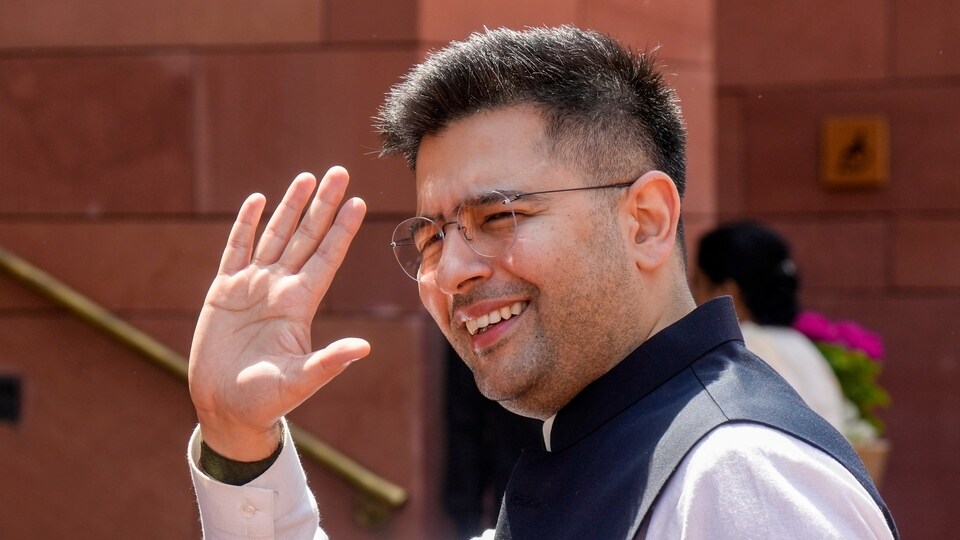
“The leader of the party I belong to is not present in the House,” he said, apparently referring to senior AAP leader Sanjay Singh.
“The newly appointed deputy leader of the party I belong to is also not present in the House.” he added, referring to Ashok Kumar Mittal, the industrialist-politician and a member from Punjab like Chadha.
"I am the recently removed deputy leader, and I am present in the House. Thank you so much for giving me the opportunity to speak," Chadha said, speaking during the felicitations for Harivansh Narayan Singh for being been re-elected unopposed as the deputy chairperson of Upper House of Parliament for a third term on April 17.
What Raghav Chadha said
Chadha, speaking in Hindi, congratulated Harivansh but added that his personal equation with the RS deputy chair had stayed “khatta-meetha” (sweet-sour, or blow hot blow cold), "
“I hope this term it'll not be like that, and in fact turns into a ‘sweet’ relationship,” he added, and said he hoped to get a minute or two extra to speak as well in the future.
He also heaped praised on the RS chairperson, Vice President of India CP Radhakrishnan, who was in the chair. “Ever since you have become chairperson, a lot of members get time to speak. Earlier during Zero Hour only 5-6 members could speak; not 15-20 members get the chance. Hence, congratulations to you too,” he said.
Also read | Raghav Chadha is reading up on ‘power’. Will he go to BJP, what about RS seat?
Why the jibe at own party
Raghav Chadha has this month gone from being Aam Aadmi Party's deputy leader in the Rajya Sabha to its most publicly attacked sitting MP — stripped of his post, blocked from speaking in Parliament from the party's quota; and accused by his own colleagues of being "compromised" and in league with the Centre’s ruling Bharatiya Janata Party (BJP).
Chadha, in the meantime, showed off a book, on the “laws of power”.
The revelation of the fallout came with AAP's letter to the Rajya Sabha Secretariat on April 2, replacing Chadha as the party's deputy leader in the Upper House of Parliament with his fellow Punjab MP, industrialist Ashok Mittal.
The party has 10 members in the Rajya Sabha, seven from Punjab and three from Delhi. In the Lok Sabha, it has three MPs, all from Punjab.
Chadha, 37, responded the same day. "Don't mistake my silence for my defeat." he said in a video posted on X. By April 6, he was sending pointed messages apparently to AAP boss Arvind Kejriwal and the leadership.
"Somebody gifted me a book this week... I turned to chapter 1 – ‘Never outshine the master’. Some books arrive exactly when they are meant to," he posted on Instagram. The book: 'The 48 Laws of Power' by American author Robert Greene.
His party's senior leaders have been combative in turn.
Delhi AAP chief Saurabh Bharadwaj accused Chadha of doing "soft PR", or public relations/publicity, in Parliament by raising allegedly less pointed issues like airport food prices and quick-commerce delivery timelines, instead of confronting the BJP-led central government on harder political ground.
"Because a small party has very limited time in Parliament, if someone is raising the issue of samosas during that time, it is more important to raise the big issues of the country," Bharadwaj said.
Chief minister Bhagwant Mann of Punjab, from where Chadha is MP, responded directly whether Chadha was "compromised". He said emphatically: "Yes!"
"If there is a party line taken on any issue, like in Gujarat where cases have been registered against 160 AAP volunteers; instead of speaking on those, if someone raises issues of samosa rates, pizza delivery, won't you doubt that the person is speaking from some other side, some other station?" Mann, a comedian-turned-politician, said.
Atishi, the former Delhi chief minister, cited specific acts of omission in Chadha’s record. She said Chadha refused to sign an impeachment motion against Chief Election Commissioner Gyanesh Kumar — an opposition initiative backed by several parties — and did not raise the issue of LPG shortages even when asked to by the party amid the US-Iran war and the West Asia oil crisis.
Chadha has denied each allegation. He said, “I challenge you to cite even one instance when the Opposition decided to walk out and I did not support them.”
On not signing the impeachment motion, he argued, "Only 50 signatures were required out of 105 Opposition MPs in the Upper House. When six or seven MPs from AAP did not sign, why am I being singled out?" He did not name who those AAP MPs were.
He called the entire AAP attack on him "scripted".


