
 E-Paper



In Bihar hooch tragedy, larger questions about prohibition
In the districts of Bihar’s Gopalganj, West Champaran and Muzaffarpur, 41 people died and 10 were treated in hospitals, in an incident which has again turned the spotlight on the prohibition law in Bihar, and its effectiveness


Gopalganj/Patna: It is Saturday, November 12, and 35-year-old Prabhabati Devi is inconsolable despite the efforts of a group of women around her. Her four infant children fight for space on her lap, as they watch their mother crying.
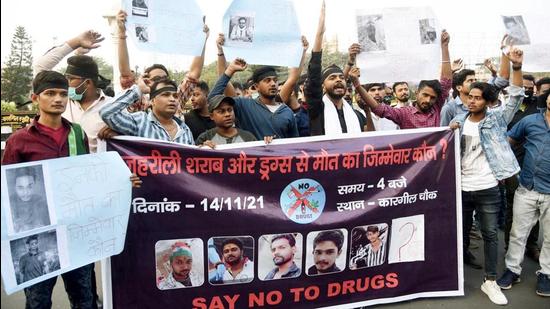
The day marks the shraddh ceremony for her 40-year-old husband, Mukesh Ram, one of the 41 people who died in Bihar between November 3 and November 10 in the most recent rendition of a hooch tragedy that spanned three districts – in a state that ostensibly has complete prohibition.
Her three-room house in the Harijan Tola of Muhammadpur village, made of brick and mortar, is locked from the outside, sealed by Bihar Police on November 6. Devi sits on the floor of a temporary shed meant for cattle, where two families that lived in the locked home now sleep. The first is her family, their home sealed on November 6 for allegedly breaking the law. The other is the family of her brother-in-law, Sunil Ram, in jail for the past two-and-a-half months, arrested for consuming liquor.
“On November 3, my husband, who worked as a daily wage labourer and earned ₹300 a day, complained of a headache and an inability to see. We rushed him to a private doctor in Motihari, and later shifted him to the Gopalganj district hospital,” said Prabhabati, holding her four young children. “Within hours, he was dead.”
Asked if her husband consumed alcohol, Prabhabati says nothing. But right next to her, neighbour Chandrama Ram says out loud an ill kept-secret: “Nearly everyone drinks.”
Around Devi, there are other homes in Harijan Tola in different stages of mourning. Suraj Ram (40) died a day after Mukesh, with the same symptoms. A few metres away is the home of Ramanand Ram, who spent days in hospital, developed difficulty in seeing, recovered, but is now in jail. In the deaths in November, this tola reported three of the 11 deaths in Gopalganj.
In the districts of Gopalganj, West Champaran and Muzaffarpur, 41 people died and 10 were treated in hospitals, in an incident which has again turned the spotlight on the prohibition law in Bihar, the effectiveness of its implementation five years after it was brought into force by chief minister Nitish Kumar, and hooch tragedies that seems to persist despite its existence.
LAW AND BEYOND
The immediate reaction to the outrage that the most recent cycle of hooch deaths has generated has been a wave of administrative action from the Bihar government. Twenty-five kilometres away from the Harijan Tola, in the diaras (river islands) that abut the Gandak river in Baikunthpur and Muhammadpur, the police demolished 45 bhattis (illegal distilleries) and destroyed 6,500 litres of illicit liquor in November.
More than 900 people have been arrested in a three-day drive in the first week of November under Section 30(a) of the Bihar Prohibition and Excise Act, 2016 in raids across 1,500 locations. In Gopalganj alone, 275 people were arrested and 105 FIRs were lodged, with 34 vehicles carrying hooch seized. In Samastipur, police arrested 65 people and lodged 32 FIRs. In East Champaran, 92 people have been arrested and 83 FIRs registered, with 11,000 litres of prohibited alcohol recovered, said Navin Chandra Jha, superintendent of police.
Overall, 106 people have died in hooch tragedies this year, officials of the excise department said. There are no figures available with the government on the total number of such deaths since April 2016, when the law came into force. Since then, the Bihar police have registered 255,000 FIRs and have arrested 212,000 people for violation of prohibition laws, with most being released on bail.
In several of Bihar’s villages, however, the law has not precluded the absence of alcohol, but new ways have been found to distribute low-grade liquor. In Gopalganj district, for instance, countrymade liquor called “BB (Bunty Babli)” is all the rage. Manufactured in Uttar Pradesh, it finds its way across the border at inflated rates.
“Originally priced at ₹50, a 180ml bottle is selling between ₹100 and 150 here,” said Ravindra Prasad Gupta, a village chief candidate of a village in Siwan. “In addition to this, there are other brands of countrymade liquor called Katrina and Laila that are also in great demand.”
Moti Lal Prasad of Bhagwanpur, who owned liquor vends before they were outlawed, said much of the spurious alcohol entering the state was through Uttar Pradesh and Nepal. “They come using road and river routes, transported through the Gandak river, mainly at night. They come in small containers of 10, 20 and 50 litres, and in small bottles. Prohibition has only increased black marketing,” he said.
Police in Gopalganj told HT that this liquor was being routinely transported to Bihar through ghats on the Gandak river, including Salempur (Barauli block), Pakhla ghat (Baikunthpur), Maharani ghat (Muhammadpur) and Bangra ghat (Bainkunthpur).
Gopalganj’s superintendent of police Anand Kumar describes the striking resemblance of the spirit with water as a major challenge, and one of the reasons why the influx is hard to stop. “The traders manage to slip by security personnel by hiding the bottles among lots of water. However, we have intensified our patrolling and search operations with the help of dog squads in all suspect areas, including Gandak’s riverine areas. We have also made the use of available drones for aerial patrolling,” he said.
At least three districts of Bihar – Siwan, Gopalganj and West Champaran – have borders with Uttar Pradesh while 11 districts share borders with Nepal. In the east, Kishanganj, Katihar, Purnia and Banka are close to West Bengal, while six districts of Jharkhand are across the border in Bihar.
Compounding this is a 726km Indo-Nepal border that has around 6,000 Bihar villages just in a 3kmradius and numerous open transit points. Every month, close to 200,000 people cross the identified 49 transit points between Bihar and Nepal, data from Bihar Police show.
Manoj Pandey, a journalist from Muhammadpur, said these ghats have long been used for smuggling, only the merchandise now has become bootlegged alcohol. “These ghats have been used for smuggling Nepali dalda, a vegetable oil cheaper than Indian vanaspati, and Chinese toys,” Pandey said. “Now they are used for liquor smuggling.”
HT spoke to a man from Muhammadpur involved in the trade who said that this “Nepalese” liquor was almost “pure spirit.”
“The mixture is one litre of spirit in five litres of water. To this is added nausadar, made of ammonium chloride which supplements the intoxicant in the drink. A 10 litre jar which costs ₹1,500 to make, fetches about ₹10,000 and is sold in pouches of 200ml each at ₹30 at the very least, but often much more. It is the improper mixture of spirit and nausadar that makes these concoctions deadly. At times, urea and stale rice is added as well, which is even more dangerous.”
Doctors at Gopalganj and West Champaran, two places which saw the maximum deaths in the most recent hooch tragedy, said most patients complained of vision loss and stomach pain. “The toxic ingredients choke the lung and the heart and cause blockages. The damage then spreads to other organs like the liver, pancreas and the eyes,” said Dr Manoj Kumar, a gastroenterologist in Patna.
A LOSING BATTLE
Over the past five years, the Bihar government has put in measures like so-called integrated check posts to stop the movement of liquor within the state. At the Kochaikot integrated check post in Gopalganj, at the border of Uttar Pradesh and Bihar, there are rows of what look like abandoned vehicles, almost like a parking lot. There are more than 300 vehicles including buses, trucks, SUVs and even motorcycles, all seized over the past two years.
The check post has five cameras, all of which were functional when HT visited the spot on November 12. In a room nearby, a television monitor records images, from the driver’s face to number plate to the goods being carried and searched. There are five such integrated check posts in Bihar, and 15 more are in the pipeline.
Milling around are a team of 24 excise officials and policemen in three shifts, separate from police personnel manning a nearby Bihar Police booth. And yet, those stationed here believe they are fighting a losing battle.
“On an average, 5,000 vehicles cross the check post, and given the resources, we can check only a 100 large vehicles on a given day. Loaded vehicles cannot be properly searched all the time,” said an excise department official posted at the Kochaikot check post.
“There are at least six motorable village roads connected with Uttar Pradesh cities of Kashiyan (22 km from Bihar border) and Kushinagar (40 km). Some farmers have land on other side and most from Gopalganj visit Gorakhpur for their medical and other needs. There is no checking at these places,” said Ramanuj Prasad, a resident of Kochaikot village.
Moreover, smugglers have developed new ways of bringing in liquor, such as the use of ambulances. On the morning of November 11, an ambulance with the registration number UP 11 BT 5759 and driving on the wrong side of the road was flagged by personnel at the check post. When it was surrounded, the driver jumped and fled, and bottles of liquor were found in the vehicle. A case has since been registered.
“The question where it is coming from or how it is being transported is not as important as the fact that this business generates black money and that in turn fuels crime. Illegal liquor used to come from other places earlier as well. Raids and seizure of bottles will not help. Those making money need to be targeted,” said Abhyanand, former director general of police in Bihar. He uses only one name.
FOR AND AGAINST
The recent tragedy has brought to the fore an old debate in Bihar, on the principle and effectiveness of prohibition. Even the Bharatiya Janata Party (BJP), part of the governing National Democratic Alliance, has asked for a review.
“There is a need to review the law. The liquor ban was a good initiative by chief minister Nitish Kumar, which had good intentions, and helped benefit women. But I believe that after six years, its success and failure should be re-evaluated,” Bihar BJP president Sanjay Jaiswal told HT. “There is a liquor mafia active in the state in connivance with police and administration, which is perhaps why the law has failed.”
The Bihar government has argued that there is evidence that suggests incremental acceptance of the liquor ban. According to the National Family Health Survey (NFHS) 2015-16, 29% of Bihar’s population used to consume alcohol. According to the NFHS 2019-20, this number has declined to 15.5%.
The ban on liquor has had a significant positive impact on women’s empowerment and domestic violence, according to excise and prohibition minister Sunil Kumar.
“The objective was empowerment of women, who were most vulnerable to alcohol related violence. Prohibition has left more money in the hands of families and women,” he said.
Cases of domestic violence have fallen to 2,397 in 2019 from 3,792 in 2015, data from National Crime Records Bureau show. The state government says it is due to prohibition.
The opposition has argued that the law has only meant that poor people have been targeted. “The Nitish Kumar regime has arrested lakhs of poor and Dalits under the Act. The actual liquor mafia is beyond the government’s reach. Can Nitish Kumar provide data of how many kingpins, liquor operators, smugglers and police officials have been sent to jail?” asked Tejashwi Prasad Yadav of the Rashtriya Janata Dal, leader of the opposition .
The law was harsher on users rather than suppliers, said Rakhi Sharma, chief executive of Disha De-addiction-Cum Re-habilitation Centre. “There is a need for a concerted drive against suppliers to break the chain, and for some leniency towards users,” sharma said. “The stringent laws affect weaker sections who are thrown into jail.”
State excise minister Kumar, though, made it clear that there would be no government climbdown.
“The policy is here to stay. Every effort is being made to ensure that excise department, police and intelligence work in tandem to make it more effective,” he said.


