
 E-Paper



In next stage of Covid-19 curbs, Delhi clamps curfew on weekends
The decision to step up restrictions came on a day when 5,481 cases (a positivity rate of 8.37%, although some experts are now coming around to the view that this isn’t the best metric for this phase of the pandemic), were added on Tuesday.

 Prefer HTon Google


A weekend curfew will be in place in the national Capital and at least half of the employees in private offices will need to work from home, deputy chief minister Manish Sisodia said on Tuesday after a meeting of the Delhi Disaster Management Authority (DDMA) to reassess curbs meant to reduce Covid-19 transmission.
The decision to step up restrictions came on a day when 5,481 cases (a positivity rate of 8.37%, although some experts are now coming around to the view that this isn’t the best metric for this phase of the pandemic), were added on Tuesday. But hospital occupancy does not seem to have risen in tandem – 531 of the 9,042 available Covid-19 beds were occupied, including 308 with “mild/asymptomatic” disease.
During the meeting, DDMA decided against activating the red alert curbs that form a part of the Graded Response Action Plan (GRAP). This level, the highest of four, is triggered if the test positivity rate breaches the 5% threshold for two days. It was 6.5% on Monday and hit 8.37% on Tuesday, and the fact that DDMA decided against moving to the highest level of alert has everything to do with the difference in this building wave of the viral pandemic -- a sharp spike in cases, but a much lower rate of hospitalisations than in previous waves.

In region after region seeing a spike in cases on account of the Omicron variant of the Sars-CoV-2 virus, this has been the trend. Delhi’s health minister Satyendar Jain said on Monday that 81% of samples sequenced showed that the infection was caused by Omicron.
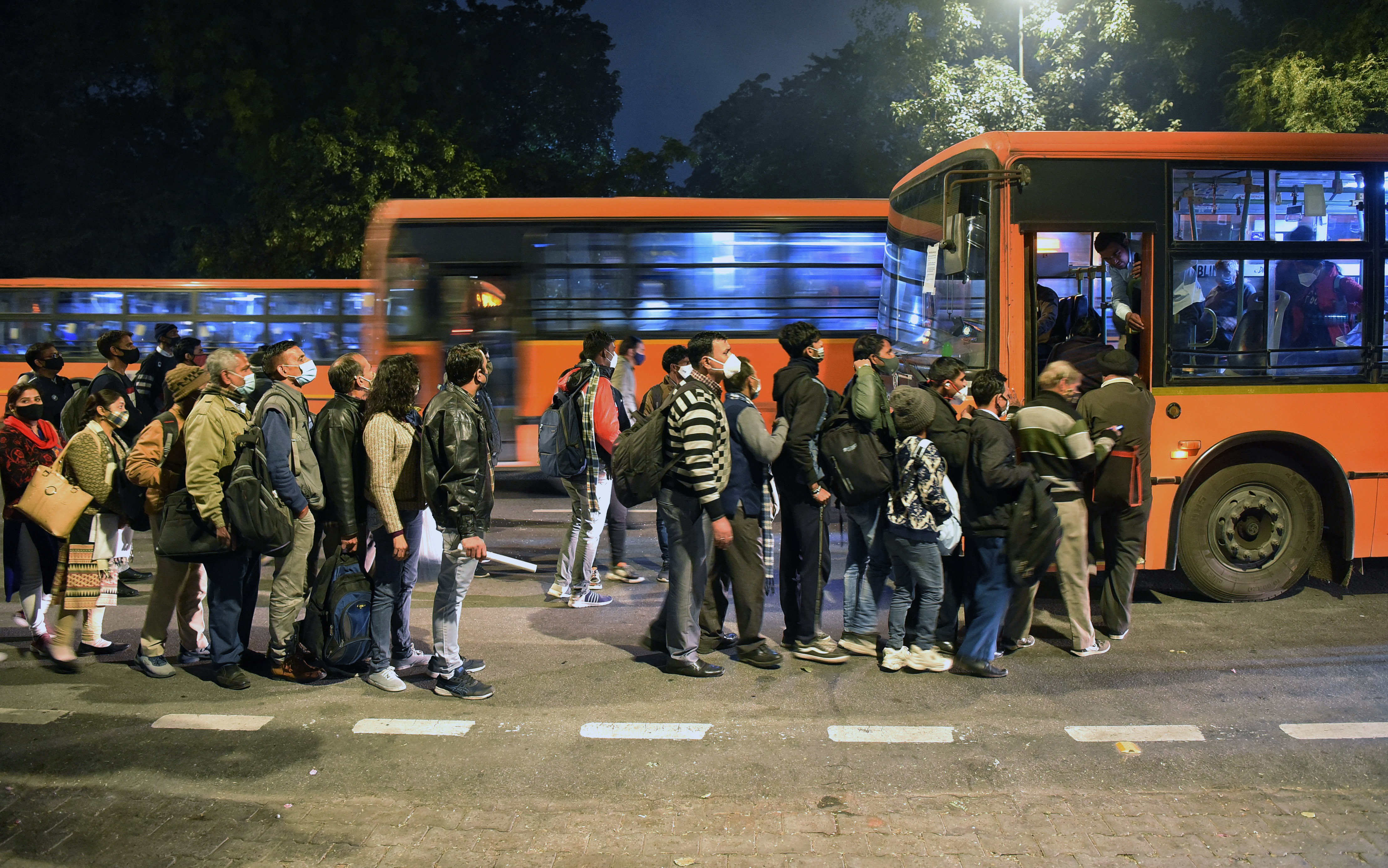
State-run buses and the Delhi Metro will operate at 100% seating capacity to avoid crowding at transport hubs such as bus stops and Metro stations, said the order of the DDMA, seen by HT. The move will reverse a 50% cap that led to crowding at stops. Passengers will, however, not be allowed to stand in metro trains or buses, and will need to take the next service, and officers will need to monitor crowding at stops and depots. It stated that action will be taken against concerned officials if violation of social distancing or mask wearing is found among passengers.
The weekend curfew, in line with the night curfew in force, will begin at 10pm on Friday and last till 5am on Monday.
Central government and judicial officials, diplomats, journalists and doctors will be allowed to travel as long as they have a valid identity card and people coming from or going to airports, railway stations or bus terminals will be allowed to proceed if they show a valid ticket.
Those working in other essential or exempted services, such as grocery shops, internet service providers, banks, delivery, petrol pumps and private security staff will need to show a valid curfew pass.
People who are travelling to seek medical attention will need prescription or medical documents, those travelling for examinations will need to produce admit cards and people attending weddings – allowed with a cap of 20 people – will have to show a wedding invitation, the order added.
Sisodia cited the rapidly increasing cases in the Capital but said the Omicron variant that is behind the surge was leading to significantly milder disease when compared to other variants. “But since cases are increasing swiftly, DDMA has decided to take certain preventive measures to contain the spread of infections in the city.”
DDMA has lieutenant governor Anil Baijal as its chairperson and chief minister Arvind Kejriwal, who tested positive for Covid-19 earlier on Tuesday, as the vice-chairperson. Members who attended the meeting told HT that Kejriwal did not attend the meeting via video conference.
The L-G office said in a statement that Baijal directed the government to ensure adequate availability of ICU/oxygenated beds, ventilators, essential medicines and sufficient supply of oxygen. “It was also advised to strengthen institutional quarantine facilities, home isolation strategy and to prioritise genome sequencing of hospitalised patients. It was also decided to work out on the basis of empirical data, all possible models of scenarios that could emerge in the days to come for further review of strategy,” the L-G office said.
DDMA also has All India Institute of Medical Sciences (AIIMS, New Delhi) director Randeep Guleria and Indian Council of Medical Research (ICMR) chief Balram Bhargava as experts.
Following the DDMA meeting, Delhi’s directorate general of health services issued an order directing all private hospitals and nursing homes in the city to reserve 40% of their total bed capacity for Covid-19 patients.
The deputy CM added that only essential activities will be allowed over the weekends. “In addition, all government employees have been asked to work from home or online. Private offices will have to ask at least 50% of their staff to work from home,” Sisodia said.
Delhi government departments catering to essential services such as Covid-19 management will work, as usual but all other Delhi government departments will work from home, the order said.
Sisodia said overcrowding at bus stops and Metro stations was discussed at length at the DDMA meeting.
“Since the highly mutated Omicron variant spreads much faster than the older variants, we cannot allow transport hubs to turn into super-spreaders. The recent decision of the DDMA to restrict passengers in buses and the Metro to 50% of the seating capacity is leading to excessive crowding and, therefore, it is being revoked. Buses and the Delhi Metro will now be allowed to operate with full capacity.”
On December 28, DDMA sounded a yellow alert under GRAP leading to restrictions including night curfew between 10 pm and 5 am and shutting of educational institutions, gyms, and cinemas. Markets and malls were allowed to operate on an odd-even basis. Delhi then had a positivity rate of 0.89%.
A day later, on December 29, at another DDMA meeting, an “amber alert” was issued for testing, tracking, and treating for checking the transmission of the virus including its Omicron variant.
GRAP spells out four levels of restrictions based on the positivity rate. The first level, classified as a yellow alert, is activated after the positivity rate remains above 0.5% for two consecutive days. The highest level is a red alert, which comes into play when the positivity rate breaches 5% and stays there for two consecutive days.
“There shall be no restriction on inter-state and intra-state movement / transportation of essential / non-essential goods. No separate permission / e-pass will be required for such movements,” Tuesday’s DDMA order stated.
Dr Rajeev Jayadevan, vice-chairperson of the research cell of Kerala’s unit of Indian Medical Association said: “The message that governments want to send through night curfews and weekend curfews is that infections are rising. During the day or during weekdays, if curbs are imposed, economic activities are impacted more. Such an announcement should be taken as a message to reduce outdoor gatherings and ensuring maximum precaution and these measures are effective.”


