E-Paper



In rural Haryana, the conundrum of Dalits goes beyond classification
In Kharkhoda, Dalits face challenges amid political promises ahead of October 5 polls, with subclassification stirring mixed feelings and hopes for change.

 Prefer HTon Google


On its best day, Kharkhoda is a shadow of its bigger cousin Sonepat. The hamlet of 40,000-odd people is a frustrating mess of cratered lanes where overloaded auto-rickshaws manoeuvre at unimaginable speeds round impossible corners, sometimes grazing the wares and vegetables displayed on either side of the road. The cacophony has only gotten sharper over the past month as street-corner canvassing has taken up whatever little space was left in this dense hamlet, and motorbike rallies are zipping through its grandly named but shabby looking chowks.
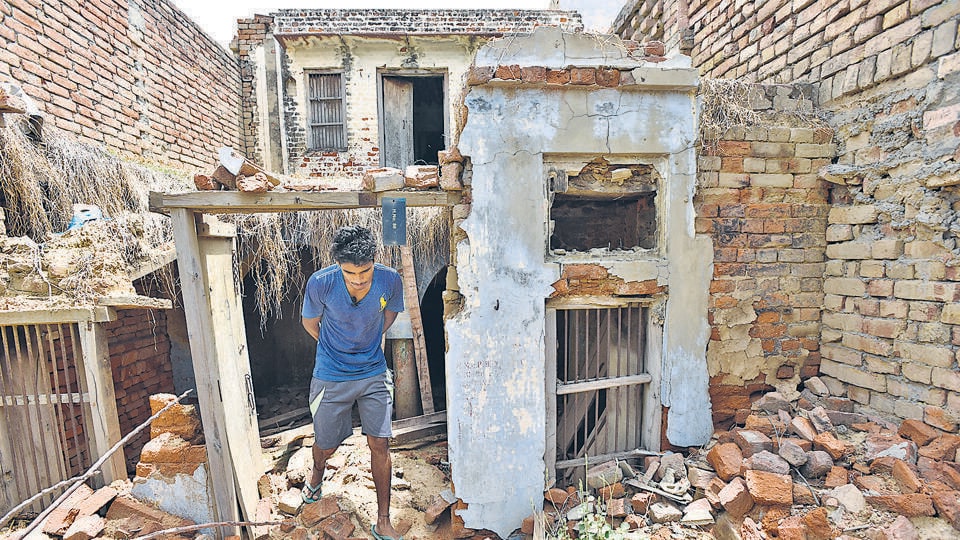
Ramesh Kumar, though, is untouched by the frenzy. The municipal worker knows the underbelly of Kharkhoda, cleaning sewers that drain the bile of the city. He isn’t moved by the lofty promises to attract voters in this constituency reserved for Scheduled Castes (SC). On his mind is a better life for his children, away from the foul darkness of the drains where he is forced to descend every day. A Balmiki, he has never voted for the Congress, which holds the seat, but is contemplating a change this time. “This time, I will vote for Congress because they promised jobs and better opportunities for people like us,” he said.
Kumar hails from a community that is in the crosshairs of a polarising debate around subclassification of the SC quota – the Balmikis, the second-largest SC group in Haryana, are likely to be the prime beneficiaries if the quota is internally benchmarked – but he isn’t sure of its benefits.
Just days before the polls, Haryana announced that it will divide SCs into deprived scheduled castes (DSC) comprising 36 groups such as Balmikis, Dhanaks, Mazhabi Sikhs and Khatiks, and other scheduled castes (OSC) comprising Chamars, Jatavs, Rehgars, Raigars, among others. The government decided that DSCs will have an internal reservation of 50% within the SC quota.
“The government’s announcement sounds good, but we haven’t seen anything on the ground yet. What we need are real changes — better housing, jobs, and schools for our children. Until then, it is hard to trust these promises,” he said.
Sunita Devi, a housewife and mother of three, echoed his sentiment. “Our family struggles to make ends meet. I will vote for whoever can bring us some relief. The subclassification of SC quota seems like a good idea, but how will it help us here in Kharkhoda?” she asked.
Haryana goes to the polls on October 5. Dalits, comprising around a fifth of Haryana’s population, are considered the swing vote in a state where caste fault lines run deep and where the dominant Jat community is often lined up against an amalgam of groups led by other backward classes (OBCs) and “upper castes”.
For decades, the Dalit vote was seen as a monolith, influenced by largesse or violence. But hamlets such as Kharkhoda are also where newer narratives centered around aspiration such as subclassification are playing out, with ramifications that can change the dynamics of national politics.
Promises vs reality
In August, the Supreme Court permitted states to internally subdivide the SC quota, arguing that the access of some communities to reservation benefits was unequal. The landmark decision immediately kicked off a furious debate, with some groups welcoming the verdict and others alleging that it will politicise the quota and cause division within the marginalised castes. Days later, Haryana became the first state to announce internal divisions in its SC quota.
On the ground, its impact is uneven. For many Balmikis such as Devi, patchy implementation of reservations has left a sour taste in the mouth. “We need health care, education, and jobs first. I hope things will change, but we’ve heard promises like these before,” she said.
Rajesh Balmiki, a young voter, also emphasised the importance of tangible improvements. “Subclassification might help in the future, but what about now? We still struggle with basic facilities like clean water.”
But the first signs of change are already visible. “If you go into the villages, you’ll now find Balmikis who have started calling themselves DSC. The change may not move votes but identity is slowly shifting,” said Bajrang Indal, a Dalit activist.
In Narwana, a hamlet dominated by the Jatav or Chamar community in Jind district, the mood is decidedly more hostile. They are the largest of the SC groups and form one half of the state’s Dalit population, and have come out against subclassification. “Not many people in our community are educated, nor has anyone tried to motivate us for better education,” explained Anil Chauhan, a clerk in a private company. To him, the question of subclassification is only cosmetic, potentially even dangerous. “Subclassification? What’s that going to change for us?” he asked.
Government data shows that roughly three-fourths of Dalits in Haryana are dependent on agriculture. “This means that they’re dependent on dominant caste or Jat landlords on whose fields they are used as labour. Subclassification has failed to fire aspirations in a big way, for now, because local people are still tied to agriculture and getting the next generation educated is the biggest challenge,” said Ashok Bharti, chairman of the National Confederation of Dalit Organisations.
“This is also why both major parties have kept quiet about sub-classification. Even the BJP, after making the announcement, has hardly mentioned it prominently on the campaign trail,” he added.
The divide within
Haryana reserves 17 assembly and two Lok Sabha seats for SCs. In the 2014 and 2019 Lok Sabha polls, the BJP swept the state but in 2024, it lost both SC seats. In the assembly, too, the party has been slipping. In 2014, it won nine SC-reserved segments but could retain only five in 2019.
This time, the Congress has focussed on building its narrative of protecting the Constitution, a caste census and more welfare for Dalits – a potent formula that fetched it five of the 10 Lok Sabha seats in the state this summer.
The BJP has attempted to counter this by reminding people of the atrocities during the tenure of former chief minister Bhupinder Singh Hooda, and the alleged disagreement between him and former Union minister Kumari Selja, who stayed away from the campaign for roughly two weeks over an alleged ticket distribution dispute.
“Selja continues to have a big following among Chamars and so the issue has had some impact in cooling enthusiasm for the Congress. So you may not see en masse voting for the Congress like you did in the Lok Sabha,” said Indal.
In Narwana, Shiv Kumar Bedi concurred. A middle-aged man dressed in trousers and t-shirt, Bedi sat on a small wooden stool outside his shop, carefully hammering a worn-out shoe. His hands, calloused from years of manual labour, reflect the years of hard labour.
“I have been voting for Congress for as long as I can remember,” he said, eyes still focused on the shoe.”But this time, I am in two minds.”
Also in the fray are two smaller alliances making a specific play for the Dalit vote. The first is the Indian National Lok Dal-Bahujan Samaj Party coalition and the second is the tie-up between the Jannayak Janata Party and the Azad Samaj Party of Lok Sabha MP Chandrasekhar Azad.
“They may get some votes but they’re small players. Plus since the Jats are unlikely to move to either INLD or JJP, I feel like voting for them would be a waste of my vote,” said Kavita Chauhan.
Whether it is Narwana, a seat the JJP won in 2019, or Kharkhoda, one the Congress retained by just 1,500 votes, the sentiment that the opposition party has an edge is common. Plus, voters such as Kavita also underline that wider causes — such as the resentment against Agnipath or farmer woes — are also shared by Dalit families. “The paper leaks that has happened and children have lost their seats in the re-exam will impact the election against BJP,” said Sunil Dhillon, a voter.
Memories of Mirchpur
As elections draw close, speculations about the Dalit vote have hit a fever pitch. Will Selja’s return to the campaign trail change dynamics? Will smaller alliances syphon off votes from the Congress? What about the parole of convicted rapist Gurmeet Ram Rahim? Will the deras influence some votes around Hisar or has their influence been overblown and largely fading?
For lawyer Rajat Kalsan, these questions mean little.
His view is still coloured by the atrocity perpetrated by Jat mobs a decade ago in Mirchpur. On April 19, 2010, a dog barked at some Jat boys in a Balmiki colony in Haryana’s Hisar district. In anger, one of the Jats hurled a brick at the dog, but was confronted by the canine’s owner – a Dalit. Enraged at the affront, two days later, around 400 Jat men burnt down 18 houses, killing a 70-year-old man and his polio-affected daughter. Terrorised and fearful for their lives, scores of Dalit families spent the better part of the next decade on the streets, unable to return to their village. At the time, Hooda was CM.
Today, around 100 families have been rehabilitated but some still await plots. Those who were given land near Hisar have started rebuilding, but still have to pay a monthly sum to the government for the plot. Their lives are far from normal. “Most still struggle to earn a livelihood. The only available jobs are that of security guards. It’s not even enough to put children through school,” said Kalsan.
The stigma of Mirchpur lingers. “In school or in neighbourhoods, everyone knows that these people are the victims, and treat them as such. Taunts and discrimination are common, as are threats from dabangs (strongmen),” he added.
“Little has changed in real terms. The Jats still dominate the police and local administration.”
The irony of the elections – where three major outfits wooing Dalits (Congress, INLD-BSP, JJP-ASP) also have Jats at the centre of their electoral calculations – is not lost on the Mirchpur victims. Ahead of voting day, this dichotomy between ground realities and poll narratives only gets sharper.
Satyawan is one of the Dalits whose life was upended that April day. Over the last decade, he has spent time in court, fending off threats and struggling to earn enough money for his family. He isn’t sure the future holds better prospects. “We can never go back, but we can hope to push our children out of here. But will anyone help us?” he asks. “I am not sure.”