E-Paper



Include disaster resilience in higher education: PM Modi at CDRI conference
The CDRI conference is taking place in Nice, France, ahead of the Third UN Ocean Conference in which resilience of coastal areas will also be discussed

 Prefer HTon Google


New Delhi: Courses, modules and skill development programmes on disaster resilience need to become part of higher education, Prime Minister Narendra Modi said on Saturday at a two-day conference, organized by Coalition for Disaster Resilient Infrastructure in Nice, France, laying down five key areas for disaster preparedness.
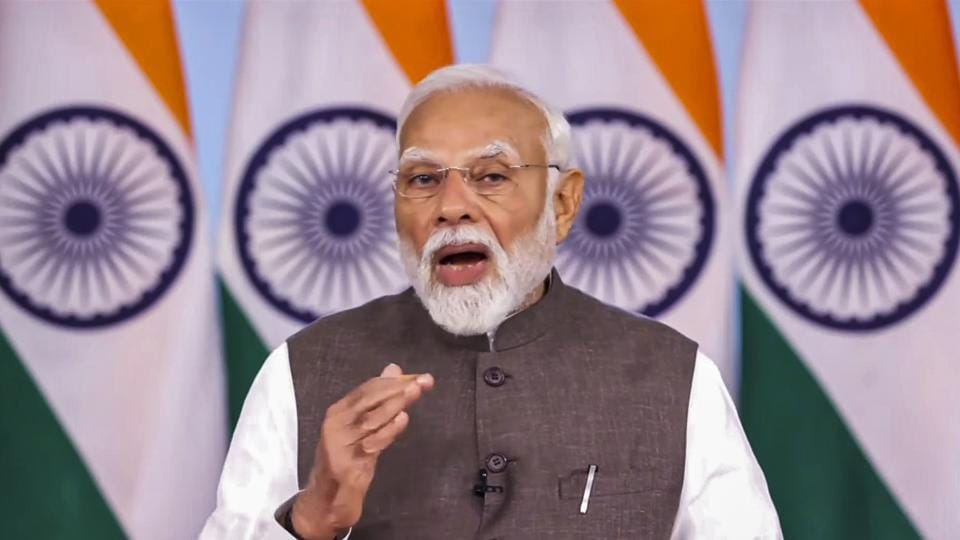
“Including disaster resilience in higher education will help build a skilled workforce that can tackle future challenges. Secondly, many countries face disasters and rebuild with resilience. A global digital repository of their learnings and best practices would be beneficial,” Modi said, in his video address.
Thirdly, disaster resilience requires innovative financing, Modi emphasised. “We must design actionable programmes and ensure developing nations have access to finance,” he said.
“Fourth: We consider Small Island Developing States as Large Ocean Countries. Due to their vulnerability, they deserve special attention,” Modi said adding: “Fifth: Strengthening early warning systems and coordination is crucial. This helps timely decisions and effective last-mile communication. I am sure that discussions in this conference will consider these aspects. Let us build infrastructure that stands firm against time and tide. Let us build a strong and resilient future for the world.”
The CDRI conference is taking place in Nice ahead of the Third UN Ocean Conference in which resilience of coastal areas will also be discussed.
“The theme of this conference is ‘Shaping a Resilient Future for Coastal Regions’. Coastal regions and islands are at great risk due to natural disasters and climate change. In recent times, we saw: Cyclone Remal in India and Bangladesh, Hurricane Beryl in the Caribbean, Typhoon Yagi in South-east Asia, Hurricane Helene in the United States, Typhoon Usagi in Philippines and Cyclone Chido in parts of Africa. Such disasters caused damage to lives and property,” Modi said.
Further he recalled: “India also experienced this pain during the super-cyclone of 1999 and the tsunami of 2004. We adapted and rebuilt, factoring in resilience. Cyclone shelters were constructed across vulnerable areas. We also helped build a tsunami warning system for 29 countries.”
CDRI is working with 25 Small Island Developing States. Resilient homes, hospitals, schools, energy, water security and early warning systems are being built. Given the theme of this conference, I am glad to see friends from the Pacific, Indian Ocean and the Caribbean here. Further, I am happy that the African Union has also joined the CDRI, he said.
With approximately 37% of the global population residing within 100 km of the coast, contributing around $1.5 trillion to the annual global GDP, and 90% of global goods transported by sea, strengthening coastal resilience is now a global priority, CDRI said.
Mohamed Irfaan Ali, President of Guyana, said, “We need a global push to unlock the resources required to bolster climate adaptation for the vulnerable regions, especially for small islands and low-lying coastal areas. For us, climate-resilient infrastructure is a question of survival.”
David WR Adeang, President of the Republic of Nauru said, “This conference is an opportunity to move from dialogue to delivery. Let us work together to ensure no nation and no community is left behind in building a future that is not only resilient but fair, inclusive, and sustainable.”
Gaston Browne, Prime Minister of Antigua & Barbuda said: “Resilient infrastructure is not just a policy option—it is a necessity for survival. We believe that resilience begins not at the shoreline but in the minds and systems we build.”
The 54-member global coalition, CDRI, said it is committed to advancing climate and disaster resilient infrastructure across Africa. Other announcements include the awarding of research grants for 53 projects spanning 21 countries, as well as a call to action for accelerating infrastructure resilience in small island nations.
In a separate event in Geneva, M Mohapatra, Director General of Meteorology, India Meteorological Department (IMD), was awarded the United Nations Sasakawa Award 2025 for Disaster Risk Reduction on Friday. The award was conferred for minimising deaths due to any cyclone over the north Indian Ocean region, not only in India, but also in 13 World Meteorological Organisation member countries bordering the Bay of Bengal and the Arabian Sea.