
 E-Paper



India, Japan PM ride bullet train, Modi meets governors of Japan’s prefectures
At their summit meeting on Friday, Modi and Ishiba decided to launch a next-generation mobility partnership as part of a roadmap for bilateral relations over the next decade

 Prefer HTon Google


New Delhi: Prime Minister Narendra Modi and his Japanese counterpart Shigeru Ishiba travelled on the Shinkansen bullet train from Tokyo to the northeastern city of Sendai on Saturday for a meeting with governors of Japan’s prefectures aimed at enhancing collaboration with Indian states.
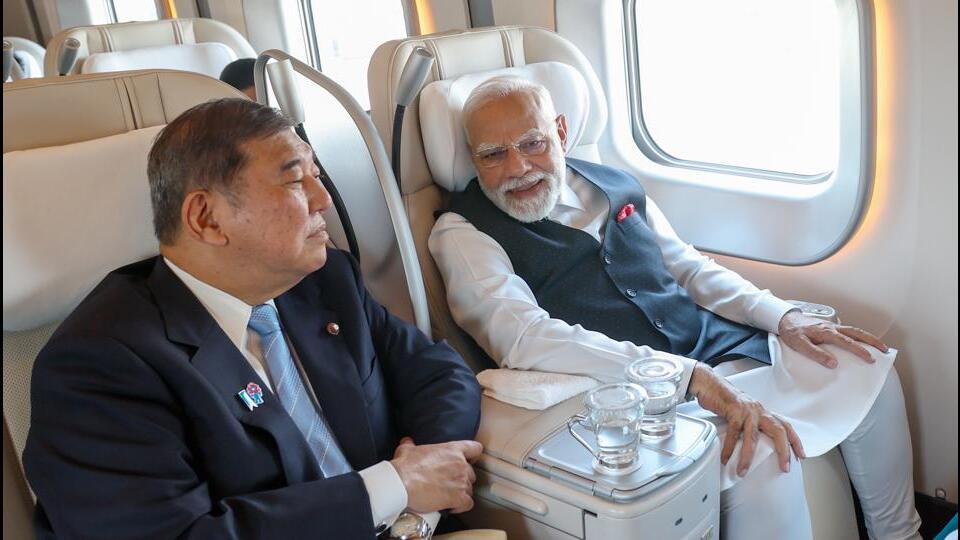
The train ride was of symbolic importance, reflecting the continued commitment of both countries to the Mumbai-Ahmedabad high-speed rail project, which will use Shinkansen trains and has run into several delays and cost overruns. Modi posted images on social media of the two PMs seated together in the train capable of running at speeds of up to 320 kmph.
At their summit meeting on Friday, Modi and Ishiba decided to launch a next-generation mobility partnership as part of a roadmap for bilateral relations over the next decade, including high-speed rail systems with “Make in India” next-generation rolling stock, operational control systems, and energy transition in the railway sector.
The leaders described the Mumbai-Ahmedabad high-speed rail venture as a flagship project of India and Japan and agreed to work on launching its operations at the earliest, along with the introduction of the latest Shinkansen technology. Japan has offered to introduce the E10 Shinkansen, currently undergoing trials, in India in the early 2030s.
On reaching Sendai, Modi interacted with the governors of 16 prefectures to discuss opportunities for their collaboration with Indian states. Describing such cooperation as a vital pillar of India-Japan friendship, he said on social media, “There is immense scope to cooperate in areas like trade, innovation, entrepreneurship and more. Futuristic sectors like startups, tech and AI too can be beneficial.”
He told the governors that the time had come to give a renewed push to state-prefecture engagement, going beyond ties centred around Tokyo and Delhi. He emphasised the State-Prefecture Partnership Initiative launched at the annual summit on Friday to boost trade, technology, tourism, skills, security and cultural links between the two sides.
Modi urged the Japanese governors and Indian state governments to leverage the new initiative to forge partnerships in manufacturing, technology, innovation, mobility, next-generation infrastructure, startups and SMEs. He also invited the governors to participate in India’s growth story and to contribute towards youth and skills exchange commitments made by the two countries, while combining Japanese technology with Indian talent.
Modi and Ishiba also visited a factory of Tokyo Electron, a semiconductor major that has a tie-up with India’s Tata Electronics to develop semiconductor equipment infrastructure for its fabrication plant in Gujarat and its assembly and test facility in Assam.
“We went to the Training Room, Production Innovation Lab and interacted with top officials of the company. The semiconductor sector is a key area for India-Japan cooperation,” Modi said on social media.
Semiconductors, along with telecommunications and critical minerals, are a key part of a new Economic Security Initiative launched by Modi and Ishiba on Friday to drive bilateral cooperation in securing and strengthening supply chains for critical goods and sectors.
The visit to the Tokyo Electron facility gave the leaders a practical understanding of opportunities for the two countries to forge collaboration in the semiconductor supply chain, fabrication and testing, the External Affairs Ministry said.
The visit to Sendai also highlighted the complementarity between India’s semiconductor manufacturing ecosystem and Japan’s strengths in advanced semiconductor equipment and technology. Both sides reaffirmed their commitment to deepen cooperation in this sector, building on an agreement for a semiconductor supply chain partnership and other partnerships under the industrial competitiveness partnership and economic security dialogue.
This joint visit “underscored the shared vision of India and Japan to develop robust, resilient and trusted semiconductor supply chains,” the ministry said.
Ishiba hosted a lunch for Modi in Sendai that was joined by the governor of Miyagi Prefecture. The PM subsequently left Sendai for the Chinese city of Tianjin, where he will hold a bilateral meeting with President Xi Jinping on Sunday and participate in the Shanghai Cooperation Organisation (SCO) Summit on Monday.



