
 E-Paper



Indian seafarers deal with sinking hearts, burning ships amid US-Iran war: ‘New hobby to spot jets, drones’
Hundreds of Indians working on various vessels across Gulf region now on frontlines of conflict ever since the US and Israel attacked Iran and latter retaliated

 Prefer HTon Google


For 26-year-old Ambuj, an Indian seafarer stranded at the Iranian port of Bandar Abbas, the "new normal" involves a constant, haunting hum of fighter jets, and a terrifying new skill of identifying drones from the deck of his merchant vessel. Ambuj is just one of hundreds of Indian nationals working on various vessels across the wider Gulf region who now find themselves on the frontlines of a conflict ever since the US and Israel attacked Iran, and the latter retaliated.
Also read | Trump says China, UK, others will 'hopefully' send warships to keep Strait of Hormuz 'open and safe'
"We know how dangerous it could be to sail without a navy escort or without permission," Ambuj told news agency Reuters, describing a state of high alert that has lasted for over a fortnight.
His crew first panicked in early March when their captain received a wireless warning from Iran’s Islamic Revolutionary Guard Corps (IRGC), stating that any attempt to pass through the Strait of Hormuz would have "consequences".
"I have not been home for six months and cannot wait to see my family," Ambuj said, currently waiting alongside 15 other crew members and 50 other ships for a safe passage that remains elusive.
"The company I work for has released us from duty and we are now waiting for safe passage because flights from Tehran are not operating. If we get clearance to sail to the Middle East or anywhere nearby, we will dock there and take the earliest flight home," he said.
M Kanta, stationed on another India-bound ship, described how the crew’s "hearts sink" every time a drone or fighter jet passes overhead. This reached a breaking point when Iranian authorities ordered the crew’s Starlink internet service to be disconnected.
Also read | Oil ship Shenlong's such a long journey to India via Hormuz Strait: Gone dark, fear lurked
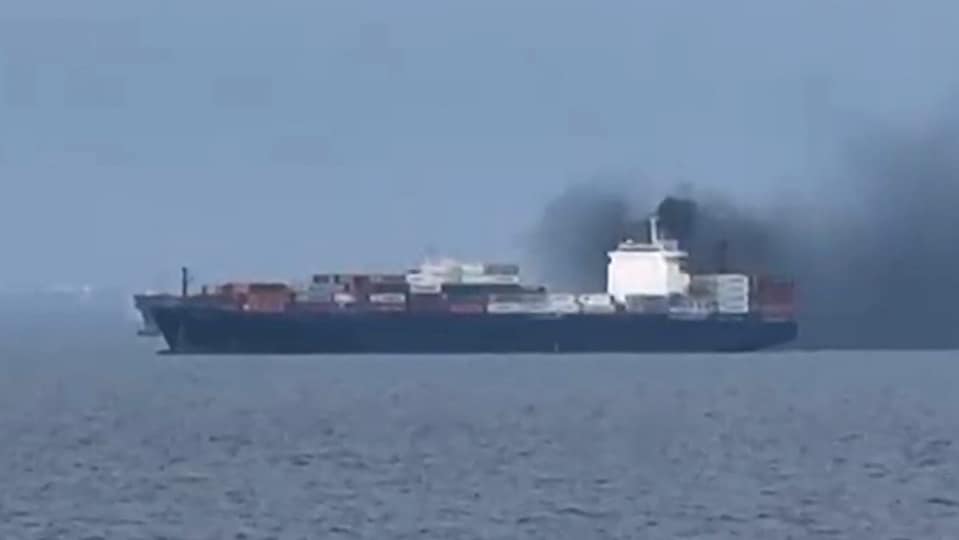
For several days, the sailors were cut off from their families and verified news, left only with the sounds of sirens and the sight of fire on distant ships. Though the internet service was restored after March 6, the atmosphere remains grim. Another crewman, who did not want to be named and whose ship is carrying bitumen and crude, recalled the moment he saw a nearby vessel hit by a drone just a few nautical miles from the Strait.
"Sleeping is hard. There is a lot of anxiety," he said, “One hobby these days is identifying planes, jets or drones we can spot from the ship.”
The Indian Ministry of External Affairs has confirmed that five Indians have lost their lives and one remains missing in the ongoing West Asia conflict.
Against this backdrop of fear, a breakthrough occurred on Saturday morning. The Indian government confirmed that two India-bound liquefied petroleum gas (LPG) carrier ships — the Shivalik and the Nanda Devi — successfully transited the Strait of Hormuz.
The vessels, which were chartered by the Indian Oil Corporation (IOC), are carrying a combined 92,700 tonnes of LPG, critical amid domestic supply concerns.
Rajesh Kumar Sinha, special secretary in the ministry of shipping, said at a media briefing that both ships are now headed toward the western Indian ports of Mundra and Kandla in Gujarat, where they are expected to dock on March 16 and 17.
More than 20 other Indian-flagged vessels remain positioned west of the Strait, awaiting similar clearance. External affairs ministry spokesperson Randhir Jaiswal stated that New Delhi is in "constant touch with key stakeholders" to ensure "safe and unimpeded transit" for these remaining ships.
Iranian officials in New Delhi have attempted to project a cooperative stance. Dr Abdul Majid Hakeem Ilahi, the representative of Iran’s Supreme Leader in India, told ANI that the Iranian embassy had "tried to provide an opportunity" for the Indian ships to cross. He reiterated that Iran views India as a friend, a sentiment echoed by Iranian Ambassador Mohammad Fathali, who spoke of a "common fate" between the two nations.
However, Ilahi also dismissed US President Donald Trump’s suggestions of a negotiation to end the conflict, stating that Iran is "ready to continue this war till the end, even for five years". He insisted that Iran considers the conflict "imposed upon it" and will continue to defend its territory.
The Strait of Hormuz is the world's most vital maritime chokepoint, handling roughly 20% of global oil and seaborne LNG supplies.
For India, which is the world’s third-largest supplier of seafarers with over 300,000 sailors in global fleets, the safety of its maritime workforce is as much a priority as its energy imports.


