E-Paper



India’s elite race walkers make a mark, with Paris on their minds
A country can send max. 3 athletes in each event to Olympics, and no other track and field discipline in India has qualified athletes exceeding spots on offer

 Prefer HTon Google


At the first international meet of his race walking career in Japan in March last year, Akshdeep Singh remembers standing at the start line with a smile. Fresh off breaking the men’s 20km race walk national record (1:19:55) a month earlier, the 24-year-old from Punjab had also become the first Indian male to breach the 2024 Paris Olympics qualifying mark. His mind was free lining up in Japan, he said, and his heart pumping.
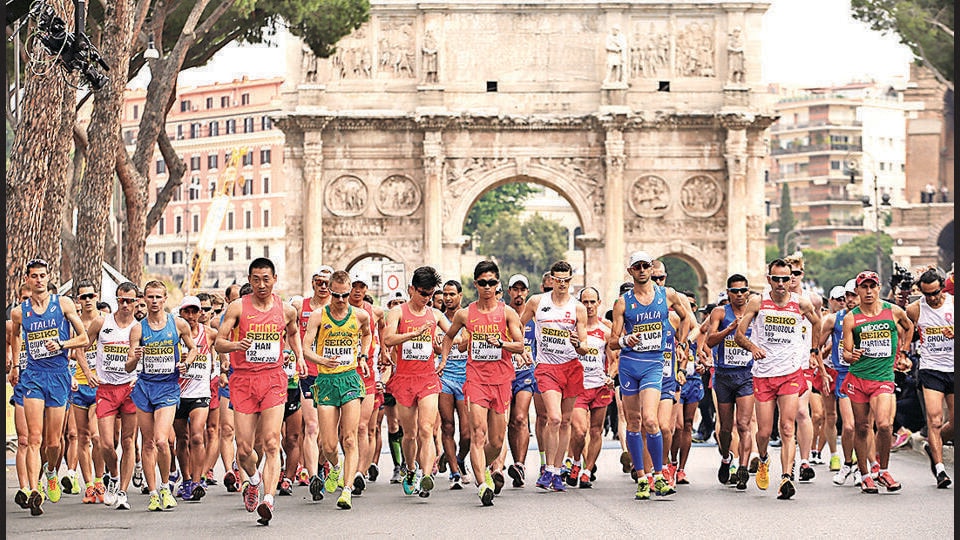
A year on, Akshdeep has lowered his own national record, and has been joined by six other Indian male race walkers in making the qualification cut for the Games.
Akshdeep’s growth, in a way, is a microcosm of the progression arc race walking appears to be undergoing in the country. Eight Indian walkers — seven male and one female — have dipped below the 20km event qualification standard for Paris (1:20:10 for men, 1:29:20 for women), in a discipline that is highly technical if not hugely popular among athletics fans.
Earlier this month, Ram Baboo became the seventh male to meet the Paris yardstick with a personal best time of 1:20:00 at a meet in Slovakia. He put his name alongside Vikash Singh, Paramjeet Singh Bisht, Suraj Panwar, Servin Sebastian, Arshpreet Singh and Akshdeep, who set a new national record (1:19:38) while winning the Indian Race Walking Championships in January. The experienced Priyanka Goswami, who competed at the Tokyo Games three years ago, is the lone female in the mix so far, having secured her qualification nice and early last year in the same meet as Akshdeep.
A country can send a maximum of three athletes in each event at the Olympics, and no other track and field discipline in India thus far has its qualified athletes exceeding the spots on offer. Winning a medal in Paris might still be a tough ask amid world-class competitors — in Tokyo, Priyanka finished 17th and Sandeep Kumar was the best Indian male at 23rd — but the swelled volume of Indian walkers staking a claim to be there is noteworthy.
“A lot of us are at 1:20, and a couple of us 1:19. So, many of us qualifying for the Olympics is a great sign for race walking in India,” Akshdeep said from South Africa, where he and most other qualified walkers are currently camped training under Russian coach Tatiana Sibileva.
The presence of a foreign coach, introduction of nuanced technical training and routines and the hunger of individual walkers to touch new peaks form the crux of this uptick in race walking in the country. Paris qualifications isn’t a standalone. At the 2022 Commonwealth Games, two Indians (Priyanka and Sandeep) won medals in race walking, twice as many from the previous editions combined. The same year, an Indian women’s 20km team won bronze at the World Athletics Race Walking Team Championships.
Not the first choice The common thread between most of these walkers is that race walking wasn’t their first choice. Priyanka was a gymnast in school who switched to athletics because she wanted to run. Baboo wanted to be a marathon runner. Akshdeep too picked up running with the hope of getting recruited in the Army.
“A coach in my village told me about race walking and that it could be a quick route to get a job. That’s how race walking began for me. Once I started winning national medals, I realised this could be my career,” Akshdeep said.
Baboo’s running days were curtailed by frequent injuries “due to lack of proper diet and guidance,” as he puts it. “So, my coach asked me to change the event, saying ‘ho sakta hai race walking mein acha kar jao (maybe you could do well in race walking)’,” Baboo said.
Most technical of eventsAkshdeep won several junior and senior national medals, taking steady strides in the sport, but the giant leap in his career came last year when he achieved two firsts – broke the national record and competed in an international meet. He puts it down to the presence of coach Sibileva, the former Russian race walker who has been guiding most of the seven qualified Indian male race walkers since 2022.
Greater attention is given to technique in a discipline considered one of the most technical in athletics. In race walking, one foot has to remain in contact with the ground at all times, and the knee straightened as the foot makes contact. Disqualifications due to technique are common even at the top level).
“The kind of workouts I’ve done and the improvements I’ve seen in my training methods, I hadn’t before,” Akshdeep says. “Earlier, the focus wasn’t so much on technique. Under this coach, we’re focussing a lot on technique alongside speed. The coaching experience and expertise is the main reason why race walking is in such a space right now in India.”
Training routines are carefully planned. Akshdeep, for instance, dedicates his mornings from Monday to Saturday to walking training, which ranges from 15km to 25km. The evenings alternate between strength training, running, swimming and rest.
Foreign exposure trips to places like Pretoria, where Akshdeep and his group is based currently for altitude training, play their part. Priyanka, too, is abroad, training in Australia under coach Brent Vallance.
“He analysed all my data for the past year,” Priyanka said in an earlier interview. “I’ve spent plenty of years doing this. But not once did I have a plan for an entire year. This coach is looking more long-term; he wants me to compete in certain events and peak in others.”
“There has been an introduction of sports science into our event, which has helped us upgrade our training methods,” Baboo says.
As training systems have upgraded, so have the walkers’ goals and motivation to break barriers. Two of the seven qualified male walkers have dipped to 1:19, and the others too are eager to get there.
“For us athletes, every event has a certain barrier,” Baboo said. “Like in javelin, once the 80-plus barrier was broken, a lot more throwers threw beyond that in India. Same is the case with race walking. A lot more athletes come up and believe they too can do that. That is why the standard of race walking in India has gone high.”
Bridging global gap While standards in India have risen, there’s still plenty of room to go toe to toe with the elite in global meets. KT Irfan’s 10th-place finish at the 2012 London Games remains the standout Indian race walking result at the Olympic stage. Most of India’s current crop of male walkers lack the experience of competing in big meets alongside the cream of race walkers.
“Indian jumpers, for example, compete in Gold Level and Diamond Level meets. If we get to compete in such big meets, it will help,” Baboo said. “If we compete with those world-class athletes, observe them, understand them and their race strategy, it will help us get better.”
This is why Priyanka decided to shift her training base this year to Australia, where she is in the company of some of the top race walkers, including Olympic and world medallists.
Akshdeep, too, reckons a “little more experience at the world level” will go a long way in further developing India’s race walking stocks. “Once we start competing more at the elite level, the competitiveness in India will rise further and we will improve more at the world level,” he said.
“I believe in the next year or two, India will take a greater stride in race walking globally.”