On Saturday, the monsoon arrived in Delhi and Mumbai on the same date – the usual arrival time for these cities is nearly a fortnight apart – marking the first time in more than 60 years this has happened. Experts said the phenomenon is one of several instances that highlight that monsoon’s behaviour is getting more and more erratic every passing year with the annual rains fluctuating over the last 30-40 years. As a result, some regions have witnessed a
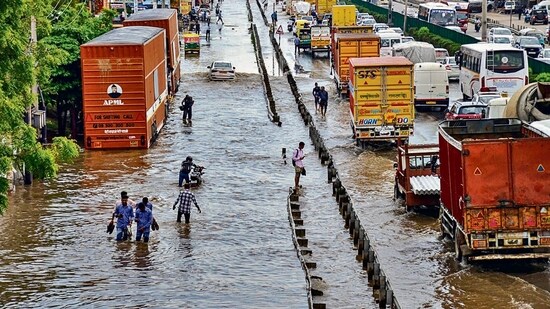
On Saturday, the monsoon arrived in Delhi and Mumbai on the same date – the usual arrival time for these cities is nearly a fortnight apart – marking the first time in more than 60 years this has happened. Experts said the phenomenon is one of several instances that highlight that monsoon’s behaviour is getting more and more erratic every passing year with the annual rains fluctuating over the last 30-40 years. As a result, some regions have witnessed a reduction in rainfall, while others have got shorter and more intense rain spells.
M Mohapatra, director general, India Meteorological Department (IMD), said that a major observation that scientists have made with respect to monsoon patterns in the country over the last few years is that parts of northeast India – including states that historically record the highest rainfall in the country – are now consistently recording less rain. However, in parts of northwest India, total rainfall is increasing every year, but the spells of rain are becoming shorter and more intense instead of being more spread out. This means that the number of rainy days in these parts is reducing.
Also read | IMD discovers new weather pattern as monsoon covers 80% of India
“We are witnessing some alterations in monsoon patterns, including onset dates, coverage and monsoon behaviour in various parts of the country. We are closely monitoring these trends and are adapting our systems to accommodate these changes, to ensure that our forecasts and warnings are accurate,” he said.
These findings are backed by HT’s own analysis of IMD’s long-term data of India’s June-September monsoon season which shows that the share of “heavy” and “extreme” rain in total monsoon rain has been increasing consistently since at least the 1970s. The share of “heavy” and “extreme” rain in total monsoon in the 2011-2020 decade was 43.3% – the highest among all 12 decades starting from 1901-1910. In the 2013-2022 decade, the share of such rain further increased to 43.4% (see chart).
Read: Unusual pattern sheds light on how monsoon line takes shape
Meanwhile, monsoon patterns in the country have followed a different route than usual. Weathermen primarily attributed the fluctuations to the severe cyclone Biparjoy, which made landfall at the coast of Gujarat on June 15. Met officials explained that the cyclone sapped moisture from the western arc of the monsoon, which thereby slowed the progress of monsoon in these parts. For 2023, rainfall data also shows that one sign of this monsoon season being erratic is that rain of “heavy” and “extreme” intensity has a much smaller deficit than overall rain. According to IMD’s gridded dataset, overall rain has a deficit of 17.1% up to 8.30am on June 26, while “heavy” and “extreme” rain combined has a deficit of just 6.9% compared to the 1961-2010 average, the benchmark for rain. While overall rain is ranked 95th highest (or 29th lowest) since 1901, “heavy” and “extreme” rain is ranked 68th highest (or 56th lowest).
To be sure, the smaller deficit in “heavy” and “extreme” rain is despite the fact that 64% of the country has not received rain of such intensity at all, whereas only 0.1% of India’s total area is yet to receive any rain this June.
IMD scientist DS Pai said that at least for the last 30-40 years, there have been fluctuations in various aspects of monsoon in India, including changes in usual onset dates in various states, rainfall trends and also the overall coverage of monsoon across the country. “Apart from fluctuations in rainfall data in different parts, we are also observing that over the past few years, the progress of monsoon is becoming slower till it reaches central India; after it reaches northwest India, the progress becomes very fast,” Pai said.
Experts also said that the human-induced climate crisis could be a factor behind such consistent change in monsoon trends. Mahesh Palawat, vice-president (meteorology and climate change), Skymet Weather – a private weather forecasting service – said that climate change and rapid urbanisation have a major role to play in altering monsoon patterns, especially in urban centres.
“Extreme concretisation results in water being left accumulated in the surface without finding a way to reach the soil from where it can be evaporated and continue the rain forming cycle. Climate change is also impacting the pattern.”
One Subscription.
Get 360° coverage—from daily headlines
to 100 year archives.
Archives
HT App & Website