E-Paper



India-UK deal ‘gold standard’ for trade negotiation: Goyal
Goyal’s emphasis on the agreement as a template comes at a crucial time, with India facing pressure from the US to open its sensitive agriculture sector—a key sticking point in ongoing bilateral trade negotiations

 Prefer HTon Google


The India-UK free trade pact represents “the gold standard” that protect both, the countries’ sensitivities and secures preferential market access for Indian industry, Union commerce minister Piyush Goyal said on Saturday, as New Delhi advances separate trade negotiations with the US and European Union.
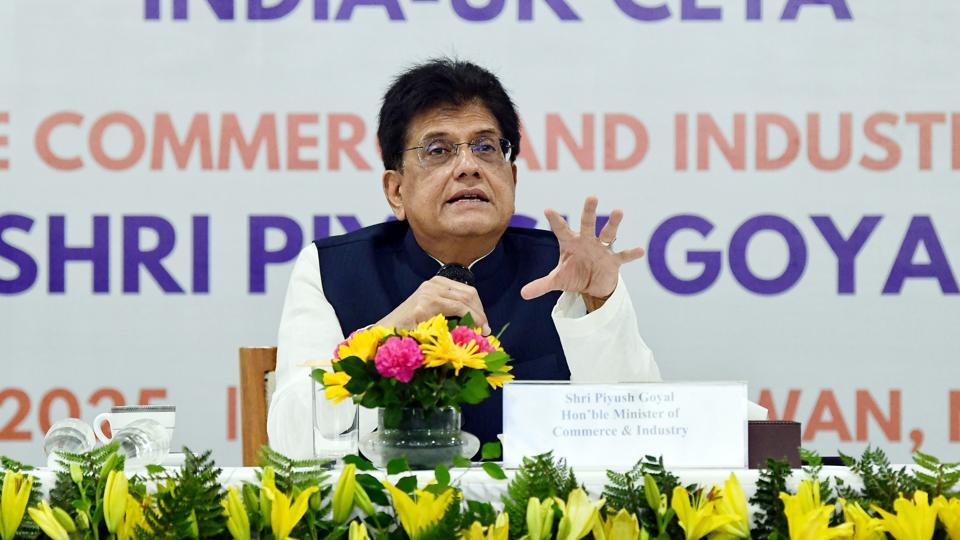
Addressing a press conference in New Delhi after signing the India-UK Comprehensive Economic and Trade Agreement (CETA), Goyal called it “a game changer” that would set “the benchmark of high-quality FTAs that India will be doing in future, adding to India’s credibility, confidence and competence.”
The minister and his UK counterpart Jonathan Reynolds signed the FTA in the presence of Prime Minister Narendra Modi and British PM Keir Starmer on Thursday in London. The deal, concluded on May 6 after nearly four and a half years of negotiations, grants preferential access for 99% of Indian exports to the UK, mostly duty-free.
Goyal’s emphasis on the agreement as a template comes at a crucial time, with India facing pressure from the US to open its sensitive agriculture sector—a key sticking point in ongoing bilateral trade negotiations.
When asked if the India-UK CETA would serve as a blueprint for other negotiations, Goyal said: “I have always consistently held that every agreement stands on its own feet. And every agreement is negotiated based on the circumstances of each country.”
However, he underscored that protecting national interests remained the top priority. “I think this can become a gold standard to ensure that India protects sensitive sectors and opens the doors, particularly in areas where its highly labour-intensive [sectors are] in competition with other competitors [of third countries],” he said.
People familiar with the negotiations, who asked not to be named, spoke to HT separately and elaborated on the strategy. India, they said, successfully convinced Britain about the necessity to protect millions of subsistence farmers against large-scale commercial farming from the developed world. At the same time, New Delhi gave some preferential access to British Scotch whisky and automobiles in return.
A similar attempt is being made with the US and EU. “Washington, in particular, wants India to open its sensitive agriculture sector for American farm produce, including GM crops, which is one of the reasons for the prolonged stalemate,” the people added, referring to the India-US trade talks where an early harvest deal currently awaits political approval from President Donald Trump.
Negotiations are also underway with the US, Peru, Chile, Oman and the EU.
According to the UK agreement, India secured key exclusions for its dairy sector (milk, cheese, butter and ghee), wheat, rice, maize, millets, apples, pineapples, oranges, pomegranates, edible oils (soybean, palm, mustard and groundnut), and vegetables including tomatoes, onions, garlic, cauliflower, cabbage, radish, peas, beans, pumpkin, bitter gourd, bottle gourd, lady finger, and potatoes.
Goyal, without going into details, too discussed this strategy during his interaction with reporters on Saturday. “What is sensitive for us, what is called defensive interest, we have not opened any product. This FTA, like the one with Australia, does not include the dairy sector, as instructed by the PM,” he said while speaking at the BJP headquarters.
Goyal differentiated the approach from trade deals with competing economies, saying: “If you will see, most of our FTAs are with countries where they don’t compete with us. Australia competes with India in nothing. We supplement, complement each other... with the UK also, they will be sending us, for example, products which we don’t have enough in India.”
The minister criticised the Congress-led UPA regime for signing an FTA with competing economies like ASEAN. “Those countries used to sell their goods cheaply in India and harm India’s manufacturing,” he said. “Many business organisations, chambers and MSME leaders have said multiple times that the kind of FTAs that were signed during the UPA were not in the interest of the country.”
Goyal revealed that FTAs with ASEAN nations are being reviewed. “We have opened our markets more. Our products do not have the same access,” he said.
The UK deal’s conclusion, thus, provides momentum for India’s other ongoing negotiations. According to commerce ministry officials, while the India-EU FTA is progressing “very fast” and expected to be concluded before end-2025, a US negotiating team is expected to visit New Delhi mid-next month to start the sixth round of talks for the first tranche of an India-US bilateral trade agreement.
“We are working at the right speed, with the right intent and in the right direction,” Goyal said when asked about impending agreements with the EU and US on Saturday. He noted that negotiations with Oman are “almost finalised” while talks for the India-US BTA are “making fast progress.”
“New Delhi is hopeful that both the US and the EU would eventually respect India’s sensitivities and the Indian team would also reciprocate,” he added.
Responding to questions about Britain’s proposed carbon tax on Indian exports, Goyal said it remained hypothetical as no such tax exists yet. In 2023, the British government proposed implementing its Carbon Border Adjustment Mechanism from 2027, similar to the EU’s move.
“ If any such issue that will harm India’s interests, then India is capable of responding to it,” he said.
Goyal outlined specific export opportunities: “Our spices will have duty-free access in the UK. 50 lakh plus south Asians live there and of this 18 lakh are Indians. There is a market for the spices. Also, 99% fisheries products will have duty-free access there. Leather goods, furniture and labour intensive sectors, pharmaceuticals will have zero duty access—and when GI products will be exported, India will have credit.”
“In every respect, this is an agreement which opens far greater opportunities for India than any other agreement in the past,” Goyal concluded, positioning the UK deal as proof that India can secure ambitious trade agreements while protecting its core economic and political sensitivities.