
 E-Paper



India-US ties, and the entry of a new envoy into the mix
On Wednesday, after a prolonged and tortuous process, the United States (US) Senate confirmed Eric Garcetti as the next ambassador to India


On Wednesday, after a prolonged and tortuous process, the United States (US) Senate confirmed Eric Garcetti as the next ambassador to India. For two years, since January 2021, the US has not had an ambassador in New Delhi — the longest period of diplomatic vacuum at the level of the envoy from the American end ever since the two countries established diplomatic relations.
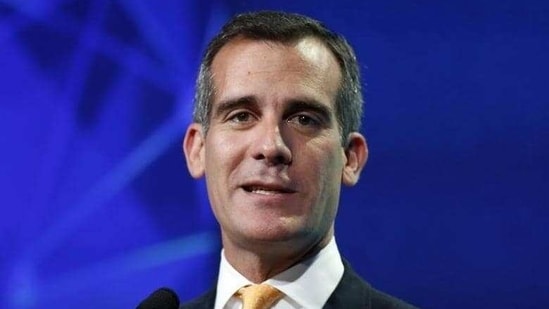
Garcetti’s nomination had got stuck because of allegations that he had ignored sexual harassment charges against a close aide in his office. Garcetti denied being aware of the allegations, but it was enough to taint his nomination trigger an investigation by Republican members of Senate judiciary committee, lead to a dip in support for his nomination even among Democrats, inaugurate a major advocacy effort by civil liberties and women groups, and block his confirmation through the 117th Congress in 2021-2022.
But through it all, one person backed Garcetti consistently, nominating him yet again as the 118th Congress commenced its session this January – President Joe Biden.
A strong Biden supporter, the former Los Angeles mayor was on the selection committee that picked Kamala Harris as the Democratic vice-presidential candidate. The White House placed its faith in Garcetti, and placed the ball firmly in the court of the Senate, basically sending the following message to lawmakers – this is the President’s pick and he trusts him; are you willing to leave the position vacant in as important a capital as New Delhi or will you do your job?
It was a rare vote on Wednesday which saw legislators step across party lines, with seven Republicans voting for Garcetti and three Democrats going against their own President’s nominee. The final tally was 52 in favour and 42 against. the nominee. The nature of the vote itself shows how important Delhi is becoming in Washington’s calculus. Those against Garcetti were against him due to allegations specific to him, but those for him on the Republican side were driven by their commitment to the India relationship.
Various factors eventually played a role in securing the confirmation on Wednesday – Garcetti’s own lobbying, his parents spent $90,000 hiring lobbyists to win over Senators); persistent efforts by the White House team in charge of legislative affairs in mobilising Congressional support; lobbying by Indian diaspora groups with their elected representatives; outreach to Republican members of the Senate who are conscious of the importance of the Indo-Pacific and the centrality of India about the need to address the diplomatic vacuum; Senate majority leader Chuck Schumer’s visit to India where his Indian interlocutors spoke to him about the vacancy in Roosevelt House, the ambassador’s residence in Delhi; and a concerted administration push given that Prime Minister Narendra Modi is scheduled to visit US for a state visit this summer and Biden will visit India for the G20 summit in September.and not having an ambassador would cause complications.
Through the process, what has been clear is that the next US ambassador to India will have a direct line to the President of the US. When HT had asked a senior Democratic political figure last year why Biden was staying the course with the nomination despite the challenges, he said, “The President is big on loyalty. He backs you fully when he trusts you and rewards those who have been with him. But this is also about ensuring the survival of a rising star of the party.”
This proximity to the President, and the fact that Garcetti has a political profile within the party, is good news, for a relationship of confidence between the highest political leadership and an envoy with a political pulse can help circumvent bureaucratic obstacles. It also enables a channel where Indian interlocutors will know that speaking to Garcetti means that word will go up the chain and a message from Garcetti means that there is political weight behind it. The relationship is already in good shape; having an ambassador can only add to it.
Garcetti’s vision of the relationship
But what does the former LA mayor think of India? Garcetti’s views on the relationship were most explicitly laid out in his testimony to the Senate in December 2021 during his confirmation hearings. He made four broad points.
The first was the importance of India. “Few nations are more vital for American security and prosperity than India.” Garcetti said he had visited India for the first time in 1990 as a guest of the then ambassador Bill Clark. Inspired by the trip, Garcetti studied Hindi, Urdu and Indian cultural and religious history. Drawing a stark contrast to the situation from that point – when the relationship “languished under the shadow of the Cold War”, US-India military interoperability was non-existent, defence trade was zero and trade was around $2 billion – to now, Garcetti said, “(Then) The very idea of a US-India strategic partnership would have been deemed laughable. Today, the fundamental nature of that strategic partnership is firmly ingrained here in Washington and in New Delhi.”
Second, Garcetti laid out his key broad-based agenda. He said would he champion an “ambitious bilateral partnership, united by a shared vision of a free and open and inclusive Indo-Pacific region”, code for the shared anxieties about China. He said he would champion an “ambitious economic partnership” with India with a focus on reducing market barriers, bolstering free trade and creating middle-class American jobs and addressing the economic dimension.
Garcetti recognised India was in a tough neighbourhood and promised to “support India’s capacity to secure its border, defend its sovereignty, counter terrorism and deter aggression” – this will be done through “information-sharing, counter-terrorism coordination, joint freedom of navigation patrols and military exercises... and sales of our best defence technologies to fully realise the potential of our major defence partnership”, all of which will build on existing work that is being done in the domain of bilateral security cooperation. The ambassador-designate had also then spoken of cooperation in space, science and critical and emerging technologies. Since then, the two countries have launched an initiative on critical and emerging technologies, and operationalising it will become a key part of Garcetti’s portfolio. He also spoke about cooperation on climate and green energy as a key priority and discussions around climate finance in particular will occupy Garcetti’s time in office.
Third, Garcetti spoke of the bedrock of the relationship being the warm and deep people-to-people ties, embodied by the four-million strong Indian-American diaspora, 200,000 Indian students in US universities and tens of thousands of Indian professionals in the US — all of whom were contributing to strengthening the US and serving in the highest offices of the land. The diaspora will be an important calculus in Garcetti’s decision-making given his roots and political ambitions in California, which is home to over 800,000 Indian-Americans and Indians.
The human rights dimension
And finally, the then ambassadorial nominee said that “respect for human rights and strong democratic institutions” were key elements of the relationship and values enshrined in both of our constitutions. “If confirmed, I will engage regularly and respectfully with the Indian government on these issues.”
When a Senator asked him about the downgrading of India’s ranking on democratic indices and the passage of the Citizenship (Amendment) Act and how the nominee planned to advance the strategic partnership while advancing human rights, Garcetti said that there was “no question” that the relationship must be underpinned by a commitment to democracy, human rights and civil society. “I will actively raise these issues. I will raise it with humility. It is a two-way street on this. I intend to engage directly with civil society.”
The remarks indicate that there remains a constituency on the Hill that is concerned about what is seen as India’s democratic “backsliding” – and the administration, in this case Garcetti, either due to conviction or compulsion or a mix of both, has to respond to these issues to allay apprehensions of its own domestic audience. It will also have to, in private at least if not in public, raise specific concerns with the government of India. As Garcetti indicated, there will possible be more high profile engagement between the US and civil society groups that Indian government doesn’t see as friendly on the political spectrum.
But it is also important to note that Biden has made his political decision on India — the relationship must be nurtured. There is both an institutional and a bipartisan consensus on this in Washington at the moment. The administration’s approach to India, the high-level engagement and initiatives that both governments have launched and participated in together, and the rest of Garcetti’s own testimony indicates that perceptions of democracy will not be the defining element of the conversation with Delhi. The defining element will remain the growing strategic convergence between India and the US and the need to consolidate it. And that is the job the President of the US is sending Eric Garcetti to Delhi for.
 ABOUT THE AUTHORPrashant Jha
Prashant Jha is the Washington DC-based US correspondent of Hindustan Times. He is also the editor of HT Premium. Jha has earlier served as editor-views and national political editor/bureau chief of the paper. He is the author of How the BJP Wins: Inside India's Greatest Election Machine and Battles of the New Republic: A Contemporary History of Nepal.Read More


