
 E-Paper



Inflation at 11-month low, eases to 5.88%
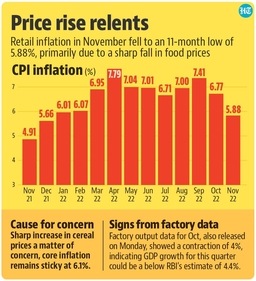
Retail inflation in November dipped below 6% for the first time in 11 months, beating analyst estimates, on the back of a sharp deceleration in food prices, especially of vegetables and edible oils, although a spike in cereal prices is a matter of concern.


Retail inflation in November dipped below 6% for the first time in 11 months, beating analyst estimates, on the back of a sharp deceleration in food prices, especially of vegetables and edible oils, although a spike in cereal prices is a matter of concern. The headline reading, as measured by the Consumer Price Index, came in at 5.88% for the month, although core inflation remained sticky at 6.1%, which, along with the Reserve Bank of India’s hawkish tone in the last policy, suggests that the central bank’s monetary policy committee (MPC) could push ahead with an anticipated increase in the interest rate in February. Some analysts, however, said much would also depend on the December inflation reading that comes out in January.
“With a material shift in global commodity prices, especially crude, we expect inflation to continue to moderate into the target range, most likely in early 2023,” Rahul Bajoria, MD & head of EM Asia (Ex-China) Economics, Barclays, said in a note, adding that his expectation is that inflation will be 6% in the current quarter.
He added that while there are signs of “inflation easing”, “hawkish” remarks by the RBI after the latest policy statement set “the stage for a 25 basis points rate hike in February.”
One basis point is a hundredth of a percentage point.
RBI expects inflation at 6.6% this quarter and 5.9% next – and November’s reading of 5.88% on top of October’s reading of 6.77%, means that the quarterly number could well be lower than that. RBI expects inflation to be at 5% in the first quarter of next financial year, 2023-24.
If RBI, which has taken up the interest rate by 2.25 percentage points since May to 6.25%, considers a pause, it will also depend on two other factors — growth, and the US Federal Reserve’s action.
The factory output data for October (measured by the Index of Industrial Production or IIP) , which was also released on Monday, showed a contraction of 4%, indicating that GDP growth for this quarter could well be a little below RBI’s estimate of 4.4%.
The central bank expects India’s economy to expand by 6.8% in 2022-23, but the lower-than-expected factory output numbers has made at least some analysts think that it will underperform. Most sectors saw a contraction, with both consumer durables and non-durables (the so-called fast moving consumer goods) recording a contraction in the mid-double digits, suggesting a slowing in demand. Manufacturing, as a whole, contracted 5.6%.
Sunil Kumar Sinha, principal economist, India Ratings & Research, said in a note: “Despite the festive season, industrial output growth in August and September was tepid, whereas these are (usually) the months of inventory build-up in view of the festive season. Thus, October IIP witnessing a contraction of 4% is indicative of the same trend, but the magnitude of the contraction is a bit of a surprise, especially in the case of manufacturing…”
He added that there appeared to be “weak domestic demand”, which, along with “waning export demands” is affecting factory output.
RBI said in its latest credit policy statement that inflation would remain its primary focus; the headline print of retail inflation has been above its upper tolerance band of 6% since January, and in early November, the central bank submitted a report to the government on reasons why it could not keep inflation below its target, as required by law. On Monday, in response to a question in Parliament, the Union minister of state for finance Pankaj Chaudhary said in a written response that the provisions of the RBI Act do not allow for publicising the contents of the report.
Speaking at the Hindustan Times Leadership Summit on November 12, days after submitting the letter to the government, RBI Governor Shaktikanta Das said that the letter highlighted three things: the reasons for inflation exceeding the target for three consecutive quarters; the steps taken by the central bank to bring it down; and the timeline by which the central bank expects inflation to come down to the targeted level.
“In February, it looked like inflation was well under control, and India was on course to reach the target of 4%,” he said. “But the geopolitical crisis, the sudden spike in commodity prices, the sudden spike in edible oil prices, the sudden spike in prices of cereals, for example, wheat…… So we were impacted by major external factors, and the entire inflation picture underwent a particular change,” he added, explaining the gist of the first part of its note to the government. He declined to share details on the other two.


