
 E-Paper



Isro conducts test flight for Gaganyaan mission
The Indian Space Research Organisation (Isro) has successfully completed a test launch and recovery of a crew module for the Gaganyaan mission, bringing the country's first human space flight project one step closer to reality. The test involved simulating an emergency situation to ensure the crew module could safely remove itself from the test vehicle and land in the sea. Isro aims to launch an unmanned flight for the Gaganyaan mission in the first half of 2024, followed by a manned mission around 2025.

 Prefer HTon Google


The Indian Space Research Organisation (Isro) on Saturday successfully completed the launch and recovery of a test vehicle carrying the crew module for the Gaganyaan mission, accomplishing a key milestone for the country’s first human space flight project.
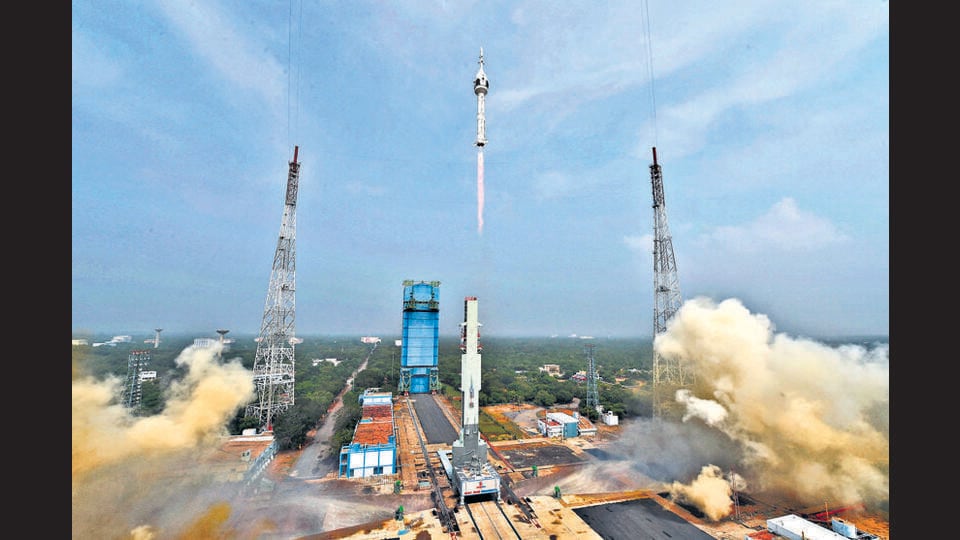
For the test, scientists simulated an abort situation for the Crew Escape System to carry the crew module out of the first test vehicle development flight (TV-D1), the space agency said in a statement.
“Mission Gaganyaan: TV-D1 Test Flight is accomplished. Crew Escape System performed as intended. Mission Gaganyaan gets off on a successful note,” Isro said.
The test essentially involved launching the empty crew module and creating an emergency situation to test that in the event of an actual contingency, the module is capable of removing itself effectively and landing safely into the sea, from where it can be recovered.
Saturday’s test was the first of many that the agency will perform as it prepares for a manned mission to space around 2025, agency chief S Somanath said.
“I am very happy to announce the successful accomplishment of the TV-D1 mission… The vehicle has gone up to a Mach number, which is slightly above the speed of sound and initiated an abort condition for the crew escape to function,” Somanath said. Mach 1 is equal to about 1,200 km per hour.
The agency is aiming for a launch window in the first half of 2024 for the unmanned flight under the mission, Somanath said.
The Gaganyaan mission is aimed at developing a human-habitable space capsule that will carry a three-member crew into an orbit of 400km for three days, before splashing down in the Indian Ocean.
Following a successful launch in the morning, the module descended using parachutes for a splashdown in the Bay of Bengal, the space agency said.
Somanath later said that the crew module has been fully recovered from the sea and it has been brought to Chennai port.
“Eastern Naval Command units recovered the Crew Module — a path paved by extensive planning, training of Naval divers, formulation of Standard Operating Procedures (SOP) and joint communication by combined teams of Navy and ISRO,” the Indian Navy said in a statement in the evening.
The Navy, on its official handle on X, also shared pictures of its personnel recovering the module from the water, about 10 km from the coast of Sriharikota.
The crew module is where the astronauts will be stationed in a pressurised earth-like atmospheric condition during the Gaganyaan mission. For the 34.9-metre-tall rocket TV-D1, the crew module was an unpressurised version, Isro said.
The success of the mission came after tense two hours in the morning, when weather-related issues first forced a rescheduling of the lift-off from the original 8am to 8.30am, and then again 15 minutes later, when just four seconds before the single-stage propulsion rocket was set to soar into the skies at 8.45am, a “hold” sign flashed on the screens.
The agency, however, was quick to respond, and the launch took place at 10am.
The liquid-propelled single-stage test vehicle, or TV-D1, uses a modified VIKAS engine with a crew module and crew escape system mounted at its fore end.
After the success of the TV-D1, the space agency will now carry out a test flight with a humanoid astronaut, Vyomitra, which will be followed by the unmanned flight, according to officials from the department of space.
The mission is the next ambitious leap for India’s space agency after a staggering couple of successes this year. Isro put the first spacecraft near the south pole of the Moon (Chandrayaan-3) and sent a probe to survey the Sun (Aditya-L1), challenging the space programmes of countries with much deeper pockets and far longer history of space exploration.
Congratulating Isro on Saturday, Prime Minister Narendra Modi said, “This launch takes us one step closer to realising India’s first human space flight program, Gaganyaan. My best wishes to our scientists at Isro.”
Union minister of science and technology Jitendra Singh also commended Isro’s efforts.
“Kudos to Isro for successfully accomplishing maiden Test Vehicle Flight TV-D1. This is the first step in the last leg of journey towards India’s crewed human spacecraft mission, Gaganyaan. In the enabling milieu provided by PM Modi, Isro is achieving success after the other and the next important one is the Gaganyaan,” Singh said.
S Sivakumar, mission director of the TV-D1 test, said that this test was a bouquet of three experiments put together—testing the safety of the test vehicle, crew escape system and the crew module.
“All systems performed well and such a test has never been done before. This was a penance for us for the last three-four years and we are glad that everything has performed as per plan, minus the minor initial glitch, which was immediately rectified,” Sivakumar said.


