The Indian Space Research Organisation (ISRO) is set to launch the GSLV Mark III rocket carrying the GSAT-29 communication satellite at 5:08 pm (IST) from the Satish Dhawan Space Centre at Sriharikota on Wednesday.
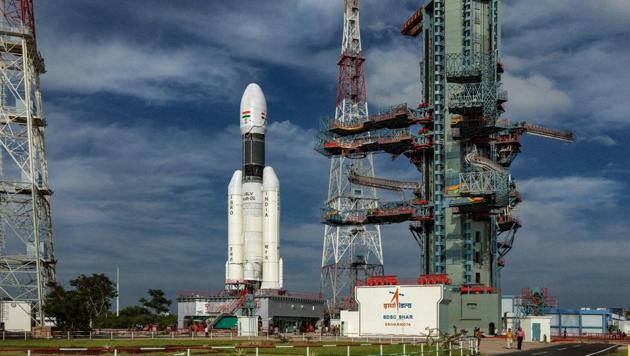
Marking ISRO’s fifth launch for the current year, the communication satellite carries high throughput communication transponders in the Ka and Ku bands which can expand high-speed data transfer in the remote areas of India.
The satellite launch is the second test flight for the GSLV Mark III rocket, which is also ISRO’s heaviest rocket. The rocket is capable of introducing four-tonne class satellites into a geostationary transfer orbit.
With an operational life of over ten years, the satellite weighs 3,423 kg during lift-off.
On Tuesday, the 27-hour countdown for the launch of India’s latest communication satellite GSAT-29 onboard the second developmental flight GSLV-MkII D2 from the spaceport of Sriharikota began.
Also Read: ISRO defers satellite launch by 12 hours due to cyclone Gaja
ISRO has also deferred the launch by 12 hours, initially scheduled at 5.08 am on Wednesday, due to bad weather conditions as a result of cyclonic storm Gaja, which was expected to make landfall at the launch venue, Sriharikota in Andhra Pradesh.
{{/usCountry}}ISRO has also deferred the launch by 12 hours, initially scheduled at 5.08 am on Wednesday, due to bad weather conditions as a result of cyclonic storm Gaja, which was expected to make landfall at the launch venue, Sriharikota in Andhra Pradesh.
{{/usCountry}}The launch schedule was moved to 5.08 pm on the same day and the space agency started the countdown from 2.50 pm on Tuesday, according to ISRO website.
The ISRO chief said the Wednesday launch was one of the “very important missions and a milestone” for India’s space programme.
“This is GSLV-MkIII-D2 second developmental flight. It is going to launch very important and high throughput satellite GSAT-29. The satellite will be useful in Jammu and Kashmir and North East region for providing connectivity under the Centre’s Digital India programme”, he said.
‘Successful Launch Would Pave Way For Very Advanced Satellite In Future’
A successful launch would pave the way for producing very advanced satellite in future for ISRO, he said.
“(It is) This vehicle (GSLV-MkIII) is going to launch the Chandrayaan-II and also the manned mission. We are getting prepared for that. If everything goes normal, lift off will happen at around 5pm and 8 minutes (tomorrow)”, he said.
Following the lift off, the rocket would inject the satellite into the Geostationary Transfer Orbit (GTO) with required inclination to the equator.
The satellite would be placed in its final Geostationary Orbit using the on-board propulsion system and it may take a few days after separation from launcher to reach the orbital slot, ISRO said.
The GSLV-MkIII-D2 is a three stage launch vehicle with two solid strap-ons, a liquid core stage and a cryogenic upper stage.Compared to solid and liquid stages, the C25 cryogenic stage is more efficient as well as complex.
According to the ISRO, the GSAT-29 satellite is intended to serve as a test bed for several new technologies. It is specifically designed to cater to communication requirements of users from remote areas of the country.
Around 16 min 43 seconds the GSAT-29 separation is expected to take place after the launch. The mission life is about 10 years.