
 E-Paper



Jain varsity on top in Bengaluru leg of HT Centennial Debate
The brightest young minds from Bengaluru took part in the battle of wits and knowledge in the third and final regional leg of the debate


The brightest minds from Bengaluru’s top educational institutions battled it out on Wednesday in the third and final regional leg of the Hindustan Times Centennial Debate.
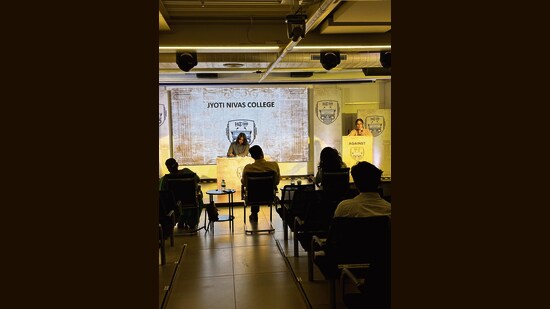
Held at the Museum of Art and Photography, the three-hour-long event saw speakers from a mix of humanities, science, engineering and management backgrounds engage in a battle of wits and knowledge on the topic – “the social media generation is more lost than found”.
A team of Aastha Bhattacharya and CS Harini from the School of Computer Science and Information Technology, Jain University, were the team winners. They proceed to the national finals to be held in Delhi, along with the team from Jyoti Nivas College, comprising Abhirami Arunkumar and Stacia Agusta d’Silva. These two teams will join Ashoka University and OP Jindal Global University, who were the winners and runner-up respectively of the Delhi leg of the debate, as well as the Vidyalankar Institute of Technology and Vivekanand Education Society’s Institute of Technology, who qualified from Mumbai. These six teams will compete for the India crown at the national finals to be held in Delhi.
Bhattacharya was adjudicated the best speaker, followed by Manpreet Singh Gill from the School of Sciences, Jain University, and Abhirami.
The jury comprised Nithya Ramesh, who is director of urban design at Jana Urban Space Foundation, where she has worked since 2013 focussing on fixing India’s cities. An Eisenhower Women’s Leadership Fellow, Ramesh was also part of a high level committee on urban planning reforms at the ministry of housing and urban planning.
“It was refreshing to see so many young men and women articulating their thoughts… I felt assured that our future is in the right hands,” she said. She also held out some questions. “What is the internet and what is social media? Are we confusing the two? We need to take into account the importance of both regulation and personal choice – both in spaces such as climate change, and in social media usage.”
The second member of the jury was Chandan Gowda, the Ramakrishna Hegde Chair Professor of Decentralization and Development at the Institute for Social and Economic Change, Bengaluru. Among Bengaluru’s top public intellectuals, he translated UR Ananthamurthy’s novella Bara that was shortlisted for the Crossword Book Award for Translations, 2017. He has since translated and edited several volumes.
“The nature of this subject was not black and white. I appreciated that most of you treaded in the greys and understood the complexity of the situation. At best, we could ask for the highest standards of community use,” he said.
He also held forth on the importance of privacy and democracy. “When technology that purports to be good for all has the potential to not just manipulate voters but also compromise personal safety, it is a serious matter,” he said, adding that he felt optimistic about the younger generation.
The third member of the jury was Ruth Manorama, one of Bengaluru’s best-known women’s rights activists and writers. She is a member of the Karnataka State Planning Board, the State Commission for Women, the Task Force on Women’s Empowerment of the Government of India, and is the President of the National Federation of Dalit Women.
“I was educated by all of you…Today it looks like without this modern tool of social media, we cannot live. I work with the poor, who now say they can go without a saree or something in their house, but need to keep updating their phones. I feel that this is causing a loss in human touch…this is the result of a confluence of capitalism and consumerism,” she said.
In her speech, Bhattacharya spoke about the rampant misinformation fuelled by social media, and the alienation it was causing among young people, who were left seeking validation from unknown people but feeling lonelier than ever. Gill argued that both social media and this generation were being falsely vilified, adding that the standards of how a person is lost or found was subjective.
The debate will now culminate in a battle of India’s top speakers on the national stage, marking the extraordinary journey of Hindustan Times, which turned 100 last year. Over the decades, this paper acted as a mirror to India and offered its platform to great thinkers and leaders – Martin Luther King Jr, C Rajagopalachari, Rajendra Prasad, Eleanor Roosevelt, MS Swaminathan and Sachin Tendulkar, among them. It blossomed from a circulation of merely 20 copies to becoming one of the most widely read papers in the country, reaching 73 million people every month.
The Hindustan Times Centennial Debate is a celebration of this journey that spans a century and straddles an extraordinary range – from a small band of men and women inspired by Mahatma Gandhi to battle brutal colonial censorship laws, to a globally respected voice chronicling the rise of the world’s largest democracy.


