
 E-Paper



Judges must judge free of social, political pressure and inherent biases: CJI
Chief Justice D Y Chandrachud said that an independent judiciary is not merely insulation of the judiciary from the executive and the legislature but the independence of judges to perform their given duties

 Prefer HTon Google


Inherent biases, social and political pressure should not cloud the art of judging, said Chief Justice of India (CJI) Dhananjaya Y Chandrachud on Sunday as he said that an independent judiciary is not merely insulation of the judiciary from the executive and the legislature but the independence of judges to perform their given duties.
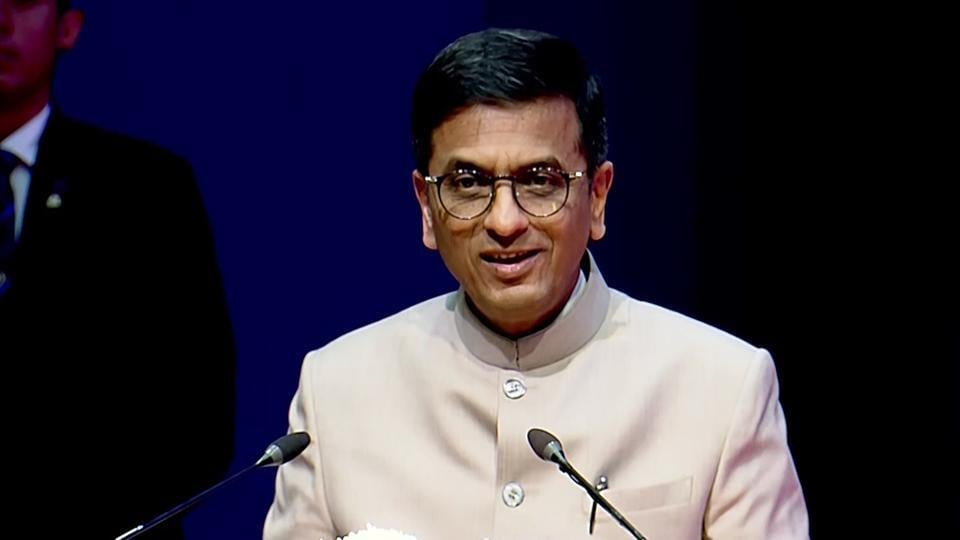
Addressing the diamond jubilee celebrations of the establishment of the Supreme Court, CJI spoke on the “structural issues” of pendency, adjournment culture and archaic procedures that need to be addressed at the earliest and favoured a conversation to begin on long vacations for courts by working on alternatives such as “flexitime” for lawyers and judges.
Holding a ceremonial bench at the Supreme Court along with all judges of the top court and chief justices of all high courts to mark 75 years of the Supreme Court, CJI said, “The art of judging must be free of social and political pressure and from the inherent biases which human beings hold. Efforts are being made from within the institution to educate and sensitise judges across courts to unlearn their subconscious attitudes inculcated by social conditioning on gender, disability, race caste and sexuality.”
In the past one year in office as CJI, justice Chandrachud has moved in the direction of providing gender neutral toilets, accessibility audit in the top court to ensure better access to disabled, opening of a cafe run by disabled persons, among a slew of other steps to promote greater inclusion of marginalised sections of society into the mainstream.
He said, “An independent judiciary does not merely mean the insulation of the institution from the executive and the legislature branches but also the independence of individual judges in the performance of their roles as judges.”
Referring to the issue of large pendency of cases clogging judicial docket, CJI said, “There has to be a radical change in the approach to decision making. Much as we would like to reassure ourselves that the mounting pile represents the faith of citizens in the line, we need to ask hard questions on what needs to be done... If we do not make hard choices and take difficult calls to resolve these pressing issues, the euphoria generated from the past may well be short-lived.”
Earlier in the day, at the Foundation Day function presided by Prime Minister Narendra Modi, CJI laid out four priority areas which require immediate redress and said, “In the near future, we must address the structural issues affecting the judiciary, such as pendency of cases, archaic procedures, and the culture of adjournments.”
First, we must emerge out of the adjournment culture to a culture of professionalism and second, we have to ensure that the length of oral arguments does not interminably delay judicial outcomes. The third issue related to legal profession in providing a level playing field for first generation lawyers – men, women and others from marginalised segments.
“Traditionally, the legal profession was a profession of elite men. Times have changed. Women, traditionally underrepresented in the profession, now constitute 36.3% of the working strength of the district judiciary,” he pointed out.
And the fourth issue was on long vacation, for which Supreme Court has been criticised as enjoying long summer and winter breaks, in the face of mounting pendency. CJI said, “Let us begin the conversation on long vacations and whether alternatives such as flexitime for lawyers and judges is possible,” while observing, “Our ability to remain relevant as an institution requires us to recognise challenges and begin difficult conversations.” He also urged judges and administrators to make effort in their work to ensure district judiciary is given due dignity
While sharing details on the journey so far and the use of technology to make courts go paperless and court proceedings a pleasant experience for litigants, the CJI said, “The Court, as the highest appellate and constitutional court of the nation, derives but cannot rest its legitimacy solely on the Constitution. The legitimacy of this Court is also derived from the confidence of citizens that it is a neutral and impartial arbiter of disputes which would deliver timely justice.”
The Court has followed two approaches to enhance the faith in its justice delivery mechanism, he added, the first being, by not conferring permanence upon judicial decisions where the Court is cognizant that the law is not constant but is ever-evolving and the second being, to increase access to courts by diluting the procedural rules for instituting cases.
This Court has been open to citizens in every corner of the nation, regardless of their social and economic status, as CJI showed statistics that in 1985, the top court received 24,716 letter petitions in English, Hindi and regional languages. This figure grew exponentially over the year touching about 1,15,120 in 2022 “clearly indicating that the common person believes that they would be able to secure justice in these halls.” While some letters do not fall within the ambit of the judicial function, “as judges we need to know what lies within and outside the judicial function,” justice Chandrachud said.
Speaking about how the transformative potential of the Constitution was unlocked by courts in the past seven decades, CJI quoted examples of judgments interpreting the mandate of reservation in Articles 15 and 16 to be a facet of equality in Indra Sahwney judgment, the limits placed on Parliament’s power to amend the Constitution through the basic structure doctrine in the Kesavanada Bharti judgment as important jurisprudential developments.
In recent years, a “positive approach” has been adopted to bring down the pendency of cases as CJI said, “Technology has been a steadfast ally in decongesting pending matters.” The electronic filing of cases has reduced the time between filing cases and curing defects, directions have been issued to list old matters pending since 1993 on priority, specialised benches have been constituted for different category of cases, criminal cases where punishment is less than 3 years have been identified and heard on priority and Constitution Bench references involving crucial questions about the interpretation of the Constitution have been taken up for hearing.
“The Court is not the sole guarantor, but it is the final arbiter that power may be used to liberate, emancipate and include, but never to oppress or ostracise. the novel challenges of today must never distract us from this most sacred duty of the Court,” he said.
The diamond jubilee event was also attended by Union minister of state for law and justice Arjun Ram Meghwal, Attorney General R Venkataramani, Solicitor General Tushar Mehta, former CJIs and judges of the Supreme Court and chief justices of five neighbouring countries of Nepal, Bhutan, Bangladesh, Sri Lanka and Mauritius.


