
 E-Paper



July retail inflation eases to 5.5% to stay within RBI’s limits
The retail inflation reading is a key determinant of monetary policy, which refers to the central bank’s decision to raise or reduce interest rates. Higher inflation limits the RBI’s room to keep interests low, needed to boost growth.


Retail inflation, a measure of what households pay for everyday items, slowed in July to 5.59%, staying within the Reserve Bank’s desirable limit for the first time in two months.
Some items, such as pulses, clothing, footwear and health costs, however remained high, data released by the government on Thursday showed.
The easing of prices, as measured by the Consumer Price Index, comes as a relief not just for consumers, who are battling income and wage losses due to the pandemic, but also the central bank, which decides key economic policies based on how inflation moves. The RBI’s tolerable range for inflation is 4(+/-2)%. A very low inflation reading, which suggests insufficient demand, is not good for the economy either.
The retail inflation reading is a key determinant of monetary policy, which refers to the central bank’s decision to raise or reduce interest rates. Higher inflation limits the RBI’s room to keep interests low, needed to boost growth.
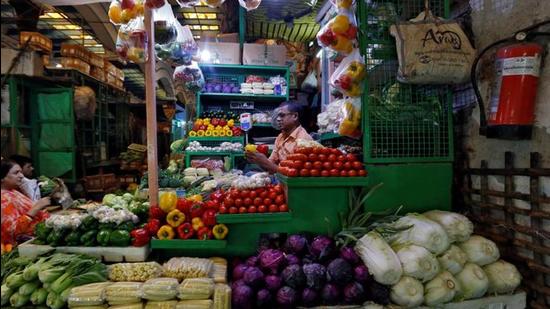
Thursday’s consumer inflation data showed inflation in the food and beverages category climbed 4.46%, slower than a 5.58% rise in June, led by easing prices of vegetables.
Economists often use the term stagflation, a worrying situation, to describe persistently higher inflation and flat growth. They are unsure of whether the lower pace of inflation in July will hold. “It’s increasingly difficult to characterise the (inflationary) pressures as purely transitory in nature,” wrote Aditi Nayar, chief economist of the ratings firm ICRA, in a note.
However, commonly consumed protein items such as pulses remained high in July at 9.04%, although they were cheaper when compared to a 10.01% rise in June.
The price rise in fuel came in at 12.38%, while clothing and footwear inflation rose 6.4% compared to 6.2% a month ago. Inflation readings compare prices on a year-on-year basis, meaning they track how prices have moved from a year ago.
“A sharp fall in food inflation to 3.96% in July 2021 led the headline retail inflation to cool off to three months low. Though sharp vegetables deflation was mainly responsible for a sharp decline in food inflation, a strong base effect both at food as well as headline inflation was also on play in July 2021,” Sunil Kumar Sinha, principal economist, India Ratings and Research, said in a research note.
The easing of prices also means supply bottlenecks are being fixed as states relaxed lockdown restrictions, said Ashok Agrawal, an analyst with Comtrade, a commodities trading firm.


