
 E-Paper



Justice Ramana takes oath as CJI
Justice Ramana, whose tenure will be until August 26, 2022, succeeds justice SA Bobde. He is the first judge from the Andhra Pradesh high court to become CJI.


Justice NV Ramana was on Saturday sworn in as the 48th Chief Justice of India (CJI) by President Ram Nath Kovind during a small ceremony at the Rashtrapati Bhavan owing to Covid restrictions.
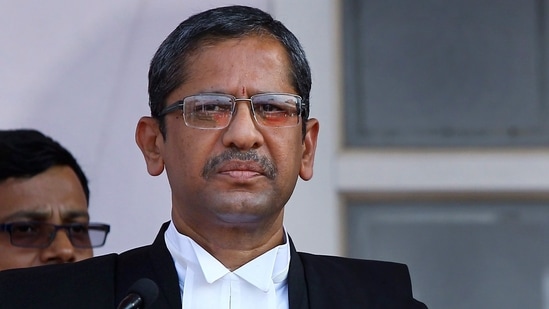
Justice Ramana, whose tenure will be until August 26, 2022, succeeds justice SA Bobde. He is the first judge from the Andhra Pradesh high court to become CJI.
At the farewell of justice Bobde on Friday, justice Ramana had paid his tribute to all those who have lost their lives due to the Covid-19 pandemic and implored the people to exercise utmost caution against the spread of the infection.
“We are going through testing times. The country as a whole is battling the severest second Covid wave. The virus does not make any distinction. During these unprecedented times, some strong measures are necessary to break the cycle. I request everyone to cooperate in implementing these measures,” he said.
“We can defeat this pandemic together with discipline, dedication and cooperation with each other and with authorities. My heart goes out to everyone who has lost their loved ones due to this virus... We are undoubtedly living in hard times. However, I believe that these circumstances will compel us to emerge stronger than ever before. Let us be strong and overcome this together,” justice Ramana had asserted.
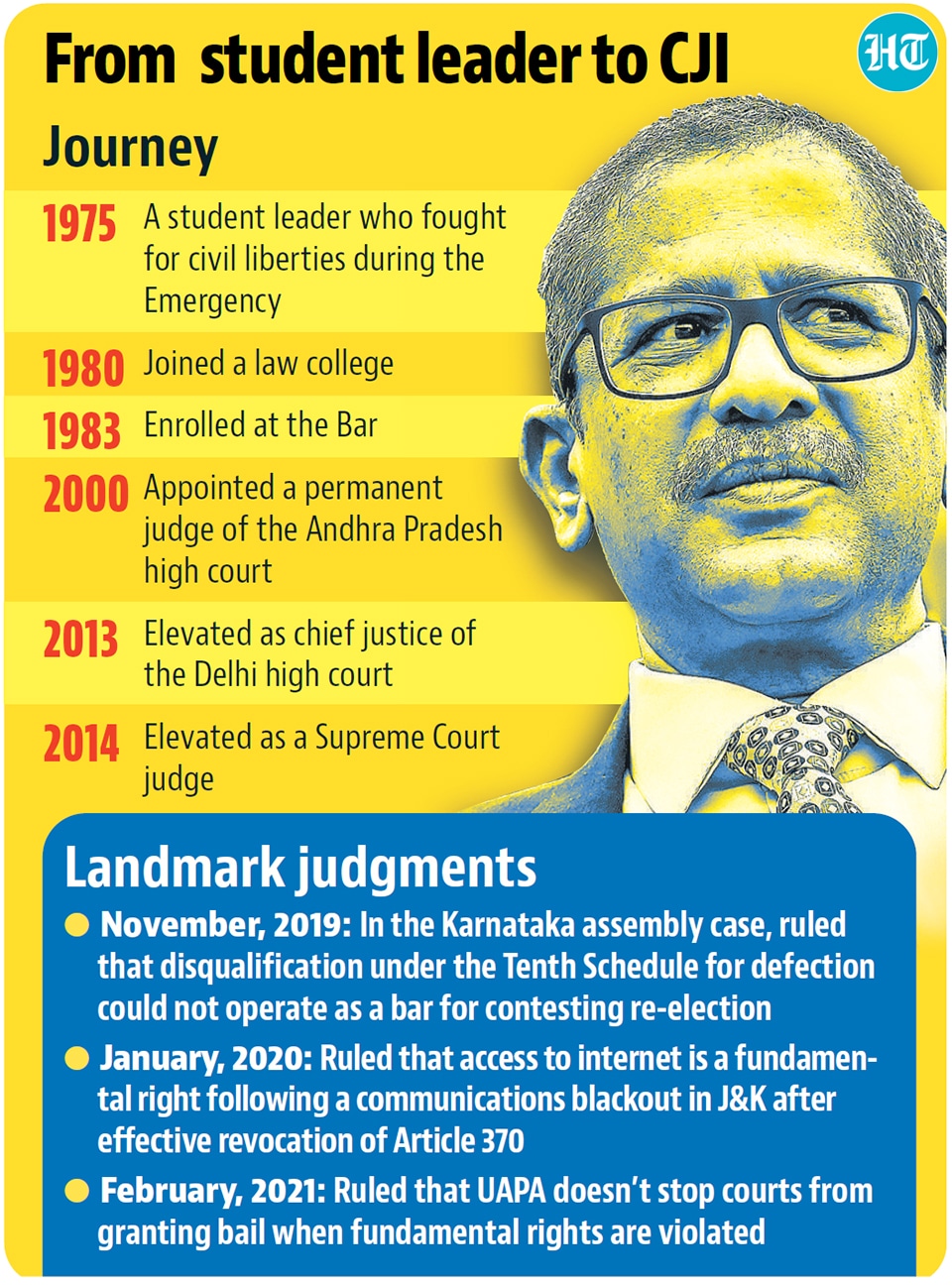
Justice Ramana was born to a family of farmers at Ponnavaram village in Andhra Pradesh’s Krishna district. He fought for civil liberties during the Emergency and lost an academic year. He also participated in the Jai Andhra movement for a separate Andhra state in the 1970s because of alleged injustices meted out to the people of the coastal and Rayalaseema regions. Vice-President M Venkaiah Naidu was among the other proponents of the movement.
Justice Ramana worked as a journalist from 1979 to 1980 and reported on political and legal matters for the Eenadu newspaper. He enrolled as an advocate in 1983 and specialised in constitutional, criminal, service, and interstate river laws at the Andhra Pradesh high court. He was appointed as a permanent judge of the high court in 2000. Justice Ramana was elevated as chief justice of the Delhi high court in 2013 and to the Supreme Court a year later.
He is seen as a conventional judge, who is restrained in his speech. He is known to talk less and for clarity of thought in his orders and judgments and adhering to the principle of judicial discipline and the rule of precedent.
Justice Ramana has been a part of several landmark judgments, underscoring constitutional rights, democratic values, and accountability. In his judgments in the cases of Anuradha Bhasin and the Foundation for Media Professionals, he ruled that access to the internet is a fundamental right by extension while pulling the government up for the telecommunications blackout in Jammu & Kashmir after the nullification of the region’s semi-autonomous status. The judgments also laid down certain parameters on curfews. They held that Section 144 of the Criminal Procedure Code, which bans assembly of over five people, cannot be used to suppress the legitimate expression of opinion or grievance or exercise of democratic rights.
Similarly, as part of a five-judge bench in Subash Chandra Agarwal’s case, justice Ramana emphasised that the right to information and right to privacy are on an equal footing. In Swaraj Abhiyan vs Union of India, he stressed the need for cooperative federalism in the implementation of the National Food Security Act.
Justice Ramana delivered the 2019 verdict related to the Karnataka assembly, clarifying the legal position that disqualification under the Tenth Schedule for defection could not operate as a bar for contesting elections again. Simultaneously, he lamented “a growing trend of the Speaker acting against the constitutional duty of being neutral” and implored presiding officers to check horse-trading and corrupt practices associated with defection and change of loyalty for the lure of office or other wrong reasons.
In the Shiv Sena vs Union of India case, justice Ramana followed the precedent of ordering an immediate floor test in the Maharashtra assembly to prevent horse-trading in 2019. In another significant case, a bench that included him, passed directives to expedite criminal investigations and trials involving lawmakers.
Justice Ramana in January ordered fixing a notional income for non-earning homemakers in insurance claim cases. He called this a step towards the constitutional vision of social equality and ensuring the dignity of life for all individuals. In a case involving an accused with mental illness facing the gallows, he wrote: “The right to dignity of an accused does not dry out with the judges’ ink, rather, it subsists well beyond the prison gates and operates until his last breath.”
Not a single judge was appointed to the top court during justice Bobde’s 14-month tenure as the CJI. All eyes will be on the new CJI to fill up the current vacancies of six judges in the Supreme Court. Justices Rohinton F Nariman, Ashok Bhushan, and Navin Sinha are also due to retire by the end of 2021. Four more judges of the top court will retire before justice Ramana demits office. There will be 13 vacancies in the Supreme Court during justice Ramana’s tenure. The apex court currently has just one woman out of the sanctioned strength of 34 judges.
Meanwhile, vacancies of high court judges have also risen to 411 out of 1,080. The new CJI will have to streamline the appointment process as the pendency in the high courts has gone beyond five million cases.


