The mighty Kaleshwaram lift irrigation project on Godavari river in Telangana, which suffered heavy damages due to massive floods around this time last year, is back in operation to meet the irrigation requirement of the state, officials familiar with the matter said.
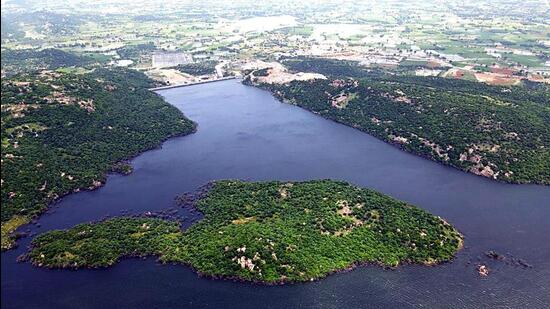
Even though it has been over a month that the monsoon has set in, the irrigation department officials are taking all precautions to prevent recurrence of the catastrophe that hit the project — built at a cost of nearly ₹1 lakh crore — in view of reports of increasing water levels in the upstream of Godavari river.
On July 14 last year, the river witnessed unprecedented floods due to heavy rains in its catchment areas, inundating two of the huge pumping stations of Kaleshwaram lift irrigation project, the Kannepalli pump house at Medigadda village of Mahadevpur block in Jayashankar Bhupalpally district and Annaram pump house in the upstream of Godavari river near Manthani of Peddapalli district.
The Kannepalli pump house, that lifts water from Lakshmi barrage built on the Godavar river, comprises 17 giant motor pumps, each weighing 2,376 metric tonnes and having 139 megawatts capacity – popularly referred to as “Baahubali motors,” has the capacity to lift three thousand million cubic feet (tmc ft) of water every day.
Similarly, the Annaram pump house that lifts water from Saraswati barrage, comprises 12 such gigantic motors. Both the pump houses got submerged last year and it was an uphill task for the irrigation engineers to restore them. “It took more than eight months and an expenditure of more than ₹1,000 crore to restore the motors. Yet, only seven of 17 motors in Kannepalli are fully operational now,” a senior engineer working on the project said on anonymity. The irrigation department has been working overnight to lift water from the Kaleshwaram project to fill the reservoirs upstream for the irrigation requirement of northern Telangana.
{{/usCountry}}Similarly, the Annaram pump house that lifts water from Saraswati barrage, comprises 12 such gigantic motors. Both the pump houses got submerged last year and it was an uphill task for the irrigation engineers to restore them. “It took more than eight months and an expenditure of more than ₹1,000 crore to restore the motors. Yet, only seven of 17 motors in Kannepalli are fully operational now,” a senior engineer working on the project said on anonymity. The irrigation department has been working overnight to lift water from the Kaleshwaram project to fill the reservoirs upstream for the irrigation requirement of northern Telangana.
{{/usCountry}}“Last week, over 2.7 tmc of water was pumped from Kaleshwaram into Sri Ram Sagar Project (SRSP), starting with 0.25 tmc feet on July 3, to meet the irrigation needs in the ayacut. Similarly, water will be drawn to fill up the reservoirs like Mallannasagar, Ranganayaka Sagar and Annapurna, to ensure there is enough water for the agriculture operations,” the engineer said.
Battling the flood threat
The Kaleshwaram lift irrigation project, which is a redesigned version of originally planned Pranahita-Chevella project, was started in May 2016. The project was completed in phases – the Lakshmi barrage was completed in 2019, followed by Saraswati in 2020 and Paravati (Sundilla) in the same year.
The project aims at irrigating over 10 million acres in northern Telangana. The construction of canal works and a chain of reservoirs as part of the project is still going on.
When there are no rains from upstream of Godavari river, water stored in the Lakshmi barrage would be pumped in reverse direction into Saraswati barrage and from there to Parvati barrage, which would supply water to a chain of reservoirs through pumps and gravity.
However, when Godavari river is flooded, there is no need for operation of Kaleshwaram pumps and the barrage gates are opened to let the water go downstream. The spillway of the Lakshmi barrage has the discharge capacity of 28.23 lakh cusecs of water and that of Saraswati barrage can discharge 15.95 lakh cusecs.
On July 14 last year, the Godavari received a flood of 28.46 lakh cusecs and the authorities lifted all the 85 floodgates of Lakshmi barrage to discharge the water. Yet, it was overflowing and it put pressure on the backwaters, resulting in the collapse of the retaining wall of the pump house and water submerging the motors.
“Similarly, at Saraswathi barrage, the inflow was about 15,95,228 cusecs. By lifting all 60 floodgates of the barrage, 15,95,228 cusecs of water was released downstream. Yet, it could not withstand the increasing inflow; resulting in the submergence of the Annaram pump house,” the engineer quoted above said.
This year, the authorities are taking all steps to prevent any further damage to the Kaleshwaram project. So, when there were reports of heavy rains in the upstream of the river in Maharashtra, the authorities lifted 36 gates of Lakshmi barrage to let 1.29 lakh cusecs of water on Wednesday.
The authorities also pumped 10,600 cusecs water back into the Annaram barrage to prevent submergence of motors, while meeting irrigation requirement of the areas upstream.
The water storage level of Lakshmi barrage is currently 13.05 tmcs, compared to its full capacity of 16.17 tmcs. “We are storing enough water in the barrage to see that the irrigation needs of the command area are met, in case of lack of rainfall upstream,” the engineer said.