
 E-Paper



Karnataka yet to make 2015 data public as debate on caste census rages
The Karnataka government is yet to act on 2015 census report amid Congress leader Rahul Gandhi demands a caste census

 Prefer HTon Google


While addressing a gathering in Chhattisgarh on Monday, Congress MP Rahul Gandhi reiterated his call for the release of the caste census data, claiming that the Prime Minister appears reluctant to make this data public. But in Congress-ruled Karnataka, the state government is yet to act on the caste census conducted in 2015.
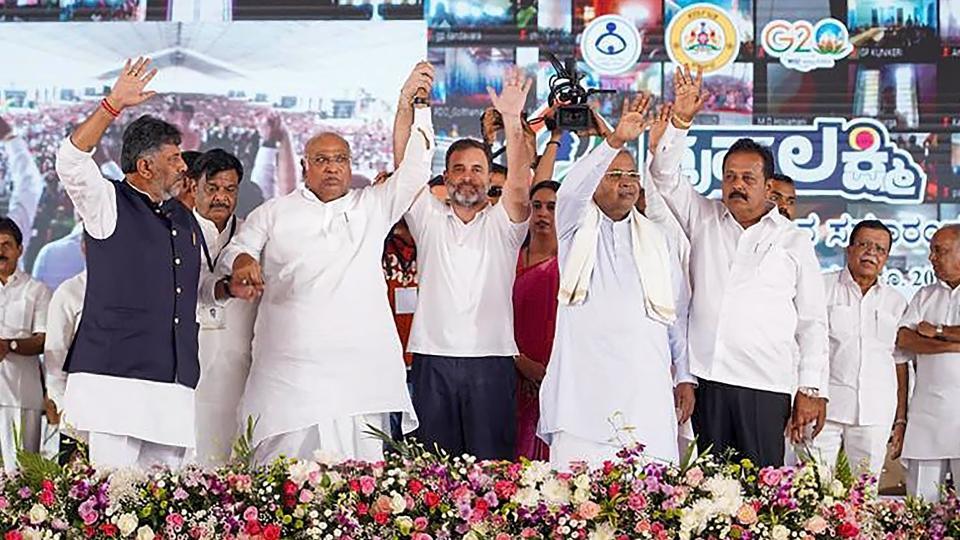
On June 7, the chief minister of Karnataka announced his government’s intention to accept the 2015 socio-economic survey report, commonly known as the ‘caste census.’ However, since this announcement, the government has taken no concrete steps to act upon this proposal, creating a political conundrum.
Party insiders suggest that although chief minister Siddaramaiah made the announcement, the party has recommended delaying any further action on the proposal until after the Lok Sabha elections. This delay strategy stems from concerns that the caste census report could disrupt the long-standing dominance of the Lingayat and Vokkaliga communities in Karnataka. These communities have traditionally held significant political influence, based on the belief that they constitute a substantial portion of the state’s population.
Moreover, the caste census has triggered internal divisions within the Congress party, with some leaders opposing the move. This internal strife arises from concerns among Dalits that the report could potentially increase the number of reserved seats (currently at 36) among the 224 Assembly constituencies. Similarly, Lingayats and Vokkaligas fear that the report might negatively impact their political representation.
Adding to the controversy, reports surfaced of deputy chief minister DK Shivakumar, a prominent Vokkaliga leader, allegedly writing to CM Siddaramaiah, urging him not to accept the state’s caste census report. However, on Thursday, Shivakumar vehemently denied writing any such letter, labelling the reports as “fake news” aimed at sowing discord between him and CM Siddaramaiah.
“I haven’t written any letter to the CM. I haven’t even discussed the matter with him. Reports in sections of the media are far from the truth and entirely imaginary. This fake news is being circulated so as to cause a rift between me and CM Siddaramaiah,” he said.
The groundwork for the caste census was laid during Siddaramaiah’s initial term as chief minister when the state commissioned the extensive 2015 survey at a cost of ₹162 crore. This marked a pioneering effort by any Indian state since 1935. The arduous task of surveying 160 million households in Karnataka, initiated in 2014, took over a year to complete, with a workforce of 160,000 personnel visiting homes across the state. The government allocated ₹169 crore for this ambitious undertaking.
On June 7, even though CM Siddaramaiah announced the decision to accept the report, its contents and the anticipated date of public release remained undisclosed. However, in 2018, certain findings from the report were leaked, leading to dissatisfaction among larger communities such as Lingayats and Vokkaligas. The leaked figures indicated that their populations were significantly lower than commonly believed. Allegedly, the Siddaramaiah government deliberately delayed submitting the report after these leaks, possibly influenced by the approaching 2018 assembly elections.
According to the leaked data, Scheduled Castes (SCs) constituted the largest caste group, accounting for 19.5% of the state’s total population, closely followed by Muslims at 16%. Lingayats and Vokkaligas represented 14% and 11% of the population, respectively. Within the Other Backward Classes (OBCs), the Kuruba community alone comprised 7% of Karnataka’s population, contributing to the OBCs’ overall representation of 20% in the state.
Collectively, when considering SCs, STs, Muslims, and Kurubas, these groups represented 47.5% of the total population, forming a potentially influential political coalition. Chief Minister Siddaramaiah’s AHINDA (Minorities, Backward Classes, and Dalits) group was poised to emerge as a formidable political force in the state, possibly relegating Lingayats and Vokkaligas to secondary positions.
However, the Lingayat community contested the report’s findings. A senior member of the Veerashaiva Mahasabha, requesting anonymity, referred to the findings of the justice Chinnappa Reddy Commission in the 1980s, which estimated the Lingayat population to be 6.9 million, or 16.92% of the total population. “We conducted our own caste census revealed a population of approximately 120 million, constituting around 20% of the total population,” he said.
When questioned about the reasons for the government’s delay in releasing the census, a senior cabinet minister cited technical issues. “There are some legal issues since the report that was prepared in 2015 was not signed by then member secretary. His term has expired, so he can’t sign it now. These problems need to be rectified before going ahead with the census report,” said the minister who didn’t want to be named.
Meanwhile, K Jayaprakash Hegde, the chairman of the state Commission for Backward Classes, informed the media that the Commission had decided to have the report reviewed by a committee of academics from the Institute for Social and Economic Change (ISEC). “When the report is final, we will submit it to the government, but it will take time,” he said.
A political expert noted that Congress is acutely aware of the significant political implications of releasing the caste census data. “The dominant communities in the state would no longer maintain their numerical superiority. The fact that Muslims emerged as the second largest group is an advantage to Congress, but they also know that SC, ST and OBCs can’t be looked at as a monolithic group. So can the Congress upset the dominant communities that seem united and supported you in the Assembly election,” said political scientist Sandeep Shastri.


