
 E-Paper



McCarthy’s election as US speaker opens period of dysfunctional legislature
The nature of Kevin McCarthy’s election and now the new House rules both reflect the divisions and dysfunctionality in today’s Republican Party and broader American politics — and will deepen it further.

 Prefer HTon Google


Soon after getting elected as the Speaker of the United States House of Representatives in an unprecedented 15th attempt, Republican leader Kevin McCarthy delivered to the Far-Right legislators of his party a set of a new rules that will govern the functioning of the chamber.
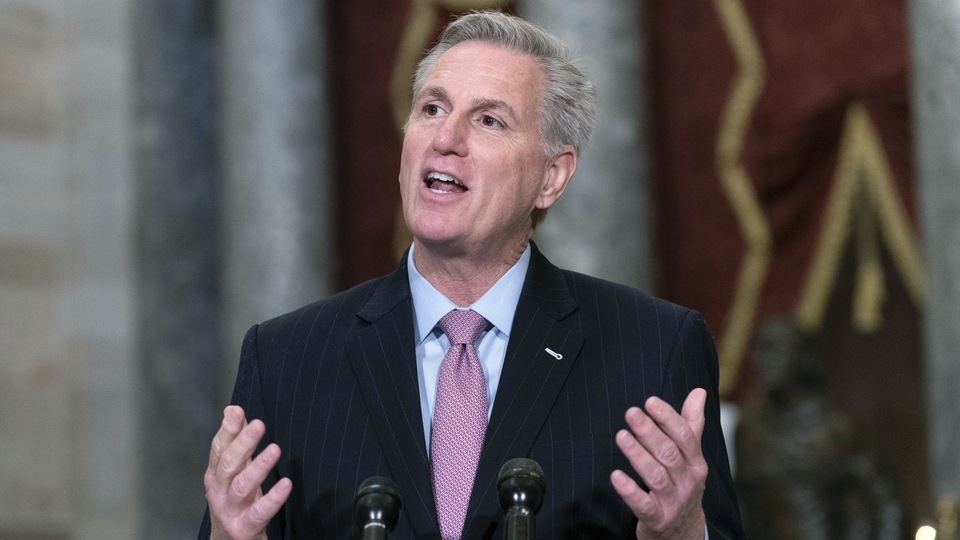
The rules weaken the position and authority of the Speaker and allow any single member to move a motion to seek his removal; kill omnibus spending legislations and open up each appropriation bill to debate and amendment, making it vulnerable to a deadlock; and will force public spending cuts.
The rules have also enabled the formation of a subcommittee under the House Judiciary Committee to examine the “weaponisation of the federal government”, a tool Republicans plan to use to counter Department of Justice (DOJ) investigations into the January 6, 2020 mob insurrection at the US Capitol in which top Republican leaders, including former President Donald Trump, are said to be involved.
Also Read: China pushes back against US criticism of actions on LAC
Besides the formal changes, McCarthy’s understanding with the extreme wing of his party has also seen members of the Far-Right take up seats in key legislative committees, including the crucial House Rules Committee. Republicans are also set to obstruct an extension or rise in the US government’s debt ceiling limit later this year, possibly creating an unprecedented economic crisis with global implications.
The nature of McCarthy’s election and now the new House rules both reflect the divisions and dysfunctionality in today’s Republican Party and broader American politics — and will deepen it further.
Also Read: Why Meta and Microsoft are vacating office buildings in Seattle?
The politics of McCarthy’s election
In the mid-term elections in November, Republicans narrowly got a majority in the House, winning 222 out of the 435 seats. McCarthy, a Republican representative from California who was the minority leader in the last House, was considered the obvious candidate for the Speaker post.
But his challenge came from within, for today’s Republican Party is marked by divisions between the Right and the Far-Right. The latter, in the House, is represented by what is known as the Freedom Caucus — a group that traced its origins to the Tea Party movement and is broadly aligned with Donald Trump. Their political beliefs revolve around visceral opposition to immigration, public spending, welfare measures, abortion, and pedagogy around sexuality and race. Their members denied the legitimacy of the 2020 presidential election outcome.
From safe Republican seats, their politics revolves around projecting Washington DC and the way business is conducted in the capital as the core problem and their stated objective is to overturn it. They seek decentralised decision-making in the House, taking power away from party bosses. And they wish they to outcompete the rest of the party in showing that they are the ones most opposed to Democrats and President Joe Biden.
Some members of this Caucus backed McCarthy — including Jim Jordan, the chair of the House Judiciary Committee, and Majorie Taylor Greene, a radical right representative from Georgia. But others, such as Matt Gaetz from Florida, held out till the very end. Given the Caucus’s close connection with Trump, speculation is rife in DC that either the former president was playing what can be called a double game or his influence with his own supporters has diminished.
This is because, on paper, Trump supported McCarthy’s elevation and even called on his loyalists to back him for Speaker. But McCarthy, for a brief period after January 6, had opposed Trump. To show to the party that he still called the shots and make McCarthy entirely dependent on him, Trump may well have been encouraging the Far-Right obstructionists to hold out till the very end — even though some of those who opposed McCarthy till the end have claimed Trump played no role in the process.
After his election, the House Speaker acknowledged Trump’s role and said: “I do want to especially thank President Trump. I don’t think anybody should doubt his influence.” Trump, in his characteristic fashion, said: “The Fake News Media was, believe it or not, very gracious in their reporting that I greatly helped Kevin McCarthy attain the position of Speaker of the House. Thank you, I did our Country a big favor!”
But irrespective of whether the election showed Trump’s power or the limits of his power, the entire process, which played out in full public view on C-Span, showed the Republicans to be entirely fragmented and in chaos. The party’s moderate wing — and moderate is a relative term, for the party as a whole has veered to different shades of the Right at the moment — was frustrated with Trump’s role during the midterms where he and his favoured candidates alienated independent voters, particularly in the suburbs. The Speaker’s election only aggravated their concerns that the Far-Right could jeopardise their prospects in the next election, especially in seats where the margins with Democrats are thin.
The one man who watched from a distance as the battle played out was Florida governor Ron DeSantis, the big winner of the mid-terms and the rising star of the Republican Party. An observer of the political process on the Hill said: “DeSantis is playing it smartly. He is letting the Republicans implode internally. He is letting frustration with Trump grow. And he is waiting for the party, the donors and the right-wing media ecosystem to come to him as the only viable candidate who can defeat Joe Biden in 2024.”
The creation of a dysfunctional House
But while the political dynamics in the House will affect the future of the Republican Party, the greater concern for the American polity at the moment is how it has set the ground for an entirely dysfunctional legislature and weakened American democracy.
In order to become Speaker, McCarthy himself has weakened the authority of the Speaker — and is vulnerable to pressure for even a single member can move a motion to remove him office. In order to keep the Far-Right happy, McCarthy has locked himself into positions that will make any deal-making with Democrats and the White House on legislations difficult, if not impossible — and give-and-take is crucial for any legislative business to be carried out, especially since the Senate is under Democratic control.
In order to counter investigations on January 6, McCarthy has agreed to the formation of a committee that challenges the autonomy of DOJ processes — this will erode faith in the rule of law and make every investigation, conducted either by the House or by DOJ, be seen as a partisan process. And in order to meet the extreme faction’s demand for more power over legislations, McCarthy has, in effect, made all appropriations bills subject to individual veto.
Republican obstructionism will play out most starkly in the case of debt ceiling. There is a statutory limit to how much the US can borrow money to meet its debt obligations — including for Social Security and Medicare benefits, military salaries, interest on the national debt, tax refunds, and other payments. This limit is suspended or raised by the Congress in order for US not to default. But the Republican Right has made it clear that this time around, the House will not do so, unless it is accompanied by dramatic cuts in expenditure.
On Friday, treasury secretary Janet Yellen notified the Congress that the US will reach its debt ceiling on January 19 and will have to resort to “extraordinary measures” so that it doesn’t default — but these measures are expected to be exhausted by June. “Failure to meet the government’s obligations would cause irreparable harm to the US economy, the livelihoods of all Americans, and global financial stability,” Yellen noted.
How McCarthy appeases the Far-Right of his party, while ensuring that US doesn’t spiral into an economic and financial crisis, will be his biggest test in the coming months and may well determine how long he lasts in office.
 ABOUT THE AUTHORPrashant Jha
Prashant Jha was formerly the US correspondent and editor of HT Premium at Hindustan Times, and has also served as the newspaper's editor-views and national political chief. He is the author of 'How the BJP Wins: Inside India's Greatest Election Machine' and 'Battles of the New Republic: A Contemporary History of Nepal'.Read More


