
 E-Paper



Key accused in 1993 train blasts acquitted, two get life imprisonment
A special court in Ajmer acquitted Syed Abdul Karim Tunda, saying the prosecution failed to provide enough evidence to prove his direct involvement in the case.

 Prefer HTon Google


A special court in Rajasthan’s Ajmer district on Thursday acquitted Syed Abdul Karim Tunda, the main accused in the 1993 serial bomb blasts case, saying the prosecution failed to provide enough evidence to prove the 81-year-old’s direct involvement in the matter.
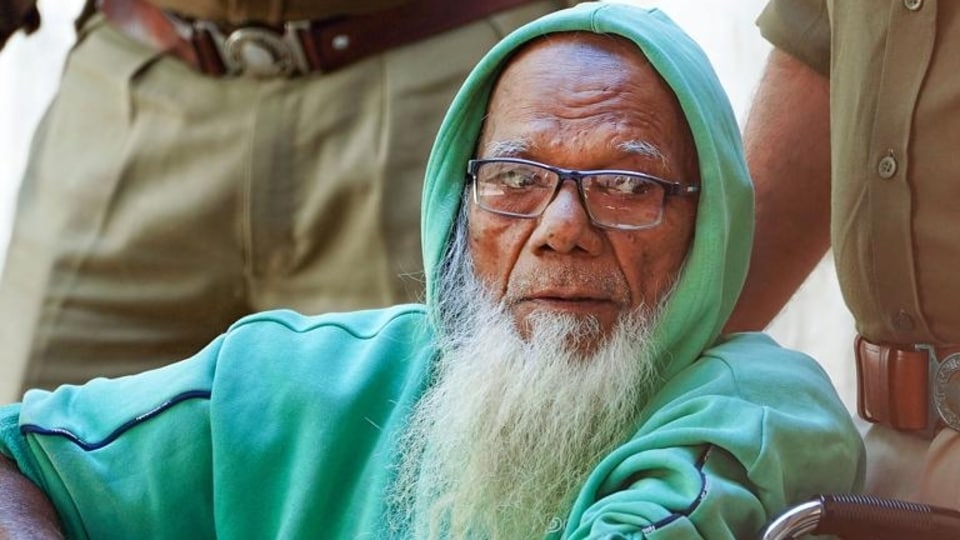
Special court judge Mahaveer Prasad Gupta of Terrorist and Disruptive Activities (Prevention) Act (TADA) court, however, awarded two others – Irfan Ahmed and Hamiduddin alias Hamir Ul Uddin – life imprisonment after finding them guilty under various laws, including the Terrorist and Destructive Activities (Prevention) Act.
“There is insufficient evidence against the accused Syed Abdul Karim Tunda regarding his involvement in a criminal conspiracy,” justice Gupta said in his 313-page judgment.
Also Read | Abdul Karim Tunda, alleged LeT bomb maker & Dawood aide, acquitted in 1993 bomb blast case. Who is he?
Two people were killed and at least 22 injured in the blasts that were carried out on five passenger trains on the intervening night of December 5-6, 1993, to allegedly mark the first anniversary of the Babri Masjid demolition.
Tunda, believed to be a close aide of fugitive gangster Dawood Ibrahim, is accused of orchestrating the blasts on Mumbai-New Delhi Rajdhani Express, New Delhi-Howrah Rajdhani Express, Howrah-New Delhi Rajdhani Express, Surat-Baroda Flying Queen Express and Hyderabad-New Delhi AP Express. He was arrested in August 2013.
Five separate cases, registered by Government Railway Police in Kota, Valsad, Kanpur, Allahabad and Malkajgiri, were consolidated after the Central Bureau of Investigation (CBI) took over the probe. Eighteen people were named accused in the case.
Also Read: Abdul Karim Tunda not a LeT terrorist, court ruled in 2016
On September 30, 2021, the TADA court framed charges against Tunda, the main accused, and Ahmed and Hamiduddin over the blasts.
Justice Gupta, in his judgment, said that while the prosecution presented evidence indicating Tunda’s role in helping other accused – Jalees Ansari and Habib Ahmed (both were found guilty in 2004) – to make the bombs, it failed to establish his direct role in the blasts.
Tunda’s counsel Shafqat Sultani said CBI failed to provide concrete evidence across various statutes against his client.
On Ahmed and Hamiduddin’s role, the special court said the two accused, along with others, had gathered at the Lucknow residence of one M Jamal Alvi in September 1993 to plan bomb detonations in long-distance trains. Alvi was also found guilty in 2004.
The two men actively participated in executing the plan with the aim of carrying out terror activities, causing train blasts, intimidating the Indian government, and instigating enmity between Hindu-Muslim communities, the court said as it found them guilty under various provisions of the Indian Penal Code, Terrorist and Destructive Activities (Prevention) Act, Explosive Substances Act, Railways Act, and Prevention of Damage to Public Property Act and awarded them life imprisonment.
Hamiduddin has been in jail for the past 14 years, and Irfan for the last 17 years.
After being sentenced to life imprisonment, Hamiduddin told the waiting mediapersons outside the court: “I respect the judgment of the court. I will file an appeal in the Supreme Court.”


