
 E-Paper



Khalistani terrorist Pannu’s assets confiscated in Punjab
The National Investigation Agency (NIA) has confiscated the property of banned outfit Sikhs for Justice's chief Gurpatwant Singh Pannu in Amritsar and Chandigarh. This is the first time that assets have been attached in a terrorism-related case. Pannu's outfit is at the heart of diplomatic tensions between India and Canada. The NIA has confiscated Pannu's agricultural land in Amritsar and a house in Chandigarh. Pannu is facing multiple criminal cases in Punjab and is believed to be living in Canada. The NIA has accused Pannu's organization of radicalizing youth and promoting terrorism.

 Prefer HTon Google


Amritsar/Chandigarh
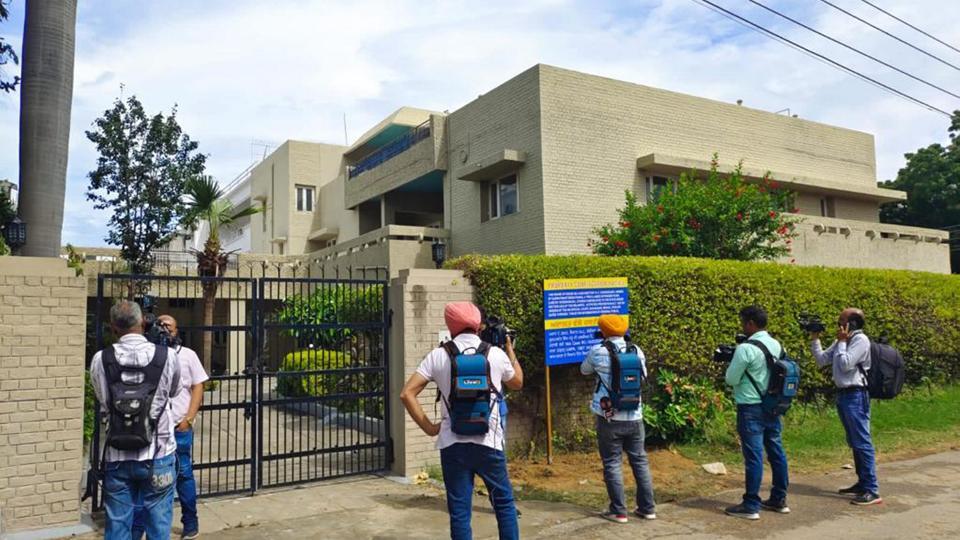
The National Investigation Agency (NIA) on Saturday confiscated the property of banned outfit Sikhs for Justice’s chief Gurpatwant Singh Pannu at his ancestral village of Khankot in Amritsar and in Chandigarh, people aware of the development said and a signboard put up outside the premises suggested.
A property confiscation notice was put up outside Pannu’s house in Sector 15, Chandigarh. The action was taken under Unlawful Activities (Prevention) Act, in what is the first time that assets were attached by the government in a terrorism-related case.
“1/4th share of house no 2033, Sector 15-C, Chandigarh, owned by Gurpatwant Singh Pannu, a proclaimed offender in an NIA case, stands confiscated to the state under Section 33 (5) of the Unlawful Activities Prevention Act by the orders of the NIA special court, Mohali, Punjab. This is for information of general public,” read the notices outside Pannu’s Chandigarh house and at his Amritsar village property.
Pannu’s outfit is at the heart of diplomatic tensions that have spiked between India and Canada, following Canadian Prime Minister Justin Trudeau’s allegations that Indian agents were “potentially” involved in the killing of Pannu’s close ally and Khalistani extremist Hardeep Singh Nijjar on June 18 in British Columbia. India had designated Nijjar as a terrorist in 2020.
India rejected the allegations as ‘absurd’ and ‘motivated’ and expelled a senior Canadian diplomat in a tit-for-tat move to Ottawa’s expulsion of an Indian official over the case.
The NIA confiscated 46 kanals of agricultural land belonging to Pannu at Khankot in Amritsar in connection with a terror case registered in 2020.
Pannu, who is facing around 22 criminal cases in Punjab, including three of sedition, is believed to be living in Canada, where he is a citizen.
In July 2020, the Union ministry of home affairs had declared Pannun a terrorist on grounds of sedition and secessionism, and requested an Interpol red notice against him. In 2020, the NIA had attached Pannu’s 46-kanal land at Khankot village and 11 kanal and 13.5 marlas of land in Sultanwind village of Amritsar.
Pannu’s father Mohinder Singh Pannu was a resident of Nathu Chak village of Patti subdivision in Tarn Taran before Partition. After 1947, the family shifted to Khankot village in Amritsar district. Mohinder stayed in Chandigarh till his death in 1996.
Pannu has been on the NIA’s radar since 2019, when the anti-terror federal agency registered its first case against the terrorist, who has been playing a major role in promoting and commissioning terror acts and activities, and spreading fear and terror in Punjab and elsewhere in the country through his threats and intimidation tactics.
Non-bailable warrants of arrest were issued against Pannu by the Special NIA Court on February 3, 2021, and he was declared a “Proclaimed Offender” (PO) on November 29 last year.
“Investigations have revealed that Pannu’s organisation, Sikhs for Justice, was misusing cyberspace to radicalise gullible youth and instigate them to undertake terrorist crimes and activities,” NIA’s spokesperson said.
“Pannu, who was declared a ‘designated individual terrorist’ on July 1, 2020, has been actively exhorting Punjab-based gangsters and youth over social media to fight for the cause of the independent state of Khalistan, challenging the sovereignty, integrity and security of the country,” the spokesperson added.


